Three Simple Steps To Fix The Record Business in 2016… Windows, Windows, Windows…

windows

This time last year we correctly predicted the restructuring of at least one major label group when we asked the question, “Who will be the First Fired Label Execs over Spotify Fiasco & Cannibalization?“. It didn’t take long for us to find out, “It’s Just Math : Digital Music Execs Exit, But will the Pivot to Paid Subs Be Enough To Save The Record Biz?” We’re still not sure that even paid subscription streaming actually works in the long term, but we know for sure that unlimited free streaming does not!

What a difference a year makes. What a difference Taylor Swift makes. What a difference Adele makes.

Going into the next year our prediction is that the power of windows can not be overstated as the leading solution to the problems faced by the record industry. Effective windowing has always been a part of the economic life cycle of every album release. The physical singles sales business (ya’ll remember 45 prm records, right?) – well, that was largely a loss leader to boost singles chart positioning that combined retail and radio reports.

In every record store there was the “hit wall” of discounted new releases to encourage higher volume sales. Every store stocked a robust variety of titles across different genres and price points comprised of front line titles, mid-line titles, budget line titles, and at the end there was the cut-out bin. Also, let us not forget the “11 records for a penny” record clubs advertised in magazines.

Those, my friends, are windows. Those who are advocating against windows are probably too young to know better or have been lead around by the nose by some digital snake oil salesman protecting their own interests.

This is not a philosophical discussion. This is financial reality. Respected stock analyst Robert Tullo who is the Director Of Research at Albert Fried & Company says this:

Longer term IP Radio and Spotify are good annuity revenue streams and great promotional tools. However, we believe the system works better for everyone when artists have the right to distribute their Intellectual property how they see fit.

Ultimately we think windows for content will form around titles that look much like the Movie Windows and that will be great for investors and the industry as soon as all these so called experts get out of the way and spot trading fashionable digital dimes for real growth and earnings.

Mr. Tullo is correct. Not only will artist (and rights holders) do better when they have the freedom of choice but so will the partner platforms. This is how it works in the film business. Every month the “virtual inventory” on Netflix is rotated. New titles come in, old titles go out. If you really, really, really want to see something right now, you have to rent it or buy it via a transactional stream or download. The record business will benefit from the same models and strategies. Windowing works. Period.

See here’s the thing… If these new digital platforms are so great for artists, why wouldn’t artists want to participate on them?  The benefits would be self evident? If the product that Spotify, Pandora, YouTube (and others) are offering is so good for artists, why are these companies so afraid of artists and rights holders opting out? Maybe, just maybe these platforms are not offering the type of value that their suppliers find meaningful?

It really speaks volumes when a business model is so bad that one of  the essential features for survival of the company is to deny its suppliers the option to fairly negotiate their participation or have the ability to opt out. In the old neighborhoods that was known as a protection racket, or extortion.

Silicon Valley didn’t invent the freemium, they’re just doing it wrong. Really wrong. Horribly wrong.

Let those who want to give away their work freely do so, but also allow those who would rather opt out the ability to do so. If artists find value in the freemium tier, and they may well as they always have, then let them chose how to best utilize that option. Musicians pioneered the freemium model often using street teams to canvas concerts by giving away cassettes to fans of similar music.

If digital platforms allowed artists to use their technologies creatively, everyone might be pleasantly surprised how much better (and more profitable) things would work out.

Watching Pandora lose $5 billion in value in a year becomes a punch line when they believe they are better suited to dictate to artists how to best communicate with their own fans. It is indeed interesting to see Pandora admit what we’ve been saying for years, unlimited, ad-supported free streaming unsustainable. No Kidding. Here it is from Brian Andrews, CEO of Pandora:

“This gray market is unsustainable. If consumers can legally listen to free on-demand music permanently without converting to paying models, the value of music will continue to spiral downward to the benefit of no one.”

Of course what makes this comment most interesting is that Pandora is entering the crowded field of on demand streaming with it’s purchase of the failed Rdio. Pandora now has to compete with Spotify’s very large free tier of unpaid and entrenched users. Migrating those users to a new on-demand streaming platform will be a challenge (ask Apple and Tidal), and even more so as artists and labels grow tired of subsidizing these horribly flawed business models.

Here’s three uses of freemium streaming most artists (and rights holders) would probably embrace if given the choice.

1: The Hit Single

– Using the freemium platform to launch a single to gain ubiquitous awareness of a new album release. This is what both Taylor Swift and Adele did and the results speak for themselves. More artists would probably embrace releasing one or two songs or singles from an album on freemium tiers. With the artists support this becomes far more valuable than extorting the them into releasing their entire album on a platform they feel devalues their work.

BONUS: What if Adele made an official playlist of her favorite songs, leading with her new single? How much added value does an artist of this caliber bring to a platform when they feel they are being respected and valued? Answer, ALOT.

2: The Focus Track

– Not everyone has a hit single, but most artists have a focus track from their album. Like the hit single, these artists would embrace the opportunity to be discoverable and to build an audience of new fans. Developing artists are the most eager to try new opportunities because the have the most to gain. If digital streaming platforms worked with artists in a meaningful and respectful way, the mutual benefits could be huge for everyone.

3: Rotating Inventory Management

– By adopting a Netflix like inventory management of monthly rotating titles on the freemium (or even paid subscription) tier more artists might feel compelled to be more engaged. Rotating inventory management is a smart way to keep users and fans engaged as old titles rotate out and new ones in. This simple trick restores a great deal of the consumer engagement that is a part of discovery, and promotion.

Of course, the goal of every freemium model is to lead to more paid revenues in higher value products. Working together with artists and rights holders the future of streaming distribution could be very bright. But to get there we need to let go of Stockholm Syndrome. the old neighborhood protection rackets, bullying extortion threats and just plain bad business models.

There is a lot that can be done in the world of streaming. Streaming is not bad, it’s just a technology. Free streaming and subscription streaming both have their place in the ecosystem. What is bad are the exploitative business models, lack of transparency and devaluation of the artists work. These are fixable issues that have nothing to do with technology, just a lack of common and business sense.
FREE Streaming is the Digital Cut-Out Bin. Artists You Deserve Better.

Cutouts

Today’s younger consumers who missed the glory days of the record store as a cultural hub will probably have little awareness of the cut-out bin. The cut-out bin was dreaded by artists and labels alike, but it served an important function in the ecosystem and economy of record sales. This was the rack in the record store where over manufactured titles made their last stop before the trash bin.

The cut-out bin was the last stop for an album, not the first stop. This is a very important consideration in today’s digital music economy. Artists, you deserve better service from your labels, management and partners.

Having your record appear in “the cut-outs” didn’t mean the album wasn’t successful, to the contrary, many of the records in cut-out bins were by well known name artists. Many of these records contained hit songs and singles. However, for whatever reason the quantities manufactured exceeded the markets ability to absorb those units into sales. At some point the decision was made to either monetize the overstock, or destroy the overstock.

The net result of the cut-out bin was that full length albums were often priced below the cost of a current 45 rpm single. However, this pricing distinction occurred at least a year or more after the initial release of the album. An album was “cut-out”after all of the front line sales, traditional discounts and higher margin retail channels had long been exhausted. Cut-out supplies were also limited and inconsistent. In other words, it was only the most patient and adventurous consumer who benefited from this deep discount.

Honestly, who would buy an album at full price if the same exact product (sans for the cut off top right corner) could be had for less than the price of current single?

So here we are a decade and a half into the new millennium and the best “new business model” for artists and rights holders in the 21st Century Digital Economy is to start at the last stop on the value chain?  You’re kidding us, right? We wish.

So how did we get here? Well, in three words “Ad Funded Piracy.” The lowest price for a product or service sets the price floor for all other comparable products. In the case of music that price has been set at about zero for over a decade and a half. But that’s not say there’s no money being made in the distribution of music online. No, there’s actually a lot of money being made by the Internet Advertising Networks supplying the advertising that fuels the corporate profits to over half a million infringing pirate sites.

It should also be noted that the CEO of the leading ad-funded, free to consumer streaming service was also the creator of the most successful ad-funded, bit-torrent client, u-torrent. Yup, that’s none other than Spotify’s Daniel Ek. Shocker, right?

Obviously, pirates and thieves are going to pirate and steal. These people should not be the first concern of business executives seeking to expand their profits on digital platforms. Enterprise level piracy requires the political will to enforce the law against egregious digital robber barons. Anti-Piracy is an “in addition to” action, not an “instead of” action. The future of the music business must be rooted in both innovation and advocacy.

Windows work. Period.

Business decisions need to developed through common sense, innovation and time tested principles of basic economics. We’ll repeat our previous suggestion for an industry wide, consistent windowing platform strategy below.

Windowing works better when there is a reasonable amount of consistency. Our friends in the film business have been highly effective at windowing for decades and there’s no reason why it can’t work similarly well for the record business.

Every new release should have the option to determine the release windows when the record is being set up. For example the default could be 0,30,60,90 day option for transactional sales, followed by 0,30,60,90 day option for Subscription Streaming prior to being available for Free Streaming.

Windowing is not new for the record business. The industry has never had pricing ubiquity across all releases, genres and catalogs. There has always been strategic and flexible pricing strategies to differentiate developing artists, hits, mid-line catalog, and deep catalog. An industry wide initiative to re-allign time proven price elasticity is the key to growing the business and developing a broad based sustainable ecosystem for more artists.

  • Windowing allows for Free Streaming to exist as a strategic price point.
  • Windowing allows for Subscription Streaming to exist as a strategic price point.
  • Windowing allows for Transactional Downloads to exist as a strategic price point.
  • Windowing allows for artists and rights holders to determine the best and most mutually beneficial way to engage with their fans.

Windowing is the key (as it always has been) in rebuilding a sustainable and robust professional middle class that will inevitably lead to more artists ascending to the ranks of stars. Some will become superstars and legends capable of creating the types of sales and revenues currently achieved by Adele, Taylor Swift and Beyonce’. To get there however we need to abandon Stockholm Syndrome and embrace windowing that works for everyone.

Quoted: Pandora CEO says free on-demand music streaming is bad | Silicon Beat

“This gray market is unsustainable. If consumers can legally listen to free on-demand music permanently without converting to paying models, the value of music will continue to spiral downward to the benefit of no one.”

Brian McAndrews, CEO of Pandora, in an op-ed published by Business Insider Tuesday.

Where have we heard this before? Now we wonder how long it may be until they acknowledge that Ad Funded Piracy Is Big Business?

READ THE FULL STORY AT SILICON BEAT:
http://www.siliconbeat.com/2015/12/02/quoted-461/


Streaming Is the Future, Spotify Is Not. Let’s talk Solutions.


Why Spotify is not Netflix (But Maybe It Should Be)


It’s Just Math : Digital Music Execs Exit, But will the Pivot to Paid Subs Be Enough To Save The Record Biz?

The problem is the music-streaming companies | The Hill – Paul Williams

Songwriters have a number of allies in the ongoing fight to update our nation’s horribly outdated music licensing laws. But after reading the recent post by CALInnovate’s Mike Montgomery (“Songwriters are fighting the wrong fight,” 10/5/15), it’s clear that he is not one of them. On what grounds can Montgomery, who represents technology industry interests, claim that he speaks on behalf of songwriters?

As a songwriter elected to represent the interests of ASCAP’s more than 550,000 music creator members, I find Montgomery’s arguments absurd and grossly misleading.

READ THE FULL STORY AT THE HILL:
http://thehill.com/blogs/congress-blog/technology/256247-the-problem-is-the-music-streaming-companies

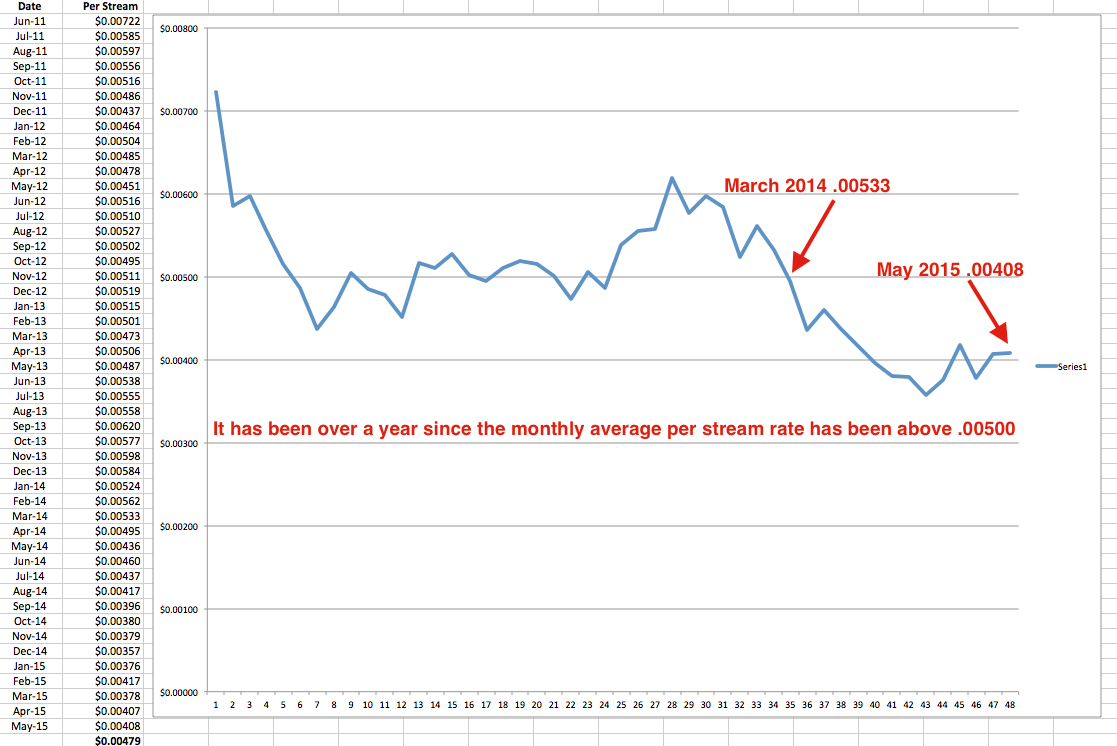
Spotify Per Play Rates Continue to Drop (.00408) … More Free Users = Less Money Per Stream #gettherateright

Down, down, down it goes, where it stops nobody knows… The monthly average rate per play on Spotify is currently .00408 for master rights holders.

PerStreamAvg_Jun11_July15

48 Months of Spotify Streaming Rates from Jun 2011 thru May 2015 on an indie label catalog of over 1,500 songs with over 10m plays.

Spotify rates per spin appear to have peaked and are now on a steady decline over time.

Per stream rates are dropping because the amount of revenue is not keeping pace with the  number of streams. There are several possible causes:

1) Advertising rates are falling as more “supply” (the number of streams) come on line and the market saturates.

2) The proportion of  lower paying “free streams”  is growing faster than the proportion of higher paying “paid streams.”

3) All of the above.

This confirms our long held suspicion that as a flat price “freemium” subscription service  scales the price per stream will drop.  As the service reaches “scale” the pool of streaming revenue becomes a fixed amount.  The pie can’t get any larger and adding more streams only cuts the pie into smaller pieces!

The data above is aggregated. In all cases the total amount of revenue is divided by the total number of the streams per service  (ex: $4,080 / 1,000,000 = .00408 per stream). Multiple tiers and pricing structures are all summed together and divided to create an averaged, single rate per play.

Streaming “Transparency” and the 70% Black Box Lie… The Solution Is #gettherateright

The argument goes something like this…

Streaming companies are paying 70% of their revenue but artists are not getting paid enough. This must be the result of record labels and rights holders not passing on the right amount to artists.

The first question is, how do we know that streaming services are actually, really paying 70% of their top line gross revenue to rights holders? We know what the revenue of a transaction is on iTunes, because it is factually transparent – it is the list price being charged. We all know this, and we can all verify this. A $9.99 album on iTunes pays out $7.00, or 70%. Same thing for a $.99 song that pays out $.70, that’s also 70% of revenue.

But when if comes to streaming services however we do not know what the revenue is that should be credited to artists and rights holders. This is what is actually of concern. There is a big black box at the top of the waterfall from which all other money flows downstream.

So if streaming services are paying 70% of revenue, what exactly is that revenue? Let us see it. So here we are with the issue of transparency. If we can’t actually see or know what that number is then yes, the low payouts are very much of concern and have very little to do with intermediaries.

We can disagree about how the 70% of revenue is passed onto artists from iTunes and other transactional sales. But one thing is clear, we all understand the transparent economics of how much money is generated on each transaction. This is not so with streaming. So without transparency at the top of the waterfall, everything that follows is suspect.

More importantly, and more to the point, if there are established retail and wholesale rates for each stream, the calculations become immediately transparent in the same way they are with Itunes. See, the issue here is not what is going on downstream, but rather what is happening at the top of the waterfall.

“WE HAVE A MONETIZATION PROBLEM”

The truth is by now (and everyone should be able to agree on this), we know that streaming creates too little revenue relative to the value of the product. In other words the product is being sold to the consumer for less than the cost that it takes to create and produce it, and still remain sustainable.

In simple terms this is expressed as selling a Porsche for one dollar. It doesn’t matter how many Porsche’s you sell for one dollar while paying out 70% of the revenue, there will never be enough money to actually pay for the cost producing the car. Porsche’s, like professional music are expensive to produce. Despite the advances in recording technology, it is he cost of human labor that is the most important in the value chain.

This is the economics of music streaming in a nutshell, but with one added twist. The Porsche may be sold for one dollar one month, and be sold for only eighty cents the next month, and maybe the month after that sold for a dollar and ten cents. This is because of the fixed (and unsustainable) revenue pool that is divided by the total number of plays.

The common sense solution would be to establish a fixed per stream rate at each platform. This is the most simple way to encourage transparency and fairness as the revenue generated per stream can be transparently and easily calculated from top line data – no more black box at the top of the waterfall. The funny thing is, the people shouting the loudest for transparency also seem to be the most opposed to the easiest solution. Why is that?

So, if we are to have conversations about transparency let’s at least be clear about what it is that we actually need to see.


How to ignore YouTube completely: One Direction’s radical gamble | Music Business Worldwide

Good luck Sony, let’s see how this goes with the “User Pirated Content” at YouTube…

Search YouTube for 1D’s new comeback single Drag Me Down, and you’ll discover Harry, Niall, Louis and Liam are nowhere to be found.

Sony won’t confirm it, but the major appears to have a taskforce stamping out any attempt to upload the track onto the platform.

Why? Because One Direction are using their colossal social media presence (Twitter: 24.5m; Facebook 37m; Instagram: 9.7m) to actively push fans towards iTunes and Spotify instead.

READ THE FULL STORY AT MUSIC BUSINESS WORLDWIDE:
http://www.musicbusinessworldwide.com/how-to-ignore-youtube-completely-one-directions-radical-gamble/


YouTube’s Content ID : $375.00 Per Million Views… aka “Block In All Countries”…


What YouTube Really Pays… Makes Spotify Look Good! #sxsw


Why .002 is Greater than .001 and Why 90 Days is Better than Forever…

There’s been a lot of talk and understandable dissent surrounding Apple’s free tier payment of the reported .002 per play during each consumers 90 day free trial period. We now live in a world of lessor evils.

Here are three things that we may want to keep in mind…

One:

Eliminating the Unlimited Free, Ad-Supported, On-Demand Access to Music is Job #1. Apple Music and Tidal are both positive steps in that direction.

Two:

.002 is DOUBLE .001 which is what Spotify is paying on it’s ad-supported free tier (see chart below). Yes, we’d love Apple to pay the full ride. Yes, Apple can afford to pay the full ride. Yes, we support any action that influences Apple to pay the full ride – but as a compromise we could be doing worse, and in fact we have been for over five years since the Spotify launch.

Three:

90 Days is Limited. Ad-Supported is forever. This is the big problem. Even if  Spotify was limiting their ad-supported free tier to 90 Days, Apple is still paying DOUBLE. But the real problem is that Spotify is FREE FOREVER. It’s time to keep the eye on the prize here.

Three Steps to a Sustainable Digital Music Ecosystem:

1) Eliminate the Unlimited Free, Ad-Supported, On-Demand Access to Music

2) Windowing

3) Tiered Pricing, based on Access and Consumer Value Proposition

That’s really it. It’s not really any harder than this and we can already see these models working for the Film and TV businesses.


Streaming Is the Future, Spotify Is Not. Let’s talk Solutions.


Why Spotify is not Netflix (But Maybe It Should Be)


Why Digital Exec’s ARPU is Bad Math and also Bad Philosophy for Artists.

Why Apple Music and Tidal are the right business models with the wrong optics.

Since Spotify launched in 2010 the music business has been in an existential crisis. Convinced that ad-supported unlimited free access to on-demand music would ultimately grow recorded music revenues the major labels opted into what may be their worst decision ever. This decision aided by an estimated 18% (or more) equity position in Spotify has not grown overall music revenues over the past five years. In fact, for the year ending 2014 global revenues reported by the IFPI stated that revenues were at the lowest point in decades. So what to do?

For starters the first and most obvious solution would be to eliminate the unlimited ad-supported free access to on-demand music. This is the model that made ad funded, for profit piracy so popular on over half a million infringing links from unlicensed businesses served by Google search and delivered to your inbox by Google Alerts complete with social media sharing buttons. These unlicensed businesses are receiving hundreds of millions of DMCA notices annually from artists and rights holders. Let us not forget that this is also the same model that Daniel Ek helped to perfect as the CEO of u-torrent the worlds most installed bit-torrent client. Ek has said he’d rather shut down Spotify than give up his failed ad supported business model.  We thought Spotify was built on converting ad supported (where Spotify board member Google makes money serving ads) to subscription (where artists make money).  So much for that.

And this is who the record business is taking notes from? Perhaps that’s why Universal is restructuring.  This may have seemed like a good idea to some senior executives but it turned out to be a complete disaster.  Time to change.

Despite moves in the right direction by Tidal and Apple Music the optics for both of these companies at launch of their respective streaming models have been somewhere between missteps and an absolute disaster. Dismissing for a second that both Apple and Tidal could be the targets of public relations campaigns by competing corporations such as Spotify, Pandora and Google (YouTube) let’s look at what each is offering. Tidal and Apple Music offer no unlimited ad-supported free access to on-demand music. That means no business to those selling advertising… like, Google.

There is nothing more important to the future of the recorded music ecosystem than removing the unlimited ad-supported free access to on-demand music.

For all intents and purposes even free streaming is ownership and here’s how you can tell. If you can chose it, and access it, you essentially own it whether you pay for it or not. Streaming replaces ownership at the consumer level but does not compare to ownership on price. At some point there needs to be a market correction to properly value music consumption.

The launch of Tidal should have been a rallying cry for all artists to support a business model that limited free streaming, incentivized paid subscriptions through exclusive offerings and diversified consumer experiences with higher quality streaming formats. This is the model we should be focused on. As the Buddhist saying goes, “trust the teaching, if not the teacher.” In other words it doesn’t matter if you don’t like Jay-Z and Madonna.  And securities laws makes the whole stock issue so difficult that Tidal would have been far better off saying they’d pay all participating artists a bonus in the cash from the company’s own stock sales rather than get down the rabbit hole of who gets stock and who doesn’t.

Unfortunately the celebrity that could have united a community, instead divided it through messaging that most would acknowledge appeared to be less than inclusive. Worse, the optics appeared to be elitist whereby those already rich and famous seemed to be more focused on their own fortunes as opposed to a sustainable ecosystem for the next generation of musicians.

Perhaps if each of the artists at the Tidal launch would have appeared with a developing artist they were supporting the messaging and optics would have been more inclusive and more about community than celebrity.

We have to acknowledge what kind of business we want going forward. Clearly, unlimited ad-supported free access to on-demand music is not working. Both Tidal and Apple Music do NOT have unlimited ad-supported free access to on-demand music. So what’s the problem?

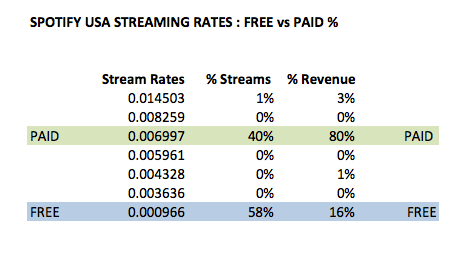
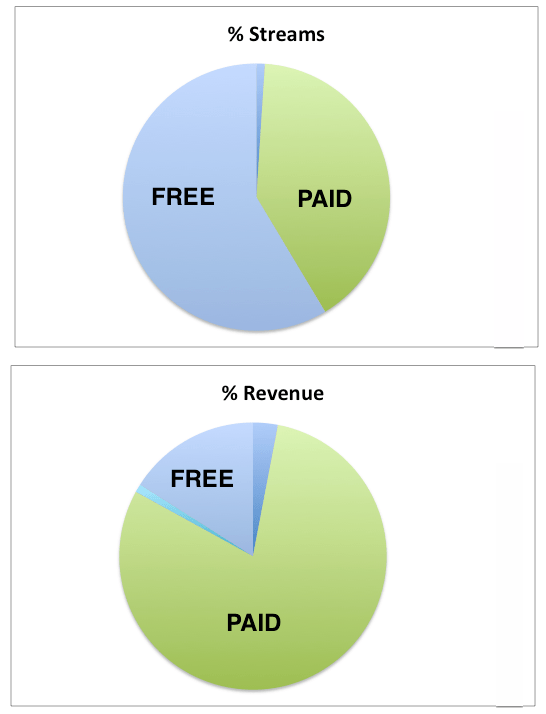
Following the Apple Music launch Spotify announced it had achieved 75m global users (we love that, “users” no kidding) and 20m paid subscribers. So let’s look at the numbers in relationship to what Apple Music could bring to the market place. Keep in mind that 55m of Spotify’s user base are NOT paying for the service. Based on reporting we’ve been provided the free tier accounts for 58% of plays which is only 16% of the total revenue.

With all the back and forth between Apple and labels and the announcement last week by NMPA of the publisher’s deal—freely negotiated without government “help” by the way–it’s pretty clear that Apple announced Apple Music without all their ducks in a row contractually.  This opened up an opportunity for haters who are just gonna hate.  Now that the picture is becoming a bit clearer, we feel more confident than ever that most of the noise is coming from competitors who would like to create yet another consent decree situation but this time for artists and record companies.

So there are a few questions we need to ask about the launch of Apple Music to evaluate the trade-off for eliminating the unlimited ad-supported free access to on-demand music. But before we ask those questions, we need to understand the mechanics of the Apple Music ecosystem.

First, the 90 days free without payment at launch requires the understanding that all consumers will get 90 days free at Apple Music whether they sign up at launch or at any other point later. This means that some people will opt in at launch, some will opt in at some later time. Based on what we have seen of how these streaming subscription services scale we have to ask a few questions.

How many people will have access to opt into Apple Music Streaming on launch? We’ll assume it’s the entire installed user base who upgrade into iOS 8.4. Here’s some back of the napkin math from the iPhone 6 launch when Apple dropped that U2 album into everyone’s Itunes.

According to CBS News 33 Million people of the 500 Million Global Itunes users “experienced” the U2 album. That’s just 6.7 percent of Apple’s reported consumer base.

So what kind of adoption and conversion rate could one expect from the launch of Apple Music? 10 million paid subscribers? 20 million paid subscribers? 50 million paid subscribers? It’s hard to know, but anything north of 20 million pretty much beats Spotify on paid subscribers.  And if you are looking for the company that has defined a paid music service, who you gonna call?  Apple or Spotify?  Who do you trust going forward?

What if Apple is able to convert 30 million or more consumers to paid streaming in only four months when it has taken Spotify five years to acquire 20 million paid?


BREAKING NEWS AT PRESS TIME. APPLE WILL PAY ARTISTS DURING THE FREE TRIAL PERIOD!
Apple Reverses Course, Will Pay Artists During Apple Music Free Trial | Mac Rumors


Of course, Apple should use a couple of bucks from it’s 178 billion dollars in cash reserves to compensate musicians for the consumption of their music during the initial 90 day launch of Apple Music. This would  incentivized artists to promote the service as being both fair and artist friendly and give Apple the thumbs up from the people that matter the most, the artists themselves. Apple’s purchase of Beats was a three billion dollar acquisition, so surely there’s enough money in those coffers to pay artists something.

To put these numbers into perspective Spotify claimed to have paid artists and rights holders two billion dollars globally from it’s initial launch in 2008 through October of 2014.

Here’s some more perspective from asymco.com: In 2012, global music revenues were reported at $16.5 billion, with $5.6 billion coming from digital music. Of that $5.6 billion in music downloads, Apple paid labels $3.4 billion for iTunes sales, which is about 60% of the total digital revenues industry wide—IN LESS THAN ONE YEAR.

In 2012, Apple’s transactional digital model created more revenue for artists and rights holders in less than a year in then it took for Spotify to earn almost 6 years.

If we want to break the death spiral of unlimited ad-supported free access to on-demand music we have to embrace the trade-off of offering limited free trial periods as an incentive for consumers to make the switch.

And by the way—compare the classy way that Eddie Cue of Apple handled Taylor Swift compared to Daniel Ek who comes off like a semi-stalker.  Who understands artist relations the best?

The problem with ad-supported unlimited free access to on-demand music is illustrated below showing Spotify domestic streams and revenues. It’s just math and it’s time to move on. Apple Music and Tidal are showing us the way.


DMN Says It’s Unlikely Spotify Pays More to Rights Holders Than Apple Does

In the dust up surrounding the Apple Music Launch and the leaked agreement that lead to speculation that Apple was paying indies less than the often heard 70% to rights holders an interesting thing happened.

Industry executives and commenters at Digital Music News reported that Spotify was also paying indies less than 70% and closer to the 58%, or less than Apple.

Update to June 15th, and Apple is not only stating that they are paying 70%, but a more aggressive 71.5% to 73% of revenues depending on territory.

But what makes this that much more interesting is that Spotify has now been outed as NOT paying the commonly accepted 70% of revenues and also has NOT responded to the claims being made at Digital Music News…

So how much is Spotify actually paying? So much for openness and transparency…

RutOh...