
The Technology Revolution Impacts and Reduces the Workforce
Read The Blog Post Here:
https://medium.com/@jonathantaplin/sleeping-through-a-revolution-8c4b147463e5
Watch the Full Lecture Here:
The Technology Revolution Impacts and Reduces the Workforce
Read The Blog Post Here:
https://medium.com/@jonathantaplin/sleeping-through-a-revolution-8c4b147463e5
Watch the Full Lecture Here:
The Lack of Ethics of Online Advertisers, YouTube, Google, Others.
Read The Blog Post Here:
https://medium.com/@jonathantaplin/sleeping-through-a-revolution-8c4b147463e5
Watch the Full Lecture Here:
Ad Funded Piracy. Follow The Money. It’s not about sharing, it’s about profits.
Most big piracy sites don’t charge their users a fee, but are still able to profit off of copyright infringement. Why? Because the operators plaster their pages in advertising.
But British police now say they are making major headway in tackling this: On Wednesday, the Police Intellectual Property Crime Unit (PIPCU) announced that Operation Creative, launched in 2013, has led to a 73% decline in advertising “from the UK’s top ad spending companies on copyright infringing websites.”
READ THE FULL POST AT BUSINESS INSIDER:
http://www.businessinsider.com/operation-creative-piracy-73-percent-decrease-pipcu-2015-8
The first three things to know about online piracy; Follow the money. Follow the money. Follow the money.
My own show, “Hannibal,” was the fifth most-stolen TV show during its first season on the air, despite being available for legal digital streaming the very next day. While I appreciate the enthusiasm of our fans, as executive producer I am responsible for all production costs for the show. Piracy directly affects my bottom line, including the wages for hundreds of cast and crewmembers.
I have been blessed with a successful, 30-plus-year career in entertainment. During that time, I have seen how the growth of online piracy directly impacts the economics of creativity. Piracy jeopardizes the rights of creatives to be compensated for their work — making it even harder to build a career in a creative field. It forces companies to either shrink their production budgets or commit to fewer, less risky projects. And ultimately, it harms audiences by limiting the types of stories that creatives can tell.
It’s a real lose-lose, unless you are the operator of a pirate site.
READ THE FULL STORY AT ADVERTISING AGE:
http://adage.com/article/digitalnext/advertisers-profit-piracy/299924/
Guest Post By Alan Graham
Last month I published this piece over on LinkedIn, but I felt it might need a second viewing (with updates) over here based on recent news on ad blocking and other developments.
————–
Silicon Valley has a drought problem. But it isn’t the lack of water I’m concerned about. It is the over reliance on ad revenue and venture capital that is sustaining both tech and media. Now there’s a debate raging about whether or not we’re in another bubble (I was in the last one). The pro-bubble argument is often about overvaluations and spending. The anti-bubble argument shows charts on how VC investments and IPOs are much lower than the last one. Both sides completely miss the mark which is that since Google (er…Alphabet) and others began building empires on “freemium” type services, we’ve become accustomed to not having to pay for things, and what began with a tool here and there and some “free” content has actually become the predominant method of generating revenue across the web.
A possible disaster.
For the past two years I’ve been working on a project called OCL. One thing it does is it is the world’s first true microlicensing platform for apps that allows the merging of any creative asset with any other creative asset with all of the rights cleared “faster than instantly.” Yes…that’s possible. And it is actually built upon the idea of paying for things (a novel idea these days I know). I’ve run into a lot of resistance over this model to the point where I recently had an argument with a music journalist who saw no problem with the idea that advertising was a viable long term model of revenue and my predictions/concerns over a non-sustainable ad market (for everything) was silly.
I’ve also had many a meeting with executives who told me countless times that the punter won’t pay for anything. Their business model is to license large platforms and take a cut of ad revenue. During this time I’ve pointed out that with a finite amount of ad revenue that must be shared across all creative industries and tech platforms (all vying for attention), it simply is not possible to sustain a vibrant creative marketplace that requires ad revenue to keep it chugging along. And if those platforms have their revenue somewhat interrupted, that trickles down.
The reasons for being concerned are clear:
-ContentID was a anomaly born out of necessity to bring some order to a chaotic system of copyright infringement and push the biggest piracy site into some form of legitimacy.
-YouTube went from a method of promotion, to a method of generating much needed revenue, to cannibalizing sales of media, as there was no reason to purchase what you were already viewing/listening to.
-Ad revenue (CPCs) have been dropping year over year for the past 5 or so years, while volume continues to increase.
-Volume is increasing because there are simply more and more locations to place ads in an increasingly competitive market with a finite amount of ad dollars that simply shift from one point to another depending on popularity. Companies with ad budgets don’t suddenly spend more money because there are more locations to spend it. And quite frankly…volume is practically infinite.
-Increase in volume means a competitive marketplace that can drive CPC and other ad rates down further because we’re witnessing something happening to ads that happened to media, commoditization. All about numbers at this point, not quality of creative.
-We’re just getting started. Estimated reach/penetration of iOS/Android/FB is anywhere from 5M to 9M apps/platforms with 40k apps being added to iTunes each month alone. Reports show that the range of “free” apps is somewhere around 90%, both ad supported and in-app purchases. As that tail grows, so does volume.
-86%+ of our time accessing the web is now done through apps.
-Ad networks and other ad-based companies are going to get squeezed out of existence because of this, causing a collapse of an entire segment of tech which means thousands of high paying jobs are gonna go bye-bye and never come back. This is already starting to happen.
-Ad revenue is currently 80%+ of all revenue generated by Facebook and Google, two of the most important platforms for media distribution. It keeps their lights on and it is this revenue creators hitched their wagons to.
-Media companies (music, news, video, images) are scrambling to get a cut of that same ad revenue and finding they not only are competing for that money, they often have to spend money towards making that money back. Welcome to the world of paid non-organic reach. You now work for the company, live in company housing, and shop at the company store.
-Ad blocking is starting to take off in popularity and in court cases the judges in two instances sided with the ad blocking company stating that the user gets to decide what they want to do with their devices.
“Online ad blocking costs sites nearly $22 billion
The study, by software group Adobe and Ireland-based consultancy PageFair, found that the number of Internet users employing ad-blocking software has jumped 41 percent in the past 12 months to 198 million.”“Those losses are expected to grow to more than $41 billion in 2016, the study said.”
“Last year, Google reported that 56.1 percent of all ads served were not measured viewable by humans.”
“Last December, the Association of National Advertisers and security firm WhiteOps estimated that up to a quarter of video ad views were fraudulent and resulting from software bots. It also said that as much as half of publisher traffic is from bots. This represents a projected $6 billion-plus in wasted ad spend this year.”
“Some industry observers go further than that, arguing that the digital ad industry is beset by traffic and other fraud because there’s a sort of arbitrage going on. Some exchanges, publishers, and ad networks are looking the other way, this argument goes, because they can make money on fraudulent traffic and fake ads.”
“The main losers are the advertisers themselves. But the publishers are getting shafted as well, Spanfeller said, since advertisers are paying $10 per thousand impressions while some publishers ‘get a buck.'”
-Mobile carriers in Europe are hinting that they also may begin to block ads at the carrier level citing increased performance and reduced bandwidth. How soon until we start to see ISPs offer the same services?
-It is estimated that Google is seeing as much as $6B in ad blocking occurring, and their total revenue in 2014 was $66B. That’s no laughing matter for a company making 90% of revenue from ads. Their response was to essentially say that the reason people are blocking ads is because we’re simply not making good enough ads. Yeah…that’s the reason. That type of flippant response to a $6B loss is why you should be very worried, because it means they are worried and don’t yet have an answer.
-For smaller publishers the problem is more pronounced. ProSiebenSat, one of the companies that sued Ad Blocker Plus and lost, stated that ad blocking was costing them upwards of 1/5 of their revenue or €9.2M
-Ad blocking users have grown to an army of nearly 200M people. That’s a word of mouth marketplace that any company would kill to have, except they are evangelizing the death of your business. Think about it as 200M people who have decided what you provide is interesting enough, just not interesting enough to pay for it via your #1 monetization plan. What’s your backup plan for monetization? What that says to me is that there are likely millions of content platforms overvalued and poised to collapse.
-With Apple’s recent announcement that they would allow third party developers to create ad blocking extensions for mobile Safari, the attention brought to this might take it mainstream, considering there are hundreds of millions of iOS devices and mobile Safari represents 25% of browsing. Welcome to the next viral technology success that you can’t actually afford to have take off.
-Facebook’s Instant Articles strategy could possibly be where advertising lives on, meaning that online publishers will have to become even more reliant on the tech giant for revenue, although it is likely both Apple and Google will follow suit. Meaning more of the open web gets sucked into the app environment where walls and AI decide what we will see and hear.
-My own tests with ad blocking has removed every ad from YouTube, one of the primary revenue sources for music labels and artists. Consider that most videos using music on YouTube (likely 60-70%) never generate any ad revenue at all, not to mention that YouTube is still not profitable (really?), this is one basket of eggs I’d be thinking of taking some eggs out of…
-Ad blocking is getting more and more sophisticated with ad block plug ins for Safari, Android, Chrome, and even Spotify. Not only can you block Spotify ads (the freemium model they defend to the death – no freemium no paid), but you can rip tracks from Spotify with all the metadata intact.
–PopcornTime. Free movies and tv shows playing direct to your device with a gorgeous interface, high quality resolution, built-in VPN, and zero ads…need I say more? Expect more solutions like this to pop up, including alternative music platforms. IMAGINE: Playlists created in Spotify exported to a BitTorrent decentralized music player…this will happen.
The next 12-24 months are going to be a watershed where we see just how much of this shakes out. The problems are numerous, but the biggest issue I see is that we’ve spent so much time investing in ad-based technologies and their revenue streams, we’ve not built a single alternative solution which can cover any losses if this all goes belly up. There is a massive consolidation of power occurring at the top of tech where we may only be left with 4-5 companies that control most of the web/Internet as we use to know it, and the creative class is left with no real technology of its own and very few options of how to reach their customers without being at the mercy of another giant tech company.
Years ago I use to drive between California and Oregon quite often and I began to see a trend happening. The boats on the reservoir began to leave the docks as the water receded from the shore. They began to huddle together in the center of the lake as there was less and less water. Essentially they became the last holdouts hoping a great rain would restore everything to the way it was. But it won’t.
Part of the problem California is facing with its shortage of water is due to the fact that they never planned for the possibility of drought, although they certainly talked a lot about it. They are shortsighted. They saw an endless supply of water and all the riches it brought. As humans we very rarely ever prepare for the worst, because we’re always so caught up in the moment and at the moment we’re still feeling the best of times: toilets are still flushing and faucets are still flowing.
The situation with ad revenue and VC backed advances and payments is no different, and if we don’t start working on a fundamental shift on how we as a society pay for things we value, we’re going to see a lot more than just water dry up.
Alan Graham is the co-founder of OCL
More artists, performers, songwriters and composers are getting it.
“YouTube are effectively paying incredibly low rates and are not a willing partner to negotiate licences and that pulls down the rates from someone like Spotify, which has to compete in their free service with YouTube,” he told The Independent on Sunday.
“The value from the music we create is being sucked out into the companies that aggregate it, [but] YouTube … are not happy to set adequate streaming rates. There is a huge shift of value from artists to tech companies.”
READ THE WHOLE STORY AT THE INDEPENDENT UK:
http://www.independent.co.uk/news/media/michael-price-composer-for-sherlock-blames-google-and-youtube-for-suppressing-rewards-songwriters-receive-10447054.html
We’ve been hearing from a number of our artist friends who are getting more proactive about using the DMCA to manage their work on YouTube. They are reporting that there appear to be more account terminations on YouTube in recent months. This would appear to be happening due to a number of factors, not the least of which is that artists, songwriters and creators are finally becoming aware of just how damaging “User Pirated Content” on YouTube really is to their careers.

Readers will note that the account in the screen shot above was terminated due to “multiple third-party claims“. That means the YouTube user is indiscriminately uploading multiple works by multiple parties. Unfortunately this appears to be a very common case with many users.
This is a serial infringer – it is not someone “just sharing their cute cat video.” There are literally thousands upon thousands of YouTube channels that are nothing more than infringement farms where artists get paid a pittance, if anything at all.
YouTube user accounts are subject to a three strikes rule. Yup, that’s it, three strikes – and now it appears more parties than ever before are starting to exert their rights via the DMCA and are sending notices to remove infringing works on the video streaming site.
This is how users, and the general public at large learn about copyright infringement. When an account is terminated the YouTube user is learning about copyright and artists rights. Those users should be directed to the artists YouTube channel where the artist themselves have chosen what material to share and promote.
Some have noted receiving direct emails from the users whose accounts are being terminated stating that the user knew they did not have the permission to upload the infringing content, but are doing so without profit motive. As much as we can appreciate that sentiment by the users, this is not the case for YouTube and Google who profit from a business built on “User Pirated Content” which attracts one of the largest online audiences in the world (thanks to our work!), and is monetized with advertising.
Because an account termination is the result of multiple copyright claims, Google & YouTube seem to forgo the attempted public shaming of rights holders that commonly appears when a video is individually removed.
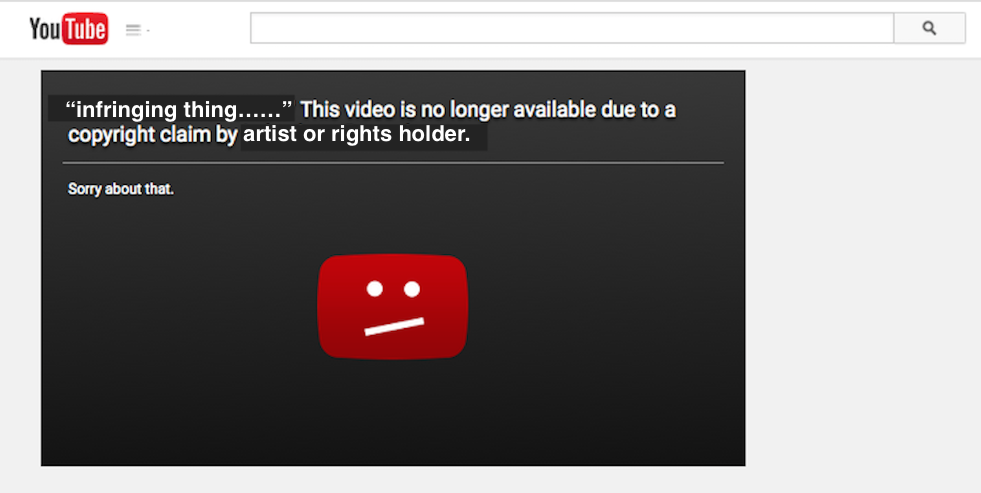 There could be a few more reasons why there are more DMCA take downs and a rise in account terminations.
First, artists are figuring out that $375 per million views when monetizing “User Pirated Content” is a really, really, really bad deal via Content ID. These collections are generally through a third party taking a percentage of that money like Audiam (25%) or AdRev (15%) as well as Tunecore and CDBaby amongst other aggregators who are also now offering this service. But no matter how you slice it, $375 per million views is just a really bad deal.
Here’s what front line YouTube (artist channel uploads) and Spotify plays look like per million views by comparison, and you can see more [here]:

Second, with the advent of YouTube’s vaporware Subscription Streaming Service (MusicKey) required artists and rights holders to be contractually bound to grant Free Streaming Licenses for their entire catalog of records via auto-generated videos and playlists. Now that every song on every album is licensed for free streaming and ad-monetization it reduces YouTube’s dependency on “User Pirated Content“.
Third, overall YouTube is a serious problem for all creators in their efforts to create and support a fair and ethical marketplace for music and media online. The best illustration is that Jay-Z’s Tidal was launched with the intention of providing it’s paying subscribers with exclusive material. The problem is, everything that Tidal made available exclusively to add value for it’s paying customers and fans was illegally uploaded to YouTube shortly after it was released. It’s hard to build a business on exclusivity when the largest streaming site in the world allows massive, repeat infringement. Thus, aggressive DMCA takedowns are probably leading to more account terminations.
Let’s see how long this lasts before the entire album is on YouTube:
And last but not least, the record industry is once again slow to get out the calculators, but when they do at least they take notice. Last year we reported on several posts during SXSW that highlighted the disparity between market share and revenue noting how much lower streaming payments were from YouTube versus Spotify (and others). Using only a limited data set we concluded that making music available on YouTube is the least profitable way for artists and rights holders to monetize their works.
Digital Music News recently posted a simple info graphic that highlights the problem as simple as it can possibly be detailing that YouTube accounts for 52% of all streams served but only 13.5% of revenues. Bad Deal. See the infographic / chart [here].
Let us be clear, that when users upload infringing material to YouTube containing our works without a license it is because of a business model that uses the DMCA to avoid responsibility for that infringement. Further more, these are not issues of Fair Use as some might like to suggest. The very fact that YouTube is a global commercial business who profits from publicly distributing “User Pirated Content” largely negates many (if not most) arguments for Fair Use.
Responsibly run services such as Vimeo (we believe Vimeo are responsibly run) have made a business by being the indie filmmakers destination for distributing their works, legally and licensed. Vimeo also has a simple and effective password protection function for non-public distribution of works intended for personal use amongst friends, family and small groups for educational purposes. This is not the case with YouTube, but it should be.
Remember all the controversy over YouTube’s ad-free streaming subscriber service, MusicKey? If the words “Google” and “Ad-Free” sound like a complete contradiction, you are not alone.

Ok, so where is it? We tried to sign up, but we’ll be notified later when the service is available.

Remember how one of the requirements was ALL OF YOUR MUSIC also had to be licensed for FREE STREAMING on YouTube or your promotional videos would be blocked or banned from the site?
Did you forget? No worries, here is the recap from Zoe Keating’s blog that brought the issue to light.
1) All of my catalog must be included in both the free and premium music service. Even if I don’t deliver all my music, because I’m a music partner, anything that a 3rd party uploads with my info in the description will be automatically included in the music service too.
2) All songs will be set to “montetize”, meaning there will be ads on them.
3) I will be required to release new music on Youtube at the same time I release it anywhere else. So no more releasing to my core fans first on Bandcamp and then on iTunes.
4) All my catalog must be uploaded at high resolution, according to Google’s standard which is currently 320 kbps.
5) The contract lasts for 5 years.
So, “All songs will be set to “montetize”, meaning there will be ads on them.” That’s one hell of a trade-off to get some subscription money, but maybe it won’t be so bad once that MusicKey money starts rolling in right? YouTube and Google have a HUGE amount of users to convert to PAYING SUBSCRIBERS, right?
Hahahahahahahahahaa. You fell for that gag? Seriously? Here’s what YouTube says about that little side business of PAID SUBSCRIBERS…in an interview between YouTube Senior Exec Robert Kyncl and Music Ally: YouTube Music Key delay ‘nothing too serious’ says senior exec.”
“We’ll always have ad-supported: that’s our core, and we’ll never stop focusing on it. It’s in Google’s DNA to be in the ad-supported business.
Subscription is just an add-on. It’s an adjacent business that we’re building.”
Suckas… You seriously thought Google who has slathered the internet with advertising on “User Pirated Content” across multiple platforms was going to pivot to a paid subscription model to move away from advertising on it’s flagship video streaming site? Really? Seriously?
You saw that five year term, right? So MusicKey is a no show for subscriber revenue but thanks to that five year term the largest streaming service in the world, that pays the least amount per stream now has licenses for the next half decade. As the kids say, LOL.
Don’t worry about MusicKey not showing up anytime soon with that Paid Subscriber Money, in the meantime enjoy your life’s work as a YouTube auto-generated music video and playlist, for free.
Oh MusicKey we would have loved to have known you – now all we have is our catalogs of master recordings being monetized on old-school YouTube for pennies on the dollar of every other streaming service including Spotify. Wow, just wow.
And Speaking of Spotify, guess who has a seat on the board to make sure that their “ad-supported DNA” remains the primary focus of that music streaming service? Three guesses… Yup, it’s Google.
Here’s a trip down MusicKey memory lane…
April 2014 : Exclusive: ‘YouTube Music’ Is Launching This Summer… | Digital Music News
June 2014 : Artists who don’t sign with YouTube’s new subscription service to be blocked [Updated] | Ars Technica
June 2014 : F*&K It: Here’s the Entire YouTube Contract for Indies…| Digital Music News
November 2014: YouTube’s MusicKey Will Cause $2.3 Billion In Music Industry Losses… | Digital Music News
January 2015 : YouTube Is Removing Any Artist That Refuses to License Its Subscription Service…| Ars Technica
April 2015 : If You Don’t Agree to YouTube’s New Ad-Free Terms, Your Videos Will Disappear…|Digital Music News
June 2015 : YouTube Music Key delay ‘nothing too serious’ says senior exec | Music Ally
Exhausting… Why would anyone trust these people? All hail “User Pirated Content“… and if that doesn’t work just come up with a non-existent paid subscriber streaming service that auto-generates music videos and playlists on the free, ad-supported platform. At least that part is working, right?
Let’s talk about transparency for a second. Why is it that YouTube would be excluded from Google’s own DMCA tracking report? It couldn’t be because DMCA notices and takedowns of infringing material YouTube dwarf even the most notorious of pirates sites say like The Pirate Bay? No, that wouldn’t be the reason would it?
 Maybe #adbusters and #blackspot really do have it right…
No surprises here, right?
“The onion is slowly and surely getting peeled back.”
…
Last year, Google reported that 56.1 percent of all ads served were not measured viewable by humans.
Last December, the Association of National Advertisers and security firm WhiteOps estimated that up to a quarter of video ad views were fraudulent and resulting from software bots. It also said that as much as half of publisher traffic is from bots. This represents a projected $6 billion-plus in wasted ad spend this year.
Spanfeller sees the current system as a big part of the problem.
No kidding.
READ MORE AT VENTURE BEAT:
http://venturebeat.com/2015/08/08/the-digital-ad-business-is-broken-says-former-forbes-com-ceo/
Good luck Sony, let’s see how this goes with the “User Pirated Content” at YouTube…
Search YouTube for 1D’s new comeback single Drag Me Down, and you’ll discover Harry, Niall, Louis and Liam are nowhere to be found.
Sony won’t confirm it, but the major appears to have a taskforce stamping out any attempt to upload the track onto the platform.
Why? Because One Direction are using their colossal social media presence (Twitter: 24.5m; Facebook 37m; Instagram: 9.7m) to actively push fans towards iTunes and Spotify instead.
READ THE FULL STORY AT MUSIC BUSINESS WORLDWIDE:
http://www.musicbusinessworldwide.com/how-to-ignore-youtube-completely-one-directions-radical-gamble/
 The Trichordist
You must be logged in to post a comment.