
Next week we will continue discussion of the Department of Justice [sic] ruling on 100% licensing and partial withdrawals from the songwriter’s point of view. Participants will be songwriters Michelle Lewis and Kay Hanley of Songwriters of North America, David Lowery and Chris Castle. Watch this space for links to the podcast when it is completed.
Category: Artist Rights
Curious Departures from DOJ Antitrust: Off to the GOOLAG?
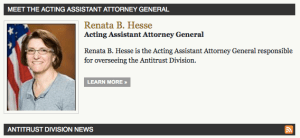
Two vacancies near the top DOJ antitrust division give former Google lawyer Renata Hesse direct control of antitrust oversight of Google.
There is a tendency in the waning months of a two term presidency for political allies to cash in their favors; push through favorable rules and regulations; and set the clock ticking on those high paying private sector revolving door jobs. So we can’t help noting two curious vacancies in the upper reaches of the US DOJ Antitrust Division. The Chief of Litigation Section III and Networks and Technology sections.
Litigation Section III oversees the entertainment business and in particular songwriters’ performing rights organization. On August 4th this division released a controversial and devastating new rule which requires a single ASCAP or BMI co-writer to license and account on behalf of the other songwriters. This caused widespread outrage among songwriters and legal scholars who noted the disruption to the music licensing marketplace, international treaty violations and potential constitutional violations of the rights of songwriters. Up until a week ago David Kully was chief of this section. His position is now listed as vacant. We find this very curious. Especially as we are told Kully indicated in a communications to songwriters that he didn’t actually write the rule and refused to disclose who wrote the rule.
Meanwhile we notice that the Chief of Networks and Technology section is now also vacant.
Both of these sections have oversight over Google’s businesses. Does anyone else find it suspicious that these two sections are vacant and are now directly controlled by a former Google lawyer (and Obama administration ethics rule violator and resume fudger) Acting Assistant Attorney General Renata Hesse?
Now the questions are:
Are these business as usual departures? Or is something more sinister afoot? Is Kully the fall guy for Google hatchet woman Renata Hesse? Or is he off too Googleyer – oops I mean greener pastures?
After songwriters recent experience with DOJ ATR Litigation Section III Congress and/or the OIG should look into what is going on here. Even if nothing improper is found, it should be done to restore public faith in the department.
Q. How Do You Know 100% Licensing is Good For Google? A. Techdirt Praises it

Remember Mike Masnick appeared on the so-called Oracle vs Google “shill list.” See here:
http://www.theregister.co.uk/2012/08/24/google_amended_shills_list/
Since Mike addresses the Trichordist directly, let me answer directly.
I am all for the 100% licensing rule because it will break the exploitative and unconstitutional music licensing system. I will educate every songwriter on how to exploit this to our advantage. We have nothing left to loose. Why not cause absolute chaos for the music users? Let them feel our pain. And it’s all perfectly legal. It simply requires us not do something the DOJ can’t make us do. And it may even allow writers to selectively window their works on streaming services. Something that was impossible until now. Stay tuned for that!
And it has also shined a light on corruption and Google control of DOJ antitrust division.
Kully who was nominally in charge of this DOJ rule is suddenly gone? His position appears vacant. This happened yesterday.
The chaos has started!
(Editor note: Masnick thinks so much of himself that he offers to shut down Techdirt forever if someone pays him $100 million dollars. See below)
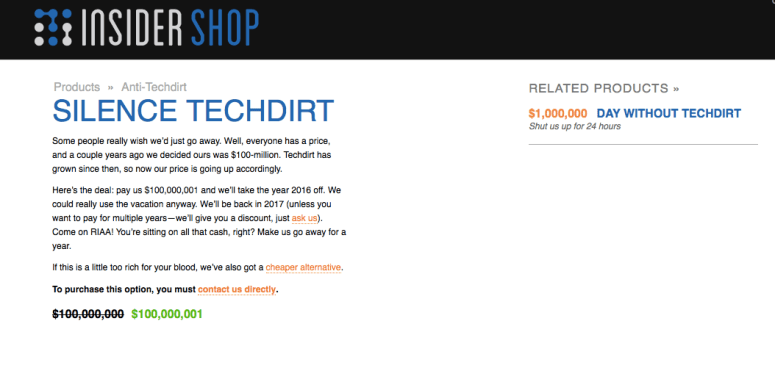
Bring on the Chaos: The DOJ and Google Think They Want 100% Licensing? Let Them Have it
Songwriters should embrace the chaos. The DOJ really thinks that BMI and ASCAP have always performed 100% licensing. Even though they seem to contradict that by offering the PROs one year to comply with 100% licensing. Fuck these idiots just let them have it.

The new rule will force hundreds of thousands of songs, if not millions of songs to be dropped from the BMI and ASCAP catalogues. Especially Hip Hop songs and songs with Samples because of private co-administration contracts. Radio stations, television stations, bars, restaurants, malls, football stadiums, cable networks, interactive and non-interactive services will either have to drop the songs, buy direct license for these songs, or buy licenses from an alphabet soup of new PROs that will appear on the scene with none of them subject to consent decrees. Even if the DOJ tried to managed to put 26 new PROs under the consent decrees it would require a vast expansion of their staff.
Careful what you wish for fuckwads.
Also imagine the calls to the DOJ, congressmen and the lobbyists that thought this was a good idea.
“Are you fucking telling me I need 26 PRO licenses instead of 3? This is a fucking improvement?”
In the meantime it will be absolute chaos.. No one knows what they can or can’t play.
What have we got to lose anymore? The DOJ hates songwriters. They will never do right by us. They are making it impossible to make a living as a songwriter.
So let’s enjoy what we can.
I say just chill and enjoy the show.
Current DOJ Antitrust: Smarter Than Last 75 Years of DOJ Lawyers, Dangerously Stupid or Corrupt?
Who IS running the shop over at DOJ Antitrust Litigation Section III? Really doesn’t it just makes a lot more sense for Google to directly pay/control the section rather than having to go through all the rigamarole of pretending to have an impartial and independent division, with revolving door Google lawyers?
You got to wonder.
Why is it that for the previous 75 years of DOJ antitrust supervision BMI/ASCAP were allowed to fractionally license music? Surely it didn’t escape notice that BMI/ASCAP were fractionally licensing songs? Fo 75 years they allowed ASCAP BMI songwriters to write co-administration agreements that require fractional licensing. I mean if the DOJ consent decree judge can issue a legal opinion that notes publisher Marty Bandier in a certain photo was wearing “short sleeves and smoking a large cigar” (clearly the judge intended this as a personal smear) surely the DOJ and rate court judges should have noticed the fact that for 75 fucking years songwriters have been writing private co-administration contracts that require fractional licensing and BMI and ASCAP have been obliging. Clear
So is the current crop of Berkeley/Harvard/Stanford/Silicon Valley DOJ antitrust lawyers just smarter than the previous 75 years of lawyers that were employed in the DOJ ATR Division?
Alternately are they more stupid? Like dangerously stupid. Like take their law licenses away because they don’t even understand fundamental things like the constitution, separation of powers and private contracts. Maybe I should be kinder. Perhaps the entire department suffers from a mass learning disability that makes it so they have a hard time understanding the Copyright Office report on the effect of 100% licensing on the existing music market. That the economic and structure of millions of private contracts concerning the administration of songs, would require pulling hundred of thousand if not millions of songs from BMI and ASCAP producing the exact opposite effect of what they intended with 100% licensing.
Or are they simply corrupt. Occam’s Razor would suggest so. It requires fewest assumptions to be added! I’m only half joking here. Consider the facts. It does seem to only benefit Google. This head of the Antitrust division is a former Google lawyer (Renata Hesse) and she appears to have pushed through the 100% licensing rule. And as Music Tech Policy notes in their devastating timeline of events, Google seems to have orchestrated a takeover of Antitrust division by Google friendly lawyers following the FTC investigation of Google.
So readers what do you think?
How Google Took Over the Justice Department Antitrust Division: Renata Hesse’s Timeline

If you have been following the machinations by the Obama Justice Department [sic] over amending the ASCAP and BMI consent decrees, you may have found yourself wondering who was responsible for rejecting the good faith efforts of the songwriting community in favor of a cynical back room deal with multinational tech companies and broadcasters. I […]
DOJ 100% Licensing Rule: An UnFair Tax on Hip Hop and Works With Samples?
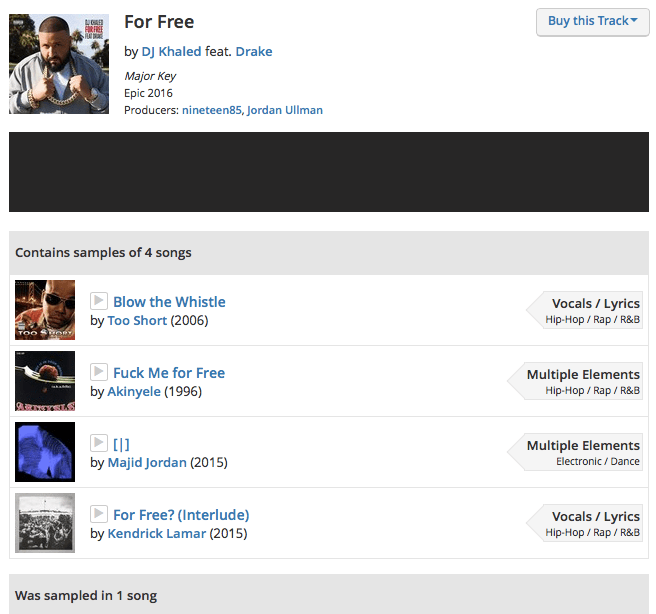
Let’s look at the implications of the DOJ 100% rule for the writers of the 5th most popular Hip Hop Song in the US this week.
These are the four samples in For Free, by DJ Khaled featuring Drake. Each of those sampled songs also has multiple writers. Consequently the list of writers for the composite work is quite long. In this case there are 13 Songwriters, 4 BMI publishers and at least 3 non BMI publishers. 6 writers use ASCAP to license performing rights. 6 writers use BMI and one writer is Canadian so they use SOCAN. As is always the case with works composed of samples, these writers have a co-writer agreement to spell out ownership percentages and then an agreement that specifies each party will license and collect it’s own fractional share. “You do your business and collect your money, I do my business and collect my money”
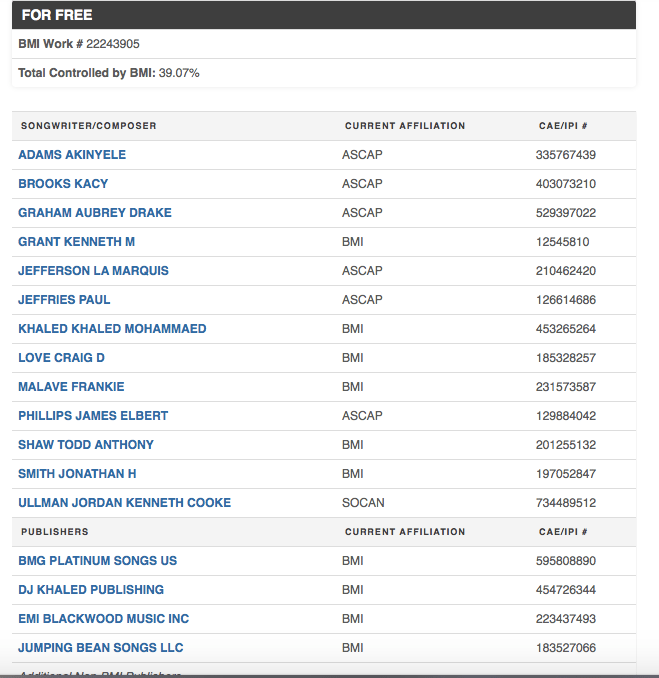
This is how the “Tax” comes in. The DOJ 100% licensing rule says fractional licensing is “illegal” under the BMI/ASCAP consent decrees so two things could happen.
- All thirteen writers and 7 publishers must throw out the old agreement and come together and negotiate a new co-writer agreement that allows either BMI/ASCAP to license this song in full, and either pay writers directly or pass it through to the other PRO. That’s 20 entities that may all have to agree on this final document. What if one ASCAP writer will only accept payment from ASCAP another ASCAP writer is cool with being paid from BMI to limit overhead deductions. Imagine if each of these parties are represented by a lawyer? What are the legal fees? $20,000k? This is the first tax on hip hop.
- If the 20 parties can’t agree? Or what if one of the authors is deceased? Maybe the heir can’t be found or the estate is unsophisticated and says “no re-negotiation?” Then the work violates the DOJ rule and can no longer be part of the ASCAP and BMI repertoires. This song becomes “stranded.” It will not be possible to perform this song in the US. No ASCAP or BMI royalties. That’s the second tax on hip hop.
Further I worry that because Hip Hop uses so many samples and co-writer deals that require fractional licensing that music users (radio stations, tv etc) begin to avoid the entire genre because they aren’t sure which tracks are “stranded” and hence unplayable in the US.
Maybe that’s a third tax on hip hop.
DOJ Engages Completely Juvenile Argument Against Copyright Office in Defense of Corrupt 100% Licensing Rule
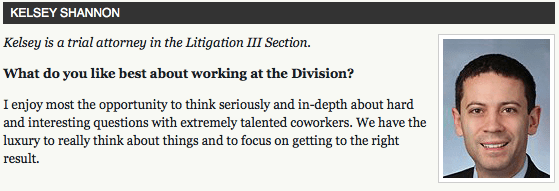
Getting the right result for our corporate masters.
We need to get the OIG to investigate or even recommend the disbanding of the DOJ Antitrust Litigation Section III over their handling of the 100% song licensing rule. This is getting totally ridiculous.
First: there is the very real chance of corruption here as this appears to have been rammed through at the behest of Google by former Google lawyer Acting Assistant Attorney General Renata Hesse. See full timeline of Google takeover of Antitrust Division:
The DOJ Antitrust Division Litigation Section III/AG Lynch/And WhiteHouse needs to get the shit FOIA-ed out of them on this alone. Everybody involved in this sorry episode needs to be investigated.
Second: Look at how stupid/Juvenile the DOJ division is. In a brief to Judge Stanton in defense of their 100% licensing rule they arrogantly take a potshot at the US Copyright Office because they dared to oppose the DOJ on this. In reference to this Kelsey Shannon says:
“the question at issue, however, is one of antitrust law and decree interpretation, not copyright law.”
The reason this is so arrogant is because the Copyright Office was not in disagreement with the DOJ on copyright issues! The Copyright Office was weighing in on the structure of the music licensing market as it stands and the effect of the DOJ rule on private contracts between songwriters; administration costs; downstream licensing and loss of repertoire to BMI and ASCAP. In short the Copyright Office noted it would be extremely disruptive and result in less competition and less efficiency.
The DOJ knows this. But these idiots are now further disgracing themselves by trying to mount a false and misleading PUBLIC RELATIONS campaign against the US Copyright Office for opposing them. (Appears letter was leaked to journalists before making publicly available, hence public relations campaign).
This is the bureaucratic equivalent of telling the Copyright Office “Shut the fuck up we are the anti-trust division.”
The argument has no substance. Who are these clowns over their anyway?
Investigate them. Prosecute them. Fire them all.
The MTP Podcast: The Consequences of DOJ’s New Rule on 100% Licensing with David Lowery, Steve Winogradsky and Chris Castle
Music Tech Policy Podcast with David Lowery and Steve Winogradsky. Great stuff from Steve on how the DOJ 100% licensing rule will affect TV broadcast and syndication among other things.
David Lowery, Steve Winogradsky and Chris Castle discuss the implications of the new rule by the U.S. Department of Justice re-interpreting the ASCAP and BMI consent decrees to require 100% licensing and prohibiting partial withdrawal.
David Lowery is the founder of Cracker and Camper van Beethoven, leading artist rights advocate and writer of The Trichordist blog, and teaches at the Terry School of Business at the University of Georgia at Athens.
Steve Winogradsky is a senior music lawyer and co-proprietor of the music services company Winogradsky/Sobel in Los Angeles. Steve teaches at UCLA and Cal State Northridge and is the author of a leading legal handbook Music Publishing: The Complete Guide.
Chris Castle is founder of Christian L. Castle, Attorneys in Austin, Texas and edits the MusicTechPolicy blog. He is formerly an adjunct professor at the University of Texas School of Law, and lectures at law schools, music schools…
View original post 190 more words
No, The FCC Should Not Have the Power to Cancel Contracts
Some casual reading on set top box proposal. But it’s important to note that the issue here is remarkably similar to the DOJ 100% licensing rule.
1) non-legislative likely unconstitutional attempt to establish what is essentially a statutory license.
2) interferes with private contracts.
3) comes at the behest of Google int the 11th hour of Obama administration.
 The Trichordist
You must be logged in to post a comment.