An Open Response to Peter Sunde | David Newhoff @ TIOM

The Pirate Bay’s Peter Sunde has recently stated he’s given up. His interview can be read here. David Newhoff at the Illusion Of More responds to Sunde in a brilliant open letter that is required reading.

This is what comes of evangelizing the idea that it’s okay to exploit other people’s investment of real labor and real capital in goods and services that would otherwise have regenerative value. And exploiting these types of investments is precisely what you and your colleagues did with The Pirate Bay.

At least part of the Internet you don’t like is what comes of preaching to a whole generation that they can have whatever they want, free of charge, as long as it’s just a mouse click away.  And indeed, we are lately seeing the wheels come off that naive (and frankly predatory) idea. As the leaders of Pandora and Spotify begin to see that “freemium” isn’t a business model; as Facebook’s video service “freeboots” the promised ad-share value out of the pockets of YouTube creators; and as the global network of pirate sites is revealed to be a malware-infested and sophisticated black market that preys on individual consumers, you seem to have missed the point, Peter. The “fight” you lost is not with the MPAA and the principles of real capitalism—but with the unfettered greed you helped foster on the Internet you asked for.

READ THE ENTIRE POST AT THE ILLUSION OF MORE:
http://illusionofmore.com/an-open-response-to-peter-sunde/

Three Simple Steps To Fix The Record Business in 2016… Windows, Windows, Windows…

windows

This time last year we correctly predicted the restructuring of at least one major label group when we asked the question, “Who will be the First Fired Label Execs over Spotify Fiasco & Cannibalization?“. It didn’t take long for us to find out, “It’s Just Math : Digital Music Execs Exit, But will the Pivot to Paid Subs Be Enough To Save The Record Biz?” We’re still not sure that even paid subscription streaming actually works in the long term, but we know for sure that unlimited free streaming does not!

What a difference a year makes. What a difference Taylor Swift makes. What a difference Adele makes.

Going into the next year our prediction is that the power of windows can not be overstated as the leading solution to the problems faced by the record industry. Effective windowing has always been a part of the economic life cycle of every album release. The physical singles sales business (ya’ll remember 45 prm records, right?) – well, that was largely a loss leader to boost singles chart positioning that combined retail and radio reports.

In every record store there was the “hit wall” of discounted new releases to encourage higher volume sales. Every store stocked a robust variety of titles across different genres and price points comprised of front line titles, mid-line titles, budget line titles, and at the end there was the cut-out bin. Also, let us not forget the “11 records for a penny” record clubs advertised in magazines.

Those, my friends, are windows. Those who are advocating against windows are probably too young to know better or have been lead around by the nose by some digital snake oil salesman protecting their own interests.

This is not a philosophical discussion. This is financial reality. Respected stock analyst Robert Tullo who is the Director Of Research at Albert Fried & Company says this:

Longer term IP Radio and Spotify are good annuity revenue streams and great promotional tools. However, we believe the system works better for everyone when artists have the right to distribute their Intellectual property how they see fit.

Ultimately we think windows for content will form around titles that look much like the Movie Windows and that will be great for investors and the industry as soon as all these so called experts get out of the way and spot trading fashionable digital dimes for real growth and earnings.

Mr. Tullo is correct. Not only will artist (and rights holders) do better when they have the freedom of choice but so will the partner platforms. This is how it works in the film business. Every month the “virtual inventory” on Netflix is rotated. New titles come in, old titles go out. If you really, really, really want to see something right now, you have to rent it or buy it via a transactional stream or download. The record business will benefit from the same models and strategies. Windowing works. Period.

See here’s the thing… If these new digital platforms are so great for artists, why wouldn’t artists want to participate on them?  The benefits would be self evident? If the product that Spotify, Pandora, YouTube (and others) are offering is so good for artists, why are these companies so afraid of artists and rights holders opting out? Maybe, just maybe these platforms are not offering the type of value that their suppliers find meaningful?

It really speaks volumes when a business model is so bad that one of  the essential features for survival of the company is to deny its suppliers the option to fairly negotiate their participation or have the ability to opt out. In the old neighborhoods that was known as a protection racket, or extortion.

Silicon Valley didn’t invent the freemium, they’re just doing it wrong. Really wrong. Horribly wrong.

Let those who want to give away their work freely do so, but also allow those who would rather opt out the ability to do so. If artists find value in the freemium tier, and they may well as they always have, then let them chose how to best utilize that option. Musicians pioneered the freemium model often using street teams to canvas concerts by giving away cassettes to fans of similar music.

If digital platforms allowed artists to use their technologies creatively, everyone might be pleasantly surprised how much better (and more profitable) things would work out.

Watching Pandora lose $5 billion in value in a year becomes a punch line when they believe they are better suited to dictate to artists how to best communicate with their own fans. It is indeed interesting to see Pandora admit what we’ve been saying for years, unlimited, ad-supported free streaming unsustainable. No Kidding. Here it is from Brian Andrews, CEO of Pandora:

“This gray market is unsustainable. If consumers can legally listen to free on-demand music permanently without converting to paying models, the value of music will continue to spiral downward to the benefit of no one.”

Of course what makes this comment most interesting is that Pandora is entering the crowded field of on demand streaming with it’s purchase of the failed Rdio. Pandora now has to compete with Spotify’s very large free tier of unpaid and entrenched users. Migrating those users to a new on-demand streaming platform will be a challenge (ask Apple and Tidal), and even more so as artists and labels grow tired of subsidizing these horribly flawed business models.

Here’s three uses of freemium streaming most artists (and rights holders) would probably embrace if given the choice.

1: The Hit Single

– Using the freemium platform to launch a single to gain ubiquitous awareness of a new album release. This is what both Taylor Swift and Adele did and the results speak for themselves. More artists would probably embrace releasing one or two songs or singles from an album on freemium tiers. With the artists support this becomes far more valuable than extorting the them into releasing their entire album on a platform they feel devalues their work.

BONUS: What if Adele made an official playlist of her favorite songs, leading with her new single? How much added value does an artist of this caliber bring to a platform when they feel they are being respected and valued? Answer, ALOT.

2: The Focus Track

– Not everyone has a hit single, but most artists have a focus track from their album. Like the hit single, these artists would embrace the opportunity to be discoverable and to build an audience of new fans. Developing artists are the most eager to try new opportunities because the have the most to gain. If digital streaming platforms worked with artists in a meaningful and respectful way, the mutual benefits could be huge for everyone.

3: Rotating Inventory Management

– By adopting a Netflix like inventory management of monthly rotating titles on the freemium (or even paid subscription) tier more artists might feel compelled to be more engaged. Rotating inventory management is a smart way to keep users and fans engaged as old titles rotate out and new ones in. This simple trick restores a great deal of the consumer engagement that is a part of discovery, and promotion.

Of course, the goal of every freemium model is to lead to more paid revenues in higher value products. Working together with artists and rights holders the future of streaming distribution could be very bright. But to get there we need to let go of Stockholm Syndrome. the old neighborhood protection rackets, bullying extortion threats and just plain bad business models.

There is a lot that can be done in the world of streaming. Streaming is not bad, it’s just a technology. Free streaming and subscription streaming both have their place in the ecosystem. What is bad are the exploitative business models, lack of transparency and devaluation of the artists work. These are fixable issues that have nothing to do with technology, just a lack of common and business sense.

“Rumor Has It” That Spotify May Stop Censoring and Start Segmenting

Music Technology Policy

The Wall Street Journal reports that Spotify is considering allowing the market to work so that artists can decide window their music between the Spotify free music service and Spotify’s subscription service.  Naturally, this decision to liberate artists from the bureaucrats in the Spotify Ministry of Culture will be welcome news although it may be limited to superstar artists.

The Journal reports:

In private talks, Spotify has told music executives that it is considering allowing some artists to start releasing albums only to its 20 million-plus subscribers, who pay $10 a month, while withholding the music temporarily from the company’s 80 million free users.

Spotify, initially, will try the new approach as a test, according to a person familiar with the matter. It wants to investigate how such a “windowed” approach might affect usage and subscription sign-ups. It also hasn’t decided which artist will get to withhold music from the…

View original post 599 more words

Coldplay Says #irespectmusic and Rejects Freemium: Mr. Ek, The Market Calling on Line One

Music Technology Policy

When the market shifts, it hardly ever happens all at once.  That’s because on a microeconomic level, a bunch of decision makers are making small decisions.  Successful entrepreneurs spot these small decisions before they become a trend, and react in a profit-centered way.  Observers notice that change.

It should surprise no one that Coldplay has rejected freemium on their new “Headful of Dreams” album release and Spotify’s pig headed response should also surprise no one, either.

Complete Music Update asks the question of why Spotify is painting itself into a corner:

Which brings us back to that old question: why doesn’t Spotify allow premiere league artists to window their new releases so that they become available to the service’s paying premium users first, subsequently arriving on freemium several weeks or months down the line? Because ‘A Head Full Of Dreams’, which is already available on premium-only streaming platforms like Apple…

View original post 546 more words

YouTube’s DMCA decision and the campaign to morph victims into villains | Vox Indie

YouTube will pay copyright court costs for a few users–not because it’s right–but to protect Google’s bottom line

According to a story in today’s NY Times, the folks at YouTube are ready to pony up cash to support some of its users “fair use” claims in court.

“YouTube said on Thursday that it would pick up the legal costs of a handful of video creators that the company thinks are the targets of unfair takedown demands. It said the creators it chose legally use third-party content under “fair use” provisions carved out for commentary, criticism, news and parody.”

You’ve probably read a lot about “fair use” lately.  It’s the Electronic Frontier Foundation’s mantra and if the folks there had their way, pretty much everything and anything would be considered “fair use.”  Fair use an important legal doctrine and when applied properly (criticism, comment, news reporting, teaching, scholarship, or research) is not an infringement of copyright.  However, these days, too often is used as a disingenuous defense for copyright theft.

READ THE FULL STORY AT VOX INDIE:
http://voxindie.org/youtube-covers-legal-costs-for-some-users/

Thom Yorke on the Disappointment of His Bit Torrent Experiment

Music Technology Policy

Remember when Bit Torrent, Inc. (Daniel Ek’s former employer) was trying to get higher value advertising…oh, sorry…was trying to demonstrate that they were all things pure and high minded because Bit Torrent was really designed to leverage their huge user base derived from piracy…sorry…Bit Torrent Bundle was really designed to help artists find an audience?

Remember when Thom Yorke allowed himself to be used as a poster boy for Bit Torrent Bundle on his solo record “Tomorrow’s Modern Boxes”?  Ever wonder how that worked out?  Thom Yorke is interviewed by the Italian site Repubblica and fills us in.

Complete Music Update translates thusly in answer to the interviewer’s question was the Bit Torrent experiment successful:

“No, not exactly”, he said. “But, in fact, I wanted it to be an experiment. It was a reaction to everything that was going on. At the time, people were only talking about…

View original post 161 more words

Seabrook’s Stories About Money

Music Technology Policy

ROOSTER

I don’t believe in fairy tales, sermons, or stories about money, baby sister, but thanks for the cigarette.

From True Grit written by Joel Cohen and Ethan Cohen

seabrook 1

The author John Seabrook has written another extraordinary piece on Spotify for the New Yorker that one could charitably describe as struggling with truthiness.  But to paraphrase Mrs. Longworth, if you’re not feeling charitable, come sit next to me.

Of course this is not the first time Mr. Seabrook and the New Yorker have come to the rescue of the Darling of Goldman Sachs.  Who can forget John Seabrook’s puff piece on Daniel Ek that appeared in the New Yorker after Spotify’s Taylor Swift debacle.  That was an article that IPO underwriting syndicates like a whole lot more than…let’s just say reality.

That Daniel Ek piece had some howlers that belied what is increasingly appearing to be Mr. Seabrook’s self-directed…

View original post 973 more words

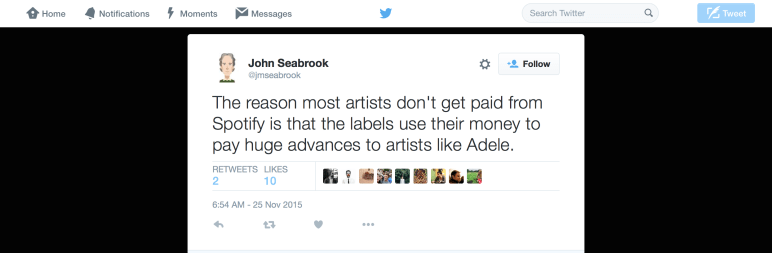
Mike Doughty Responds to John Seabrook at The New Yorker about Adele Doing Windows…

Musician Mike Doughty takes on the New Yorker’s anti-artist editorial “Who Is Really Paying for Adele?”. Seabrook argues that somehow Adele is cheating fans by not giving away her new, historical, record breaking album.

Seabrook’s piece reads like it was written by the Spotify PR dept with lines like this “Could it be possible that the record business, pursuing a strategy of inflating sales by keeping an album off Spotify, Apple Music, or Deezer, is choosing short-term profits over long-term growth?” No. It’s actually long term growth that is the goal of windowing. Variable pricing and pricing elasticity works for most business and has historically worked well for the record industry as well (see below).

Doughty’s response from Facebook can be seen here. You can share it directly via this link:
https://www.facebook.com/mikedoughty/posts/10154544998845200


DoughtyVSNYTimes

What is of particular interest is that it is people like Seabrook who chastise artists and the music industry even in the the light of Rdio going defunct and owing $220m to creditors and labels! Somehow the bad bubble math of Silicon Valley is what artists should be striving for? No. Enough.

WINDOWING THAT WORKS FOR EVERYONE

So what does this mean for the non-superstar artists? Very simply, windowing works. Windowing works better when there is a reasonable amount of consistency. Our friends in the film business have been highly effective at windowing for decades and there’s no reason why it can’t work similarly well for the record business.

Every new release should have the option to determine the release windows when the record is being set up. For example the default could be 0,30,60,90 day option for transactional sales, followed by 0,30,60,90 day option for Subscription Streaming prior to being available for Free Streaming.

Windowing is not new for the record business. The industry has never had pricing ubiquity across all releases, genres and catalogs. There has always been strategic and flexible pricing strategies to differentiate developing artists, hits, mid-line catalog, and deep catalog. An industry wide initiative to re-allign time proven price elasticity is the key to growing the business and developing a broad based sustainable ecosystem for more artists.

  • Windowing allows for Free Streaming to exist as a strategic price point.
  • Windowing allows for Subscription Streaming to exist as a strategic price point.
  • Windowing allows for Transactional Downloads to exist as a strategic price point.
  • Windowing allows for artists and rights holders to determine the best and most mutually beneficial way to engage with their fans.

Windowing is the key (as it always has been) in rebuilding a sustainable and robust professional middle class that will inevitably lead to more artists ascending to the ranks of stars. Some will become superstars and legends capable of creating the types of sales and revenues currently achieved by Adele, Taylor Swift and Beyonce’. To get there however we need to abandon Stockholm Syndrome and embrace windowing that works for everyone.


Did Cox Communications Just Do the Dirty to Shareholders?

Last week Cox Communications lost its DMCA “safe harbor” defense against songwriters in BMG Rights Management’s lawsuit against Cox for failing to maintain a repeat infringer policy in Cox’s ISP business.  It has always seemed pretty obvious that an ISP running a “whack a mole” business requiring songwriters and artists to send repeated DMCA notices shouldn’t get the protection of the safe harbor if the law was working the way it should.  Finally a U.S. federal judge things so, too.

As we are often told by Big Tech, the DMCA safe harbors were a negotiated balance, a “grand bargain.”  What usually comes next is some spin that would have you believe that the “notice and takedown” operates as a kind of “tag you’re it” functionality that allows certain anointed ones to get away with not doing the actual stealing, but providing the means for the stealing to occur.  You know, because the Internet.

But now it looks like at least Cox Communications executives might have a real problem on their hands depending on how the facts turn out in the BMG case.  Why?

As Professor Tim Wu taught us before he started working for the New York Attorney General:

If the Internet were not a bookstore, or tubes, but rather a red-light district, YouTube would best be imagined as the hotel, and Napster, well, the pimp. YouTube, like a hotel, provides space for people to do things, legal or not. It’s not doing anything illegal itself, but its visitors may be. But Napster, everyone more or less now admits, was cast as the pimp: It was mainly a means of getting illegal stuff.

To extend Professor Wu’s pimp allegory, in Cox’s case it is the ISP who is providing the means of getting illegal stuff, and Cox wants to hide behind the “grand bargain” of the DMCA in order to look less like that metaphorical pimp.  In a way, it’s actually more complex than that.  According to Cox’s insurance carrier that is suing Cox to get out of any coverage, Cox’s executives intentionally failed to implement a repeat infringer policy.  The burden of implementing that policy is what ISPs take on in return for the benefit of the safe harbor.  The “grand bargain,” remember?

This notwithstanding the fact that BMG gave Cox many opportunities to get out of the middle.  Although Cox received far fewer DMCA notices than Google has, by failing to adopt a meaningful repeat infringer policy, Professor Wu might say that Cox has pimped its way to do the opposite of what the Congress intended with the DMCA’s repeat infringer requirement.  Or that seems to be clear to Cox’s insurance carrier who ought to know.

This is the real significance of the ruling and why notice and stay down is both vital to artists and entirely consistent with the goals of Congress when drafting the DMCA.

Continuing the criminal motif, Mr. Wu’s new boss, New York Attorney General Eric T. Schneiderman, had this to say in an op-ed that could easily have been written about Cox and certainly could at least be applied to ISPs:

Regulators should not be deterred and, as a practical matter, they can’t and won’t be — we are now living in an online world, one that offers great promise but is also becoming one of the primary crime scenes of the 21st century. Major service providers cannot be allowed to treat it as a digital Wild West. The only question is how long it will take for these cybercowboys to realize that working with the sheriffs is both good business and the right thing to do.

There is, however, a new face at the table now that Cox has both lost the protection of the safe harbor and may well be denied coverage by their insurance underwriter at Lloyds of London.  That face is Cox’s stockholders.

Lloyds is already trying to get out of paying Cox’s legal bill which appears to be north of $1 million already with trial starting next week.  Why is Lloyds denying coverage?  Because Lloyds quite correctly says it won’t insure Cox for its intentional refusal to comply with the DMCA for largely the same reason that the DMCA has a repeat infringer requirement in the first place.  If you try to do it right and screw up, you can get insurance or you might be entitled to the safe harbor (and you can probably more easily get insurance if you promise to comply with the safe harbor).  You cannot insure your way out of doing something that is purposely bad behavior.

The Hollywood Reporter tell us:

According to Lloyds’ complaint filed in New York Supreme Court, Cox has been told that its insurance policy doesn’t cover the BMG claim because it “arose out of intentional and not negligent acts” and “did not arise out of acts in rendering internet services but rather Cox’s business policy and practice of ignoring and failing to forward infringement notices and refusing to terminate or block infringing customers’ accounts.”

….It’s one thing for an ISP to put up a brave front — and maybe even win some goodwill among customers by fighting those like Rightscorp — but to do so with neither safe harbor nor possibly insurance raises the risk level quite substantially. Time will tell if this is a game-changer on the piracy front.

May be–but what this means is that the individual conduct of Cox Communications executives has now put the company’s shareholders on the hook for what could be massive copyright infringement damages for failing to implement a practice that’s not much more complicated than what you would expect from a university network.

Remember when Google paid a fine of $500,000,000 of the stockholders’ money to keep its senior executive team (many of whom are insider board members) from being criminally prosecuted for violating the Controlled Substances Act?  Google stockholders sued Google’s board members for breach of fiduciary duty and a bunch of other nasty things.

The argument goes like this:  We hired you executives to comply with the law.  If you choose to operate outside of the law that is your business, but you can’t use our money to pay for your bad behavior.  Cox Communications is the 17th largest private company in America, so we would have to assume that there are some institutional investors who hold shares of Cox and who are not too pleased about the pimping part.


Cox Communications DMCA Woes Continue as Lloyds of London Cuts the Cord

The massive Internet Service Provider and cable operator Cox Communications currently being sued by BMG Rights Management and Round Hill has been dealt two body blows in a week.

First, Cox lost its DMCA “safe harbor” protection and now its insurance company (the venerable Lloyds of London) is refusing to cover any damages from claims for intentional copyright infringement.  Those two go together if you think like Lloyds of London because the safe harbor isn’t supposed to protect “intermediaries” from their intentionally bad behavior and you’re not going to get insured against it either.  Given how bad this is for similarly situated companies like Google (who also sells advertising), Cox should have no want of litigation financing, but it sends a chill up the spine, even so.  If Cox loses, that could push the company into bankruptcy where intentional infringement and crimes are not washed away.

Cox is getting sued by BMG Rights Management and Round Hill over the infringement of songs, a great example of publishers standing up for their songwriters and putting their money where it counts.  The case is going to trial next week in Virginia, and it’s starting to look like songwriters are finally going to get justice from ISPs who don’t understand the purpose of the DMCA safe harbors, eloquently summed up by Beggars Group Chairman Martin Mills at Canadian Music Week last year:

They were introduced, with some foresight, by the legislators in the USA framing the DMCA, to provide a notice and take down procedure for unlicensed content. But the legislation has been distorted into a protective wall behind which cyberlockers and torrent sites, and companies such as YouTube and Grooveshark, operate [or used to for Grooveshark].

The original intent was to protect reasonable people acting reasonably from falling foul of the law, to enable the digital economy to grow without “gotcha” law suits against ISPs who had no idea that their networks were being used for infringement. They were not intended to provide fortress walls behind which companies could build billion dollar businesses on content that had not been cleared. They were never intended to become a de facto “license”.

Mills captures the exact problem with the way that “intermediaries” like Cox profit themselves off the backs of creators, and especially songwriters.  Remember, Cox failed to join the Copyright Alert System, the user education and graduated response agreement signed by AT&T, Cablevision, Comcast, Time Warner and Verizon.  Also remember that songwriters and music publishers are also not covered by the CAS.

According to Ars Technica, the judge in the case apparently didn’t think much of Cox’s repeated failure over a couple years to properly adopt a repeat infringer policy.  We don’t have a full opinion yet from the judge in the case, but it’s starting to look like the whack a mole problem we have all experienced with Google, YouTube and others in the piracy chain may actually turn out to be evidence of a failed repeat infringer policy that will trump the safe harbor.  Once that opinion comes down, we will report back.

Google BMG

Now wouldn’t that be interesting.  That’s starting to sound like notice and stay down.

In other words, the availability of the safe harbor may turn on an objective truth.  If you get over x DMCA notices, you’re just not doing enough to be entitled to the special protection of the safe harbor law.

As Martin Mills also said at CMW:

Copyright is meant to allow you to control your own work. That is totally undermined when another law says that people in effect can ignore it with impunity. Would we consider a safe harbour law allowing small restaurants to ignore food hygiene laws ? Or a safe harbour for personal data being inappropriately used ? Of course not.

Cox is out of the safe harbor business (although somehow they’ll appeal that ruling–in a hurry because trial starts December 2 according to Ars).

On top of that, Digital Music News is reporting that Lloyds of London  (Cox’s insurance company) sued Cox in New York for a ruling that they don’t have to insure Cox against claims for intentional copyright infringement.

It’s the “intentional” part that will get Lloyds out of insuring Cox’s bad behavior.  Just like you can’t get insurance if you have a fatal wreck while driving drunk on alcohol, Cox can’t get insurance for destroying songwriters’ lives while drunk on power.  And they can’t get out of the liability by declaring bankruptcy for largely the same reasons.

There’s a very long way to go before this case is over, but Lloyds isn’t waiting around to find out.  They want out right now, which may–may–mean that they know something we don’t.

All in all, one of the best litigation weeks for songwriters in a very long time, and thanks to BMG and Round Hill (who was dismissed from the case on a technicality) for sticking it out.  But wait…there’s more.

Needless to say that Google is going to be very interested in this case.  Naturally, Google sent in its shills back in October to file friend of the court briefs intended to influence the judge–the Electronic Frontier Foundation and Public Knowledge.  According to Ars Technica, Judge O’Grady was having none of it, and refused to allow either the EFF or Public Knowledge to file their briefs (which is evidently at the discretion of the court).

“It adds absolutely nothing helpful at all,” O’Grady said of the EFF brief, according to Techdirt, based on a transcript of the October hearing. “It is a combination of describing the horrors that one endures from losing the Internet for any length of time. Frankly, it sounded like my son complaining when I took his electronics away when he watched YouTube videos instead of doing homework. And it’s completely hysterical.”

Yeah.

One other point to brighten up your Thanksgiving.  The same judge will be hearing the U.S. criminal case against Google Adsense customer Kim Dotcom/Megaupload once Dotcom is extradited from New Zealand.  Dotcom was no doubt thinking about making some of the same “head in the sand” defenses that Cox tried on Judge Liam O’Grady, so the betting is that Mr. KDC may be taking a long look at the hospitality of the federal government right about now.

That can have a tendency to focus the mind and loosen the tongue.

Please pass the turkey.