The Wall Street Banker and Box of Donuts Parable vs MMF-Berklee-Rethink-Music-Kobalt Transparency Charade

So here’s a little parable that I often have heard in union and labor circles.

A group of Wall Street bankers, hedge funds and private equity firms buy out a small manufacturing company with both union and non-union workers. The bankers set about dismantling much of the company. They sell off parts of the company, they liquidate the pension and health funds and load the company up with unsustainable debt. When they have worked all the usual financial angles, they send a young banker out to the factory to find more ways to extract more value from the company. The banker is hungry and exhausted from his long trip. He goes into the workers break room and sees a box of a dozen donuts. He sits down and promptly eats 11 of the 12 donuts. Just as he’s finishing donut 11 a union worker walks in. The union worker looks at the nearly empty box of donuts, looks around, shrugs and takes the last remaining donut. Just then a non-union worker walks in. The non-union worker looks at the empty box of donuts and is totally outraged. The banker points at the union worker and says “he ate your donut.”

This is the MMF-Rethink-Berklee-Kobalt transparency charade. These organizations all receive considerable funds from Spotify/YouTube. They are essentially the bankers. And these institutions refuse to acknowledge that the bankers ate 11 of the 12 donuts. When performers and songwriters ask where the money is they point their fingers at players much farther down the revenue stream, like PROs, publishing companies, HFA, SoundExchange and record labels.  Get it?

Orders from Spotify/Google? Reports Suggest MMF is Trying to Push Artist Advocates off Board of UK PPL

As we have reported here the parent organization MMF which also funds the Featured Artist Coalition has reportedly been taking substantial funds from Google and the streaming service Spotify (according to some reports now 80% of its budget).   Since that time advocacy efforts by MMF and FAC have slanted towards the streaming service Spotify,  despite artists and songwriters continuing complaints of unsustainable rates.

In 2014 three highly regarded FAC artist executives Crispin Hunt ,Mark Kelly and Martyn Ware ( Human League/Heaven 17) resigned reportedly due to a lack of artist autonomy and concerns over the Google and Spotify funding. And now we have reports that MMF are trying to neutralize Hunt and Kelly by having MMF chief executive Jon Webster challenge them for a board seat at the PPL Director Elections. PPL is the UK organization that collects and distributes public performance royalties to performers and labels. Crispin and Mark currently occupy a board seat reserved for artists representatives.

So the managers are standing against the artists for a hard fought artists position? MMF want to remove an artist from the board and replace them with a pro Spotify manager/former record executive? How is that even allowed? In what capacity is he a performer or possibly represent performers? Manager? Give me a break. The history of pop music shows managers rarely have the long term interests of artists at heart. Why don’t we just go ahead and let the foxes guard the henhouse also?

This is a dick move.  Doesn’t MMF already have an attendee seat at PPL?  They want two?  But I doubt that MMF care about the optics.   This is the kind of thing that petty and small men are compelled to do. They can’t help it.
And this is why I officially declare the MMF  dead.  It is not that it is ineffective or failing to advocate for managers and artists. No, it is now actively fucking with two of the UK’s most outspoken advocates for artists rights.   Time to wind MMF down and put it out of its misery.  Featured Artists Coalition should go its own way.


Letter to the New York Attorney General Asking for Investigation of Unpaid Royalties at Spotify and YouTube

November 9, 2015

The Honorable Eric T. Schneiderman

Attorney General of New York

120 Broadway

New York , New York 10271-0332

Re: Unclaimed Property/Unpaid Royalties at Spotify and YouTube

Dear Attorney General Schneiderman:

I wish to call your attention to reporting by the Wall Street Journal that digital music service Spotify routinely fails to pay songwriter royalties for songwriters who Spotify has failed to locate—but whose songs they use anyway.  (“Songwriters Lose Out on Royalties”, October 14, 2015 available at http://www.wsj.com/articles/songwriters-lose-out-on-royalties-1444864895).   Precedents established by your office over 10 years ago could go a long way to solving this problem if you enforce them against “new boss” companies failing to disclose they are holding royalties.

According to the Wall Street Journal, Spotify’s practice is to “escrow” royalties for songwriters whom Spotify has not located, and it is our understanding that YouTube also follows this practice, as may other services.  Some estimate that the total sums being held in this manner by Spotify, YouTube and Google are in the tens of millions of dollars.  I personally have estimated that Spotify is using over 150 song I wrote or co-wrote for my bands Cracker and Camper van Beethoven and am demanding an explanation from Spotify.  (“Spotify Has Apparently Failed to License, Account and Pay on More than 150 Cracker and Camper Van Beethoven Songs” available at https://thetrichordist.com/2015/10/20/spotify-has-apparently-failed-to-license-account-and-pay-on-more-than-150-cracker-and-camper-van-beethoven-songs/ )

However, because no digital service does something as simple as publishing lists of songwriters for whom it holds royalties, it not only is impossible for anyone other than the individual services to determine how much is owed, it is also impossible for the songwriters concerned to know there is money being held—ostensibly on behalf of the songwriters–by these services.  If the monies are never disclosed or paid, then how are these services not unjustly enriched?  This seems like a prime case for the imposition of a constructive trust—that “has been famously described as a remedy applicable to ‘whatever knavery human ingenuity can invent’” (In re Alpert, 9 Misc 3d at *7 [Sur Ct, New York County 2005]

Recall that a similar situation arose in 2004 when the New York Attorney General took swift action to protect creators.  According to a press release from your office (http://www.ag.ny.gov/press-release/50-million-royalties-returns-artists):

State Attorney General Spitzer today announced a deal with the nations top recording companies that returns nearly $50 million in unclaimed royalties to thousands of performers.

The agreement comes after a two-year investigation by Spitzer’s office found that many artists and writers were not being paid royalties because record companies had failed to maintain contact with the performers and had stopped making required payments. This problem affected both star entertainers with numerous hit recordings and obscure musicians who may have had only one recording.

“As a result of this agreement, new procedures will be adopted to ensure that the artists and their descendants will receive the compensation to which they are entitled,” Spitzer said.

Under the deal, the recording companies have agreed to do the following:

  • List the names of artists and writers who are owed royalty payments on company websites;
  • Post advertisements in leading music industry publications explaining procedures for unclaimed royalties;
  • Work with music industry groups and unions to locate artists who are owed royalty payments; and
  • Share artists contact information with other record companies.

In addition, each company has agreed to have the heads of the royalty, accounting and legal departments meet regularly to review the status of royalty accounts and take steps to improve royalty payment procedures.

The companies have also agreed to comply with New York State’s Abandoned Property Law, which requires that if an artist or his or her family cannot be found, unclaimed royalties be “escheated” or turned over to the state. The state then holds these monies until a claim is made.

I see no difference between the 2004 situation regarding record companies and the 2015 situation involving digital services.  I think that highly sophisticated and well-funded high-tech digital services like Spotify and Google should be held to at least the same standard as the record companies regarding unpaid royalties if not a higher standard—if licensees don’t know who to pay, then why are they using the music in the first place?

If what Spotify told the Wall Street Journal is true, then Spotify knows which songs they are “escrowing” royalties for, and Google likely has the same information. They should know the song title and the name of the artist who performed the song.  Even if Spotify doesn’t know the name of the songwriters concerned, they could at least publish the song title and artist name so that there could be a hope of the songwriter tracking down what was owed to them.  I suspect the same is true at YouTube and all the other digital services.

While the Wall Street Journal refers to the monies being held in “escrow,” I don’t know of any legal basis for a secret “escrow” with an unknown songwriter accrued at a royalty rate the songwriter did not agree to because they were not asked and for which there is no license.

This situation seems ideally suited to the kind of investigation that your office undertook in 2004.

I look forward to your reply.

Sincerely,

David Lowery

The Question Music Ally Didn’t Ask Brian Message at Web Summit: What if any compensation did you receive from Spotify, Google or Google funded Kobalt

Brian Message manager of Radiohead has been an outspoken (if somewhat abrasive) advocate for streaming services like Spotify.    We know that the UK Music Managers Forum  that he once headed (but for which he still apparently directs policy) is now largely funded by  Spotify and Google (Spotify’s ad supplier).  Since that time Music Managers Forum have hosted a series of poorly received soviet style propaganda forums on streaming in the US.

But Brian Message has personally been very outspoken in his support of Spotify going back to 2013.  He even went so far as to support Spotify despite his own clients Thom Yorke and Nigel Godrich strong criticism of the streaming service. In July of 2014 Message stepped down as head of MMF to “focus on the economics of music streaming.” Since that time Message has been jetting about the globe relentlessly defending the streaming services especially Spotify.  At last weeks Dublin Web Summit while being interviewed by MusicAlly,  Message emphatically agreed with Steve Angello as he suggested that artists that criticize Spotify are doing it for the publicity. Further Message goes on to suggest that Spotify is a form of “exposure” rather than consumption.  Look here:

Music Ally: How do we judge streaming’s impact on musicians? When artists talk or tweet about tiny royalty cheques, is that the start of a bigger conversation about how they make their money, and the role streaming plays on that?…

Steve Angello:So for me, it’s one of those: it usually always falls on a time when they need to market a record, y’know? When they attack the streaming services, because they get a lot of publicity out of it. But for me it’s like, I started making music because I want to create music, I didn’t start making music because I want to make money.

For a lot of these young boy-bands or manufactured groups it’s different, because they were put together to make money, so they’re a money-making machine. So for them it’s different, because they need to make money, because the record label’s invested a lot of money. But for me it’s different: I’m just happy that anybody listens to my music. Sometimes you give stuff away for free, and I do that a lot, so it doesn’t really matter for me.

Brian Message: I couldn’t agree more. In fact, just recently with our last Nick Cave project, we very much saw streaming as the language of his business that was going to allow other revenue streams to propagate (emphasis added). And so Nick didn’t do any TV, no promo, nothing in advance. We just used streaming to get to as many people as we can, and off the back of that built his business a bit further up the food chain, at some level. That worked out very very well.

We will devote an entire post to Steve Angello’s uncharacteristically  Lefesetz/Rand style statements later, but at last we get the admission from Message (and Angello) that streaming doesn’t really pay.  Hence the “other revenue streams.”  And why shouldn’t a manager like Message say this?  As I have noted here managers are more highly paid on live music revenues (20% of GROSS) than recorded music revenues (20% of NET).  If streaming don’t pay shit, the performers will tour more instead. Ka-Ching if you are a manager.

So what I’m really wondering is why does everyone just lob this guy softballs? He has  been going at this for a couple years now and it is not like the MMFs ties to Google and Spotify is a secret.   What I think everyone who has followed the evolution of policy from the MMF and Message the last few years really wants to know is this:

“Brian, what sort of renumeration, if any, have you received from Spotify? Cash, stock options, speaking fees, travel expenses and other in-kind considerations?  Same goes for Spotify’s main ad supplier Google and the Google financed Kobalt.”

This is not some random off the wall question.  It is clear Message as head of the MMF was involved to some extent with the Spotify and Google funding of the MMF. How could he not know? So it’s not unreasonable to assume that Message’s 100% pro Spotify “focus on the economics of streaming” junket might be financed by the same people.  Adding further suspicion is

1) Message seems to have intimate knowledge of non-public finances at Spotify  “Spotify will report its first profit (for FY 2014)”;  and

2) Message seems to be defending Spotify’s future viability in the face of competition from Apple Music.

This last act by Message is potentially the most problematic for Spotify if in fact there is a financial relationship.  This is because SEC and Spotify investors might see this is a materially important statement if Spotify collapses or has a “down round.”  Spotify’s deteriorating finances suggest this could be a real possibility as losses are growing faster than revenues.

But let’s rewind for a second to that disagreement between Brian Message, Thom Yorke and Nigel Godrich, because this is truly the crux of the matter:

“Streaming suits catalogue, but cannot work as a way of supporting new artists’ work … Spotify and the like either have to address that fact and change the model for new releases or else all new music producers should be bold and vote with their feet.” -Godrich

I agree 100% with Godrich’s statement on Spotify. It’s not that Spotify doesn’t work for all artists.  In fact those artists with hits that have become recurrent favorites with radio (my tracks Low, Teen Angst, Eurotrash Girl, Get Off This and Happy Birthday to Me are examples) may find that Spotify is a net positive.  But my experience as performer, songwriter, publisher, label owner, studio owner, music supervisor and manager leads me to conclude it doesn’t work for

1) new artists

2) niche and middle class artists; and especially

3) songwriters.

And that is what is so infuriating about Message.  As manager of a ground breaking band like Radiohead he must surely realize there is a vast middle class of professional and semi-professional artists and songwriters that are ill served by the streaming model. For aren’t these the bands that Radiohead has long championed? These are indie rock bands, punk rockers, progressive metal bands, underground hip hop artists, folk artists and outlandish artists that defy categorization.   No, not all these artists are full time professionals but that’s not to say money doesn’t further their art.   A couple thousand buck here and there allow them to take time away from jobs waiting tables and painting houses to not just start but finish great recordings.  And just as important, to promote those records to non-mainstream like-minded souls.  In a 21st century music industry dominated by a “tyranny of choice” promotion is more important than ever. It’s even required to reach the non-mainstream fans of stoner doom metal or ambient black metal.

But Message and his ilk downplay these sorts of artists.  Sure these artists maybe don’t mean much commercially but culturally they have great impact.  Sure the economic losses of these sorts of records  that don’t get finished (or heard) may not be great but culturally there is a great loss. To put it in Message’s current and crass venture/tech lingo these commercially unsuccessful bands “incubate” the commercial successes.  It’s sad that someone like Message doesn’t understand that The Glands leads to The Shins and The Fall leads to Modest Mouse.   Citizens of the UK should be especially concerned about the marginalization of these culturally important but commercially unimportant acts.  For these sorts of performers, writers and filmmakers have allowed the UK substantial “soft power” and influence that no similarly sized nation in the world enjoys.  I don’t expect you brits to go all football hooligan on this, but you should reflect long and hard on this before you start following this very 19th century (American) robber baron line of logic.

Getting beyond what Message and Agnello say,  the criticism that most Spotify supporters have thrown at artists like Godrich is that they are pining for a past that no longer exists.  Or “old” artists need to update their business models. In a article titled Musicians on the Wrong Side of History Dave Allen former member of the “marxist” post punk ensemble Gang of Four (Now Beats Music employee) gets in touch with his inner robber baron as he surveys a landscape of artists speaking out against low pay from Spotify and other streaming services.   “Yelling get off my lawn is not a serious response to a lack of demand” is how Allen smugly concludes the article.  Never mind that an avowed marxist is DEFENDING a low paying corporation and railing AGAINST the workers supplying them their goods, he’s just plain wrong.  Go back and read what both Godrich and I have said about Spotify.  That’s not what either of us is saying at all.  If anything this is what Godrich is saying:

“Hey kids, we’re on your fucking lawn and we probably shouldn’t be. Danger ahead.”

Godrich is sounding the alarm for all those up and coming bands, those currently out there toiling away in some basement and those artists-to-be that are only now just dreaming of buying a guitar, drum set or synth.  He’s talking about the future of the music business not the past.  He’s not talking about his own revenues from his back catalogue.   But people like Dave Allen prefer to ignore this inconvenient fact and instead hurl epithets like “luddite” or “mediocre” at artists correctly noting the unsustainable revenue generated by these firms.    But streaming services don’t want that message getting out there because there are literally billions riding on the Spotify ad revenue and the coming IPO.  Follow the money people.  Out the shills.



More Free Non-Display Uses of Music: Google’s Tying Agreements Force Phone Companies to Use YouTube

Music Technology Policy

We’ve talked before about how Google profits out the back door from its “fair use” of scanning millions of books at its high security scanning center (see “Epsilons at the Brave New Googolplex“), what I call “non-display” uses of works of authorship.  Here’s another one, this time with YouTube.

Remember–YouTube is essentially a datamining honeypot disguised as a video service.  Google uses the behavioral and other data scraped from YouTube users (very likely indiscriminately including children) to assemble its highly refined data profiles that it makes most of its revenue from exploiting.  That’s the real money, not the advertising that some YouTubers get a few mils from permitting to clutter up their videos.

Needless to say, none of that revenue finds its way to the pot.  Hence–non-display, as in happening in the background and undisclosed.

Not only does Google profit from data profiling culled from YouTube users, Google…

View original post 596 more words

Performers (and NAB) Should Stand With @WJCU887 Music Director Karoline Kramer-Gould

This has really been a remarkable couple of weeks for artists’ rights as the campaign to pay performers for terrestrial broadcast has just received its first public support from a radio station music director.  The courageous Karoline Kramer-Gould the MD for Cleveland AAA tastemaker station WJCU has publicly endorsed a terrestrial royalty for performers.  In a HuffPo interview she says this:

“To imply that artists should be willing to work for free invalidates everything about them and what they have spent years working on. I would never ask any other skilled professional to work for free and it disgusts me that the radio industry finds it acceptable. Not only that, but the fact that some musicians find it okay makes me think of Stockholm Syndrome. It horrifies me that so many people have been brainwashed to believe it’s acceptable–it not only lessens their hard work but also lessens them as human beings.”

Wow.  That says it all.  Tweet at Karoline to show your support: ‏@RadioCleveKKG 

The debate over a terrestrial radio royalty has usually pitted artists against radio and that’s a shame because it doesn’t really have to be this way.  After all radio stations rely on the constant supply of (relatively cheap) content that performers create.  It’s not in the interest of radio to deprive performers of revenues to create music. But often overlooked is the fact the NAB members enjoy significant protections as copyright holders.   If performers don’t have a “right” in the public performance of their sound recordings, might congress decide NAB members have no exclusive right in the public performance of their broadcasts? If that’s the case what’s to stop unlicensed streaming sites from re-broadcasting their signals?

See that’s the thing about rights. You may not like them when they belong to others, but if you don’t support the rights of your “suppliers,” you end up undermining your own.


Pandora’s Butterfly Effect: They should have just paid the Duke

Music Technology Policy

The Wall Street Journal reports that the (largely) European streaming service Deezer has pulled its initial public offering float of shares on the Paris stock exchange.  Let me tell you, pulling an IPO is no small thing, particularly on the eve of registering the shares.  That’s the kind of thing that can ruin your whole day, and makes it very, very difficult to keep the underwriting syndicate together.

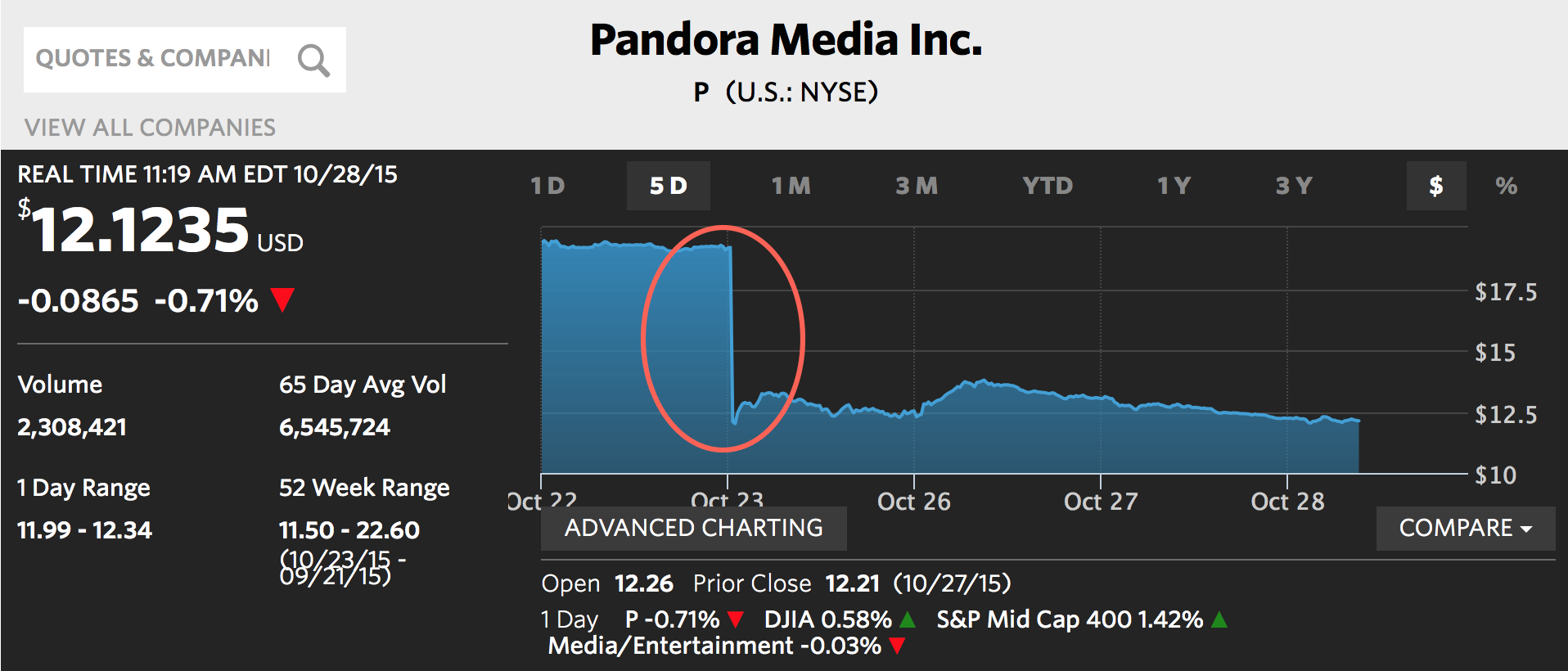
Why did it happen?  Partly due to the sharp drop in Pandora stock after investors began to realize that Apple Music had made significant gains against “free music” services like Pandora and Spotify that survive on advertising often served by Spotify board member Google.

This is to be expected–even Google’s legendary ability to suppress news about its interests that it doesn’t like cannot break through this:

Pandora Stock Drop Pandora Media, Inc., from Wall Street Journal

We can understand how a public company’s stock…

View original post 265 more words

The Global Database Fallacy: Disdain for Rights + Numerosity + Secrecy = Steroidal Black Box

Music Technology Policy

You’ve probably heard a lot about the gut wrenching need for a “global rights database” because “music licensing is broken”.  It sounds like of like a political campaign advertisement, right?

Music licensing is broken

Let’s drain the swamp

And protect the future for our children

Let’s get something straight at the outset:  This “if we only had a database” jive is the grand deflection at work.  You see it coming from a number of places all at once which is a bit of a head scratcher.  I think that having a global rights database will do absolutely nothing to fix what is looking more and more like a totally predictable and massive black box of earned but unpaid royalties at streaming services (other than Apple).  Which is why streaming services are trying so hard to get you to “look ovah theah” with the light touch of a James Carville (a…

View original post 1,612 more words

Smoking Gun? Spotify “Accrued Fees To Copyright Holders” Now at 146 Million

Spotify Royalty Liabilities

As the unlicensed unpaid song fiasco with Victory Records indicated last week, and as I illustrated with my own catalogue in July,  Spotify and other streaming services have a serious problem with unpaid and unlicensed songs.

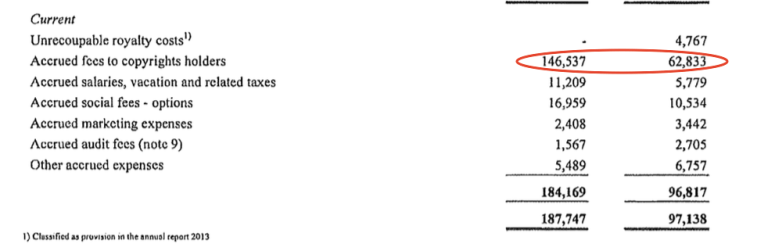
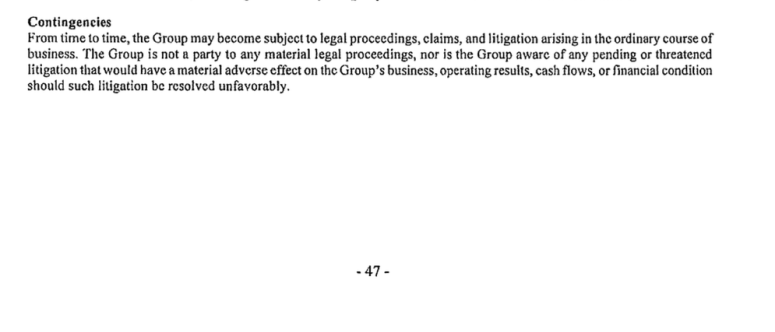
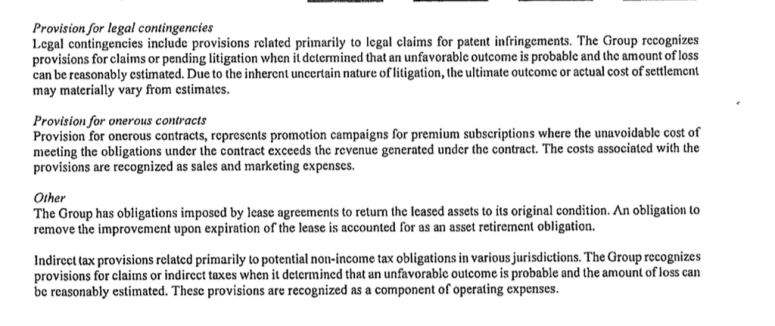
Estimates on the amount of unpaid royalties range from $50$150 million dollars.  A source just provided us with a copy of the 2014 financial statements for Spotify and this shows that Spotify lists under current liabilities $146 million in “Accrued Fees To Copyright Holders.”   A certain amount is expected, as any service accrues royalties to copyright owners but doesn’t pay them immediately.  However you would think this amount as a percentage of overall revenue would remain the same, right?   But as noted below this liability category increased from 8% of revenues in 2013 to 13% in 2015.   Or looked at another way Spotify’s growth was 144% but “Accrued Fees to Copyright Holders” increased 233%!     There are all sorts of reasons that this non-linear relationship between revenue and unpaid fees exists,including the fact our sample size is 2 and easily represents noise!  But it is certainly an intriguing fact.  And if there are tens of millions in songwriters royalties hiding in the balance sheet?  This is where they are hiding.   Spotify could of course clear this up.  Unfortunately as far as I can tell it is not broken out in the balance sheet nor is it listed as a contingency/contingent liability.

Screen Shot 2015-10-25 at 5.12.13 PM

Screen Shot 2015-10-24 at 9.35.28 PM

Screen Shot 2015-10-24 at 9.31.52 PM


Turnabout is Fair Play: $100 Million Dollars in Unpaid/Unlicensed Spotify Songwriter Royalties Demands Investigation

Spotify’s $100 Million Problem
Billboard magazine estimates that Spotify and other streaming services have as much as $100 million dollars in unpaid songwriter royalties and documents provided to us confirm that Spotify had more than $140 million in “unpaid fees to copyright owners” at the end of 2014.  While these kind of “unmatched” and unpaid balances are a long standing problem throughout the music business,  Spotify’s unpaid royalties are different because it appears to be the result of not having licenses for these songs.  If true this means Spotify broke the law. As I reported last week this appears to be the case with a large portion of my own song catalogue being unlicensed by Spotify. Victory records also reported that its entire song catalogue was unlicensed by Spotify and Spotify subsequently yanked their entire catalogue.  Here is Spotify’s head of global communications and policy seemingly admitting this in an email to The Wall Street Journal:

“We want to pay every penny, but we need to know who(sic) to pay,” Spotify spokesman Jonathan Prince said in an email.

If Spotify does not “know who(sic) to pay” that means they have never bothered to license the songs.  You see in order to be fully licensed Spotify would have to enter into a direct licensing agreement with every songwriters’ publishing company or exercise the federal compulsory license which also requires notifying the songwriters’ publishing company 30 days in advance of use of the song.  In advance! Not after the song accrued royalties.   The reason the law is written this way is it forces the streaming service to gather contact information from songwriters and publishers in advance so they “know who to pay” and don’t accrue unpaid royalties.   This is explicitly and precisely the intent of the law and why  the register of copyrights Marybeth Peters recommended keeping in place this licensing requirement in her strangely prescient 2004 statement to House Judiciary Committee:

“The problems might be only deferred rather than avoided because the licensee would still have to identify and locate the copyright owner in order to pay royalties to the proper person…”

Is this a Crime?

I am not an attorney, but it is clear that at the very least using unlicensed songs is copyright infringement.  The NMPA has stated that up to 25% of the royalties are not making it from streaming services to songwriters.  As noted above the only way this happens is if you have a large pool of unlicensed songs at the streaming services.  This would seem to qualify this as mass copyright infringement and my understanding is this is potentially a RICO predicate.  Spotify may have also run afoul of many other state and federal laws in the process.  As I noted last week virtually every state has unclaimed property laws that could apply to this situation. Certainly NY State AG office has forced companies holding unpaid royalties (including major record labels) to pay these out under abandoned property laws. There is also the matter of Spotify’s fiduciary responsibilities to investors.  The $100 million question in this case is this:

Has Spotify disclosed to it’s investors in a timely manner that it has a large pool of unlicensed songs and unpaid royalties?

This by law should be disclosed  in their financial statements to investors.  First the actual amount of unpaid royalties  should appear in financial statement as a current liability since these royalties are immediately payable. Second since Spotify is now aware it may be distributing a large pool of unlicensed songs, it is also aware that there is the potential for large court awarded damages or private settlements. In other words there is high likely hood of pending lawsuit or settlement.  Billboard reports that Spotify is already in settlement talks with the NMPA.  Has Spotify disclosed this to investors?

I’m not an expert on corporate accounting but if it’s true that the accrued unpaid and unmatched royalties are now $100 million, that didn’t just start last quarter.  It seems likely to me that this is a material issue that someone knew about before Spotify filed their 2014 financial statements.  Did they disclose this then?  For more on the importance of reporting contingent liabilities see  Motley Fool’s simplified explanation of GAAP rules on contingent liabilities here.

Certainly before Spotify files for an IPO or goes into another round of fundraising the unlicensed songs must be fully disclosed to the public.  (Why doesn’t Spotify set up a wikileaks type searchable database so songwriters can search for their songs.  The major labels were required years ago to do something similar by New York Attorney General).

It should be noted that civil and criminal charges may also apply to not just Spotify and it’s officers  but also to its public accounting firm Ernst and Young that audited and then certified financial statements to investors.  In the Enron collapse investors sued Enron’s audit CPA firm Arthur Andersen.  As a result Arthur Andersen lost their CPA license and went out of business.   And yes the possibly of third party liability also  applies to The Harry Fox Agency which appears to have been hired by Spotify to license songs and distribute royalties. But (for the moment) chasing HFA is a red herring, because  ultimately it is Spotify’s legal responsibility that those licenses are obtained and royalties are paid.

Finally as Spotify is a global firm with headquarters  in Luxembourg, any accounting irregularities, or failure to disclose contingent liabilities as described could trigger legal action in the EU or member countries. And certainly EU laws governing financial disclosure are much tougher than US laws.

Spotify screenshot

Should DOJ, FTC, Congress, NY State and EU Investigate. 

Yes, Yes, Yes, Yes and Yes.  Why?

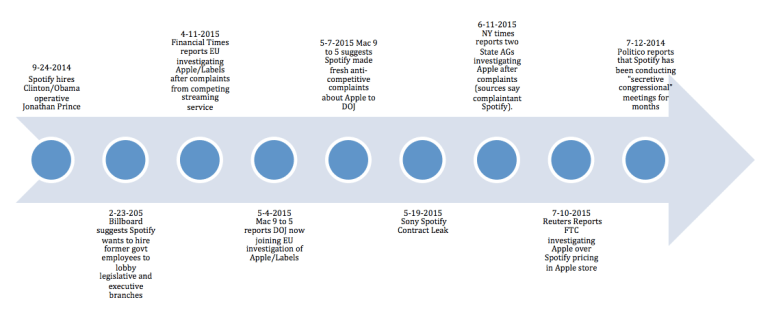
The DOJ, FTC, NY State and EU have all launched investigations into anti-competitive practices by Apple music and the major record labels/publishers.  Our sources tell us that in three of those cases the complainant was Spotify.  The “temporary” 70 year old  DOJ anti-competitive consent decrees that severely limit songwriters ability to negotiate also benefits Spotify.  So clearly the DOJ, FTC, NY State and EU believe that anti-competitive practices in the digital music business warrant investigation.  So I ask this:

What could possibly be more anti-competitive than one market dominant streaming service (Spotify) operating with the advantage of a large pool of unlicensed songs while its competitor (Apple) seems to license them all?

I realize that what I’m saying also applies to YouTube.  But we all know why YouTube/Google will never be properly investigated by the executive branch. Here, here, here, here, here and here.   That’s why people go to EU to get justice on Google.  The question is this: does Spotify enjoy the same level of protection?

It certainly appears that way.

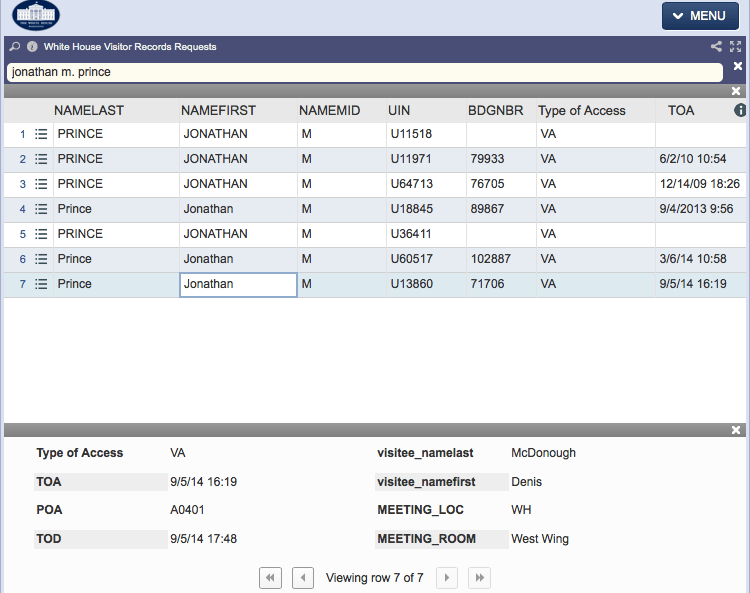
The above timeline suggests Spotify began conducting “lawfare” against Apple and major labels shortly after it hired former Obama and Hillary Clinton aide Jonathan Prince.  (Prince is connected enough to get a 90 minute meeting with Denis McDonough White House Chief of Staff at 4:00 pm on a Friday afternoon-see White House visitors log below.) Each of these investigations appears designed to preserve the free tier of Spotify’s streaming service which has come under scrutiny by artist and labels for meager payouts.  Labels, performers and songwriters object to the free tier because it pays 1/7th  per spin when compared to the $9.99 a month subscription tier.

Although the free tier makes less money per user than the subscription tier, a Spotify IPO is likely to value the service on the number of users, not revenue.   Thus CEO Daniel Ek and Spotify’s Silicon Valley VC backers are highly incentivized to build a bigger money losing company through free streaming than a smaller company through higher sustainable subscription revenue.


White House Visits


But ultimately this anti-trust/unfair competition push by Spotify is a head scratcher. Spotify’s rumored complaints seem absurd*:

  1. The dominant streaming service Spotify (50%+ global market share) is complaining that a smaller higher priced competitor (Apple Music) somehow has an unfair advantage?
  2. It is anti-competitive for record labels and performers to favor subscription services like Apple that pay a higher fee? In essence Spotify demands government agencies repeal capitalism.
  3. Apple has payment information on over 200 million consumers because it sells things.  Spotify does not because it decided to mostly provide its product for free, an email address or FaceBook account is all it requires.   Governments should step in to protect a shitty business model?

In other words Spotify is saying:

“In order to save competition we have to destroy competition”

Now if the government absolutely insists it wants to get involved in the digital music business,  they need to do it for the right reasons. The right reasons are things like protection of property rights,  unlawful activity and market failures.  When it is credibly reported that a music streaming services is: operating with perhaps 25% of revenues to songwriters going unpaid; entire catalogues of songs are unlicensed;  holding $100 million in unpaid royalties; and may not have not properly disclosed material financial concerns to investors? It is time to investigate.

Besides, turnabout is fair play

++++++++++++++++++++++++++++++++++++++++++

*We really should know the nature of these complaints.  It’s absurd that it is a secret.  I have been researching a related matter at University of Georgia and I submitted a FOIA request to the FTC and FOIL request to the NY State AG office on certain details of this investigation but the requests were denied.  I plan to appeal the decisions as there is no reason to not release this information as it appears the main complainant (Spotify) has clearly been running its mouth to reporters.  Ergo, it is clearly not a secret!  The release of this information would only enhance the public understanding of the operation of government institutions which is the purpose of these laws. Further open government is foundational to a properly functioning democracy otherwise citizens begin to doubt the fairness of the system. Just saying.