A Compromise Proposal to Fix Streaming Royalties,Licensing and Notification

I have a feeling I’m about to wander off the reservation here.

I say this because what I’m about to propose is essentially a modification of a potential legislative proposal that rumor has it the NMPA is floating.  That proposal seems to be generating some negative backlash in songwriter/publisher community (whether it deserves it or not.)  Also, it will at first seem to go against some of my long held principles on market pricing,  “orphan works” type proposals and the establishment of any further federal copyright exemptions and safe harbors.  So hear me out while I make the case for a win-win compromise.

What is it that digital services want?

Digital services have two major issues with the current law and regulations on “streaming mechanicals,” those small royalties paid to songwriters and publishers on each stream of a song.

Interactive streaming services get a federal “compulsory license” to use any songwriter’s work on their services as long as they follow a relatively simple procedure (with some exclusions).   A pre-condition to services using this protocol is that the law requires them to send a “Notice of Intent” (NOI) to owner or agent for owner of the song.  The NOI is intended to make sure the songwriter knows their song is being used, and the service must demonstrate that it knows who to pay.

Implicit in the logic of the law and the related regulations is that the federal government did not want the interactive streaming services building up a black box of “unmatched” songwriter royalties.   Nor does the law necessarily require that the streaming services would have access to every single song in existence.

However, commercial pressures, coddling from music distributors and lax enforcement of songwriters’ rights (until the recent class action lawsuits), has encouraged these services to use as many songs as possible with full knowledge that they didn’t have licenses for every song and were thus committing mass copyright infringement. Streaming services literally very likely have billions of dollars in willful copyright infringement liabilities on their books whether or not they acknowledge the liability on their books or to their shareholders.

In order to extricate themselves from this situation, I hear that interactive streaming services have generally proposed three key solutions that can be generalized as follows. (See Spotify comment to Copyright Office).

  1. A global rights database with information on every song ever written.
  2. A “safe harbor” or “grace period” that allows services to use songs when they can’t find the owners of the works in this global rights database.
  3. A webcasting style NOI process (like Section 114), whereby each streaming service notifies the copyright office of their intention to stream music.  They don’t have to hunt down every single songwriter.

Does this seem reasonable? Let’s dig into the details and look at the problems.

Songwriters’ objections to these proposals

The first objection from songwriters goes something like this.  Interactive streaming services knew the law before they got into the streaming business.   Some of them (like Google) bought companies with song data (like Rightsflow) or developed their own (like YouTube’s Content Management System).

There is a real moral hazard in rewarding services’ bad behavior by forcing songwriters to do the heavy lifting on a rights database and then granting the offending party a very valuable safe harbor.  In the view of most songwriters, we are the ones being abused and are the ones deserving of concessions.

The second objection is painfully obvious to songwriters, but seems to be totally lost on the streaming services, academics and many in the music industry:  An up to date global registry of  all songs is impossible.  Last I checked 75,000 new albums were released every year in the United States.  It’s likely that hundreds of thousands if not millions of new works are created every year worldwide.  How many a day?  An hour?  It’s really great that the NMPA may “certify” the database but there’s really no need for their members to indemnify services that could easily have done the research themselves.

Consider also the spontaneous, informal and collaborative nature of all songwriting.  Many new works are created by aspiring non-professionals with little knowledge of publishing rights.  How on earth do you ever get this ownership and songwriting splits into a database in a timely fashion?  Certainly there is ownership registration software that works with music creating production programs that is beginning to capture more of this information, but it will never capture all of it.  So why would the government want to punish this creativity by making sure it is uncompensated through yet another safe harbor?

As a result of the inevitable incomplete nature of the database, it will never fix the problem it is designed to fix.  There will still be mass infringement of works by streaming services and they will be vulnerable to more lawsuits. This is especially true for new works, niche works, and works containing samples.   For this very reason there is a sneaking suspicion among songwriters that streaming services are aware of this problem and are simply using the lack of a unicorn database as a delaying tactic.  Further you don’t have to put on a tin foil hat to realize that an incomplete global database is just gonna create a bigger black box of unpaid royalties that someone other than the songwriter will get to keep.

Finally–safe harbors have been a disaster for songwriters and performers.   The biggest music streaming service in the world is YouTube.   YouTube is by a far the worst paying streaming services. This is precisely because the DMCA safe harbor allows them to operate like a mob protection racket: “Some nice songs you got there, sign this usurious contract, cause we’d hate to see our users upload your songs, and then you don’t get any royalties.”

Another safe harbor for streaming services?  No thanks.

If the management at these streaming services were truly exercising their fiduciary responsibility to their own shareholders they would be OPPOSED to YouTube/Google’s extra-legal interpretation of the DMCA safe harbor.   How will any of these streaming services achieve profitability when they have to (unfairly) compete with YouTube/Google.

This is an area where the interests of songwriters and interactive streaming services are aligned.  If streaming services took the long view, they would join songwriters in demanding congress/FTC/DOJ force YouTube/Google to end this shakedown practice. They wouldn’t demand their own safe harbor. Another safe harbor just invites a new round of lawsuits, political cronyism and abuse.

What do songwriters want? 

Songwriters wants are simple: fair pay and control of their works.  That’s pretty much what any property owner wants.

When it comes to streaming services it generally implies two things,

  1. Higher royalties; and
  2. A right for the songwriter to withdraw their songs from digital services that pay too little.

As it stands performers and labels have the right to NOT license their work to interactive services if they don’t like the terms of direct licenses.  In contrast songwriters have no right to withdraw their works from compulsory licenses.  Further the federal government caps songwriters share of streaming revenues at 10.5%.

You think the minimum wage sucks?  Try working under a maximum wage.

This is patently absurd if you think about it.   Would the federal government mandate that all bands sell their t-shirts for $5?   Would the federal government mandate that Whole Foods cap pay to their employees at 10.5%  pro-rata share of their gross revenues?  Fundamentally this is an extremely regressive practice.  I find it particularly amusing that some of the strongest supporters of the regressive status quo are Congressional Democrats.

The Known Unknowns

While higher revenue and the right to withdraw a work seem pretty simple on the surface, closer inspection reveals problems.

Raise songwriters royalties how high?  What is fair compensation when there has never been a free market for mechanicals royalties.  From 1909 to 1976 the statutory mechanical royalty for phonographs was stuck at 2 cents a copy.  This wage and price control has cast a long dark depressive shadow on all mechanical rate setting proceedings after 1976.

But it goes deeper than that. Should all songs and songwriters receive the same rate per spin? Always?   Do individual songwriters value each of their own songs the same? Do consumers place the same value on each song?  How about streaming services? Do they value songs by certain artists over others? Why are songs treated as a commodity like light Brent crude or pork bellies?

My guilty pleasure is Taylor Swift’s “Shake it Off.”  I paid $1.29 for the song. I thought my band Camper Van Beethoven should cover it. Would I have paid $5.99?  Probably not (I’d have streamed it on YouTube). Would I pay $5.99 a song for an unreleased Captain Beefheart song?  Probably. Would I pay $50 dollars for a sequel to Sleep’s Dopesmoker?  I don’t know.  Maybe.  But the compulsory license mandates flat rate pricing.

Economists generally agree that flat pricing is wasteful practice.   Flat price streaming  (both rates to songwriters and consumer) is a kind of POTS economics in an Ebay world.    Companies as diverse as Amazon and Delta Airlines employ dynamic pricing algorithms that change prices instantaneously.  Why can’t songwriters have more control over the pricing of their work? Why is the music business stuck with a 1970s Columbia House Record Club model? “Get 19 albums for a dollar, when you sign up for a year!’  I’m pretty sure we can do better than that.

Second complication,  if a songwriter wishes to withdraw their catalogue (or a work)  from a federal compulsory license, who do they notify?   Is the withdrawal immediate?  Do they need to notify every service?  Do they notify the Copyright Office?    Aren’t we back to the same impossible database problem explored in the previous section?

No. A database of songs or songwriter/publishers who have “opted out” would be smaller.  Sure it would be a dynamic database, but if the right to opt out is contingent on registration with a public database, it would by definition be 100% accurate.  Especially since songwriters recapture a valuable right by doing so.  This is a real incentive,  (unlike this proposal which seeks to “punish” rights holders by withholding puny streaming royalty checks that aren’t simply worth going to the bank to cash).

The compromise

The idea of this compromise is that we are fundamentally flummoxed by the question “What is this song worth?”  So if we are going to come out of our trenches and try to reach a compromise we must set up a mechanism that helps us discover the answer to the question.   Keep in mind there is not a positivist answer to this question.  It is constructivist by nature.  The answer is whatever the participants agree is fair.  As Ari Emmanuel once said, “Fair is where we end up.”  It is whatever the licensor and licensee deem fair on that day at that time.

Let me say right at the start that no one is gonna be completely happy with this solution.  There are elements here to which I would normally be ideologically opposed.

This compromise is largely based on something called Extended Collective Licensing that is used in some Nordic countries. Other elements are pulled from proposals the NMPA seems to be floating.  This is an extremely rough draft, and I’m making substantial concessions to streaming services, not because I necessarily want to give them concessions,  but because this is what I think an acceptable  compromise would look like

Anyone with a valid compulsory license gets to keep it (although the “address unknown” mass NOIs have to be dealt with separately). Going forward for new licenses and works:

  1. Do away with the 115 NOI system for streaming mechanicals.
  2. Establish a quasi governmental body like SoundExchange to license and administer a compulsory streaming mechanical. The CRB would continue to set rates. But this should eventually sunset. For simplicity sake let’s call this entity SongExchange.
  3. However songwriters/publishers could serve notices and opt out songs or catalogue from SongExchange and the compulsory license.
  4. In order to exercise this right all songwriters and publishers would have to agree before opting out,
  5. Substantial advance notice must be given to SongExchange and streaming services.
  6. A necessary condition of opting out of SongExchange would be to register in a machine readable public database and opt out information once registered must be kept current.
  7. This database will belong to the public and shall not be privatized.
  8. If the owner of the song fails to keep information current it reverts back to SongExchange for administration.
  9. SongExchange would administer the database and administrative fees would be split between songwriters and services.
  10. Opted out songs could be directly administered by owners or assigned to third parties for “extended” collective negotiation.
  11. Songwriters/publishers may form new non-profits or co-ops to administer these rights.
  12. Alternately songwriters/publishers may assign these rights to the existing non-profit PROs, ASCAP and BMI.  The DOJ consent decrees should be modified or dropped in order to make this possible.
  13. Songwriters/Publishers may assign these rights to private PROs like SESAC or GMR.
  14.  Like labor unions, professional sports leagues and farm co-ops, these third parties should be given explicit exemption from the Sherman act and other anti-trust restrictions.
  15. The CRB must be allowed to consider as evidence rates set by songwriters and composers that opted out of the SongExchange (“race to the middle”)
  16. SongExchange must hire an independent 3rd party to conduct a royalty compliance examination of the services and the services must accept those audits, and any group of songwriters can conduct a group audit under the same conditions.
  17. SongExchange may impose penalties on services that have excessive unmatched and unidentified compositions. These penalties may be used for overhead.
  18. SongExchange will hold unclaimed royalties for a period of three years. Song Exchange will post a list of unclaimed works.  After three years the unclaimed royalties are transferred to the applicable Secretary of State as unclaimed property to be held as other unclaimed property (like unclaimed utility deposits or bank accounts).

This proposal is obviously disruptive to the status quo.  I’m not opposed to phasing it in over a few years. Here’s what I think this proposal does that is not possible in the current system:

  1. It simplifies the licensing of songs by eliminating the per-song NOI system;
  2. Provides an accurate database to assist in licensing songs;
  3. Is pro-competitive and eliminates need for ATR supervision;
  4. Allows true price discovery;
  5. Encourages competition among rights holders and third party licensing authorities; and
  6. Allows songwriters to collectively bargain if they wish.

It should also be added, that unlike any other proposal offered so far, this is the only proposal that can achieve a 100% licensing rate by streaming services.  All other proposals  (even those floated by the streaming services themselves) would leave streaming services open to copyright infringement lawsuits.

Spotify’s $600 Million Loss, Currency Risk and What it Means for Artists

Stuart Dredge over at Music Ally is reporting Spotify’s losses widened to $600 million last year.   Read his article here.

I just wanted to point out that some significant portion of these widening losses are due to currency swings.   March 29th 2016 Spotify announced a $1 billion US denominated convertible debt deal with TPG and others.  Since that time the US dollar has risen considerably against most currencies.  A disproportionate share of Spotify’s income is NOT in US Dollars.  Therefore the vig on that convertible debt is now headed towards payday loan rates. Ouch!

This is good news and bad news for artists.

The good news is this may force Spotify to limit the free tier and convert more US subscribers to premium.  They need more US dollar income to stop the hemorrhaging from the US debt!  Remember artists’ royalties from premium subscribers are 8-10 times higher than free listeners.  More premium subscribers is a good thing for artists.

The bad news is Spotify has already indicated they want to pay lower royalties to artists because they are losing so much money.  This is completely fucked up. It’s not our fault the company is so poorly managed.

Artists and labels should stand strong and not give in to Spotify’s demands.  Make the bondholders/shareholders get the expenses and management under control. Or eat the losses.

Not our problem!


Is Spotify Kicking STIM the Dog?

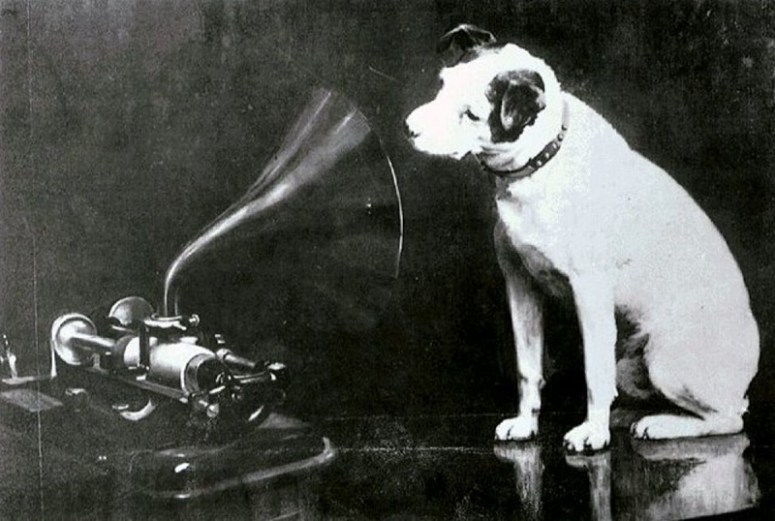
Nipper says” WTF Spotify?” Is kicking songwriters in Spotify’s corporate DNA? 

For those of you not familiar with this expression, “kicking the dog” is when some does something bad to you, and you in turn do something bad to someone weaker than you.

We call your attention to this odd dispute in Sweden between Spotify and STIM which is the Swedish performing rights organization for songwriters.   Spotify has for the second time decided to delay payments to Swedish songwriters because they have “unmatched” tracks.   Generally unmatched performing rights royalties get paid to the societies anyway, and then the society sorts out who is to be paid.  We are completely puzzled as to why Spotify would take on this extra burden when they are not required to.   Performing rights are easy.   This is in marked contrast to mechanical royalties in US, in which the burden (by law) falls on the service to sort out unmatched royalties.

Coming on the heels of a stinging $45 million (plus) loss to songwriters in the US, specifically over the mechanical royalties,  this feels like Spotify kicking the dog.  Especially since the dispute is specifically over “unmatched recordings.”

Read Stuart Dredge’s excellent piece in Music Ally:

The relationship of Spotify and Swedish collecting society STIM has encountered a bump in the road, relating to the terms of their royalties agreement.

“We have informed our rightsholders that the royalties from Spotify will be delayed, since Spotify has not yet payed the invoice regarding Q4 2016,” STIM’s spokesperson told Music Ally.

“We have invoiced according to the same routines as during the whole of 2016, but Spotify now makes a new interpretation of the terms of our current agreement. STIM’s position is that already agreed principles and business standards shall apply.”

STIM Spotify royalty payouts delayed after ‘unmatched tracks’ dispute


@YouTube Still Hosts ISIS National Anthem: Tell your record company pull videos

It’s not just that YouTube hosts the ISIS national anthem. The comments sections on many of these jihadi nasheeds appear to be used to recruit, radicalize and otherwise support terror. Look for yourself. We have been pointing this out for years. YouTube have long been aware of the problem. 

 We noted here previously that in addition to hosting the videos, YouTube was profiting by often serving advertising on this heinous “content.”  Since the revenues are shared with channel hosts it’s likely YouTube is violating anti-terror funding laws. 

How many people have to die before YouTube does the right thing?  

No more profile pic changes

No more prayers, “thoughts” and expressions of solidarity with victims. 

Let’s actually do something tangible. 

Three things need to happen.

1) Artists and other creators should pull videos from YouTube for enabling radicalization and terror

2) Advertisers should pull all advertising from  YouTube

3) UK and US governments should arrest top Google executives for supporting terror.  In the past they have clearly violated  these laws. No statute of limitations on terror! 

Seeing one of their peers in handcuffs, might finally get the social media robber barons to do something about it this time. 

@ALA Libraries (Again) Enable Apparent Corporate Lawfare Conspiracy Against Authors, Artists and Songwriters

Does ALA counsel Jonathan Band really have libraries best interests at heart.  Or is he more interested in helping Silicon Valley in its war on the individual rights of authors. 

If you haven’t heard the “used” digital file platform ReDigi case is back.   The case rests on the question of whether consumers have the right to sell a digital copy of a file, as long as they delete the old one.    ReDigi supporters argue that it’s no different from selling a used paperback book or CD.  And in the  tl/dr world of digital punditry that probably sounds pretty compelling.  Just add the American Library Association support to your argument and you’ve got a rancid pseudo-intellectual veneer of legitimacy.  Enough so that say that  law professors at insular institutions like Harvard or Stanford can claim there is some legitimate question of the law here.

There isn’t.

Read David Newhoff’s excellent analysis of the case here and here.

ReDigi’s arguments were soundly rejected by Judge Sullivan:

At base, ReDigi seeks judicial amendment of the Copyright Act to reach its desired policy outcome. However, “[s]ound policy, as well as history, supports [the Court’s] consistent deference to Congress when major technological innovations alter the market for copyrighted materials. Congress has the constitutional authority and the institutional ability to accommodate fully the varied permutations of competing interests that are inevitably implicated by such new technology.” Sony, 464 U.S. at 431, 104 S.Ct. 774. Such defence often counsels for a limited interpretation of copyright protection. However, here, the Court cannot of its own accord condone the wholesale application of the first sale defense to the digital sphere, particularly when Congress itself has declined to take that step. Accordingly, and for the reasons stated above, the Court GRANTS Capitol’s motion for summary judgment on its claims for ReDigi’s direct, 661*661contributory, and vicarious infringement of its distribution and reproduction rights. The Court also DENIES ReDigi’s motion in its entirety.

So why is this case proceeding? I mean digital downloads are dying and being rapidly replaced with music streaming.  This firm does not have a viable business model going forward.  And surely the backers of this company know it.  What is the point of appealing?

I believe there is only one reason this case is being reasserted:   This is simply more lawfare by Silicon Valley aligned groups against the individual rights of creators*.   It only makes sense as a strategic move to weaken creators rights organizations and associated trade groups by forcing us to deploy our limited resources fighting this absurd case.

The ALA has no compelling interest in this case despite what the ALA’s  DC gollums may argue. In fact it is a strategic mistake.

First, purely on a PR level it undermines libraries broad support by authors.  I don’t understand why in this age of shrinking budgets and growing irrelevance of libraries that the ALA continues to wage war on authors and other creators? (I count more than a dozen amicus briefs in which ALA or the related LCA  has sided with Silicon Valley interests against creators). I can’t imagine libraries have many allies anymore.

Second, it casts libraries’ lot in with the shyster capitalists of Silicon Valley.  By tying the exemptions granted for libraries under the copyright act (happily granted by authors I might add),  to imagined loopholes viscously  exploited by tech firms,  it begs the question:  Why should libraries be treated any differently than say Google?

Librarians should remember this.  Unlike the rest of the industrialized world, US libraries do not pay a public “lending royalty” to authors.  This is a profound “give” to public and academic libraries by authors.  IMHO if libraries continue to play “hardball” and  support the rapacious behavior of tech firms and VCs,  we should do the same and withdraw our support for the exemptions that libraries take advantage of and demand they pay lending royalties to authors.

So rank and file librarians should ask their public policy apparatchiks “what is the game plan is here?”

When NPR cast their lot with corporate giants like Google and ClearChannel and joined the Mic-Coaliton.org in an effort to reduce royalties to performers and songwriters the backlash was huge.    We crushed them (with tactics like this) and they had to eventually withdraw from the alliance.     It’s a little weird that say UVA pays it top librarian $325,000 a year, but UVA public policy  seems happy to see authors and songwriters stiffed.   Just saying…

*We would like to point out for the 157th time, that groups do not have rights.  Under our constitution rights are vested in the individual.  The ALA and it’s allies is arguing that “consumers” a group have rights, that can violate the constitutional rights of individuals.


Here it Comes: Another Safe Harbor For Digital Services

Think of the damage that Google has been able to do to artists’ income with the DMCA safe harbor and YouTube.   The DMCA safe harbor means that artists have to play an endless game of  Whac-A-Mole with the second largest corporation on the planet,  or take the shitty music licensing deal they offer.  A textbook case of market failure.

And really the other streaming services should object to  YouTube’s abuse of the DMCA takedown process because it makes it near impossible for them to fairly compete.  Why pay for Spotify premium when you can get  all the  same music for free on YouTube? Again another market failure.  I’m positive the authors of the 1998 copyright legislation did not intend for companies like Google to build an interactive music streaming service on the safe harbor protections.

So after 2 decades of living with the DMCA safe harbors, every rightsholder, performer or songwriter will tell you the same thing.  The DMCA safe harbor needs to be fixed.  Anyone that knows anything about music licensing would NOT propose another safe harbor.

Yet this looks like it’s being seriously floated. The video above is from a Technology Policy Institute panel at NYU.  Starting at 10:15 Professor Lawrence  White proposes a new safe harbor for streaming services.   It’s important to note that White is sitting between two of the four horsemen of the songpocalypse (Sirius and Jim Griffin).  This is clearly a harbinger.  The idea is that if a streaming service makes a “good faith effort” to find a song and they can’t find the owner they don’t have to pay. In the world this professor lives in (not ours) the new safe harbor thus “incentivizes” songwriters to build a global all-encompassing database in order to get paid.

Neat, except…what the professor (and to be fair most music licensing lawyers and policy wonks) don’t understand is there is no incentive to register precisely because the royalty is too low!   Would you spend 20 minutes registering something in some wonky database if it meant you’d get $1.08 check 2 years from now? There is an entire generation of musicians that have given up on registering music or collecting royalties because it’s not worth the hassle.  Second no database would ever be fully up to date anyway.   New songs are written every day.  Songs and catalogues change ownership.  This perfect database will never exist.   The services will just legally keep all the “unmatched” royalties.  They will have a financial incentive to NOT find the owners.

Curiously White has an interesting paper on creating more competition in music licensing.  But after watching this, if he’s pro-competitive, as he claims, it’s a funny kind of pro-competitive.  Competition requires regulatory “space” not further narrowing of the songwriters ability to negotiate. Adding new federal safe harbors or expanding compulsory licenses for the use of music further reduces competition.

Rarely noted is that we have exactly the same problem on the other end of the compulsory license. By federal statute all streaming services have access to exactly the same composition repertoire. Federal regulations force them all to function in much the same manner.  They all have the same royalty expense structure. They charge the same subscription rates etc.

How do they distinguish themselves?

They don’t. And once one music service becomes dominant all competition will fade away.  There is no way for a competitor to innovate and displace the dominant service. So why bother?

I guess I’m not NYU-educated enough to understand how adding more mandates to the swamp of federal music licensing regulations “drains the swamp” and creates competition.  To me this looks like another handout to Silicon Valley billionaires and the VCs that back these services.


If Only Artists and Managers Had Listened To Us : Spotify Per Stream Rates Keep Dropping

We hate to say we told ya so, but… Below is our post from September 2015. Two years ago we predicted the inevitable truth of the all you can eat Spotify subcription model. Like many of our predictions and proposals (example; windowing titles) we’ve had to wait for the industry to catch up to us. Today, two years later, Digital Music News confirms our prediction.

Read the report from Digital Music News by clicking the headline link here.

Exclusive Report: Spotify Artist Payments Are Declining In 2017, Data Shows | Digital Music News

Our original post from 2015 is below…


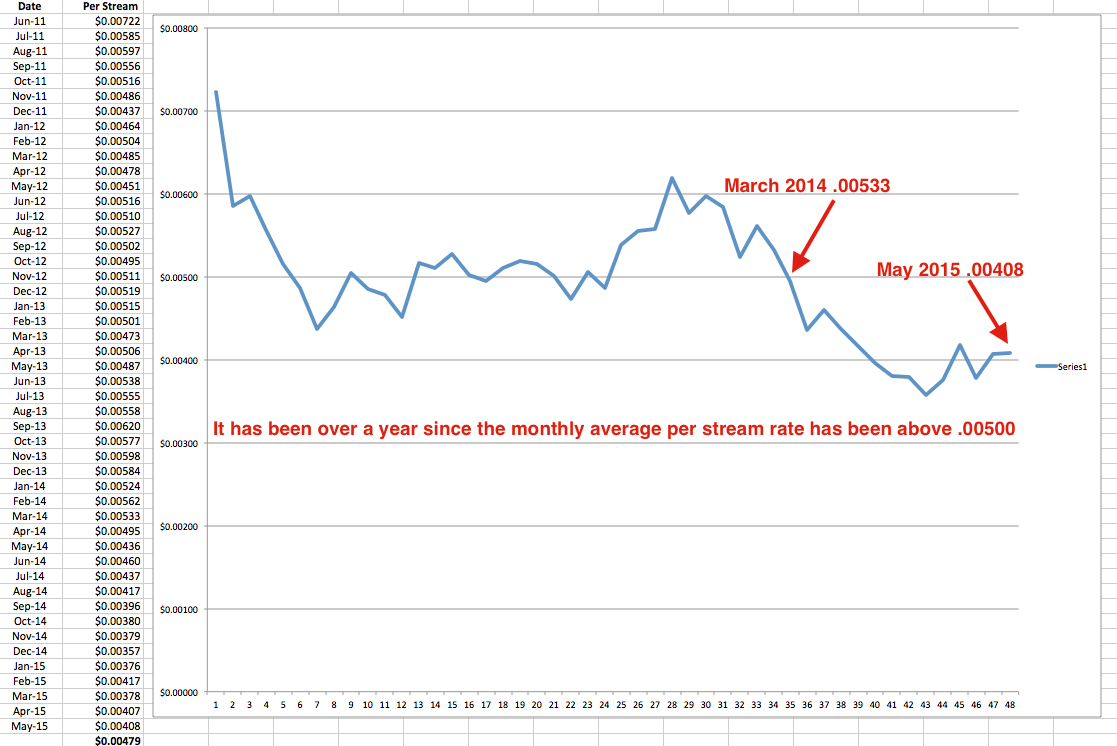
Spotify Per Play Rates Continue to Drop (.00408) … More Free Users = Less Money Per Stream #gettherateright

Down, down, down it goes, where it stops nobody knows… The monthly average rate per play on Spotify is currently .00408 for master rights holders.

PerStreamAvg_Jun11_July15

48 Months of Spotify Streaming Rates from Jun 2011 thru May 2015 on an indie label catalog of over 1,500 songs with over 10m plays.

Spotify rates per spin appear to have peaked and are now on a steady decline over time.

Per stream rates are dropping because the amount of revenue is not keeping pace with the  number of streams. There are several possible causes:

1) Advertising rates are falling as more “supply” (the number of streams) come on line and the market saturates.

2) The proportion of  lower paying “free streams”  is growing faster than the proportion of higher paying “paid streams.”

3) All of the above.

This confirms our long held suspicion that as a flat price “freemium” subscription service  scales the price per stream will drop.  As the service reaches “scale” the pool of streaming revenue becomes a fixed amount.  The pie can’t get any larger and adding more streams only cuts the pie into smaller pieces!

The data above is aggregated. In all cases the total amount of revenue is divided by the total number of the streams per service  (ex: $4,080 / 1,000,000 = .00408 per stream). Multiple tiers and pricing structures are all summed together and divided to create an averaged, single rate per play.

Five Lies In YouTube’s Spin on Content ID

This was from June of last year. But it’s as accurate as ever considering YouTube’s latest smokescreen!

Music Technology Policy

youtube-logo-parody-1

An increasing number of artists are stepping forward to condemn YouTube’s sleazy business practices ranging from YouTube’s improbable royalty payments to Google’s legacy DMCA notice and shakedown business practices.  YouTube has struck back with the usual squid ink trying to obfuscate Google’s absurdly ineffective Content ID and Content Management System (“CMS”), most recently to the New York Times.

YouTube’s theory according to the NYT is that independent artists (such as five time Grammy-winner Maria Schneider who graced our pages with her groundbreaking essay on YouTube’s sleaze) are not harmed by YouTube’s “catch me if you can” DMCA shakedown because Content ID–the principal tool that some artists and copyright owners use to block or monetize both UGC and official video assets on YouTube–is widely available.  The implication being if those pesky artists would just use the tools YouTube provides, there would be peace in the valley with sunshine and puppy dog tails…

View original post 1,812 more words

Google Fingerprints on John Oliver’s GoFCCYourself Website? Why? Also Why Are Cyber-Libertarians Bankrolling the Whole Thing?

What’s wrong with this picture?

GoFCCYourself.com is the website that John Oliver used to flood the FCC Net Neutrality consultation page  with comments.  Purportedly his action brought  the FCC website down.   Sound familiar?

I’ve registered a lot of domain names. I’ve registered many with Google domains.  I’ve never seen this.  A new website registered at exactly zero zulu time?  Right down to the second!  I went through a bunch of other domains that were listed as registered by Google Domains they appeared to reflect actual times registered to the second.

For instance  the registry for the domain http://www.GoogleDomains.com shows

Updated Date: 2017-04-10T04:00:33-0700
Creation Date: 2003-08-09T14:36:38-0700

The registry for Alphabet.xyz shows
Updated Date: 2016-02-10T09:59:37.0Z
Creation Date: 2014-12-02T14:02:50.0Z

I find this odd. This website URL thus appears to have been registered differently by Google Domains than any other registration I can find. How and why was this registered differently than other domains? Did Google help John Oliver with this?  Did they automate the timing of the registration?  Is Google involved in yet another assault on the FCC?  Is this payback for the failed “unlock the box”proposal? The enemy of my enemy?

Net Neutrality is a complex issue. Reasonable people disagree on how best to implement it.  But before we move on, let me ask you this.  Given the news coverage…  Is the FCC proposing ending net neutrality?  yes or no?   Quick! don’t think about it!

I bet you said yes.

You would be wrong.

You are purposely being misled by fake progressive astroturf groups.  This is the SOPA playbook.

In actuality the FCC is not proposing ending net neutrality but instead transferring authority over net neutrality back to the FTC, where it lived for many years.  I don’t remember my internet being broken then.  Do you?

But more importantly there are a number of complex reasons why I think that this is not necessarily a bad thing for copyright holders.  The most important reason is that the FCC has extraordinary powers and under the last FCC chairman they demonstrated their intention to essentially force compulsory licenses onto copyright holders.  Haven’t we artists, songwriters especially suffered enough under compulsory licenses?  For you civilians you’ve probably read stories about songwriters getting checks for ridiculously small amounts like  17 cents from a streaming service.  Compulsory licenses and rate setting by the federal government are the cause of that particular outrage.     No thanks, no more compulsories.

Further, you know, it’s possible to be pro-net neutrality and also be against granting the FCC extraordinary power to regulate the internet.  Right?  They are not mutually exclusive.

Now will it be better for artists if we were are not under the FCC? I can’t say for sure.

But what I CAN tell you is that a lot of people who have been on the wrong side of copyright and artists rights issues for a very, very long time are pulling out all the stops trying to keep Net Neutrality under the FCC.  For this reason alone artists and copyright holders need to be very careful here.  These assholes are up to something.

Take for instance our old friends Fight For The Future.  We have written extensively about them.  Best we can tell they are pure astroturf for silicon valley corps. And readers of this column will remember this company well,  These were the folks that “comment bombed”the Copyright office  consultation page on DMCA takedown reform.   They illegally posted 86,000 identical comments to the Copyright Office using an automated tool from a third party website.  Or in layman’s terms they attacked a government website with “a bot.”   We caught them. Nobody in the last administration had the balls to do anything about it.    See our coverage here, here, here and here.   Since that time we learned that this “progressive net rights group is heavily funded by a mysterious cyber libertarian bitcoin promoter named Andrew Lee.   Lee was also somehow  involved in Mt Gox the famous bitcoin exchange that lost hundreds of millions of dollars worth of bitcoin and then collapsed resulting in criminal charges and arrests.    Why is a “progressive” grassroots group taking money from people like this?   What is really going on here?

I doubt this is really about net neutrality and empowering the individual.  I think this is a battle between corporate proxies, and one set of mega corps wants to keep the Net Neutrality under the FCC.  Poor John Oliver and fans. They’ve been duped into being human shields for silicon valley interests.


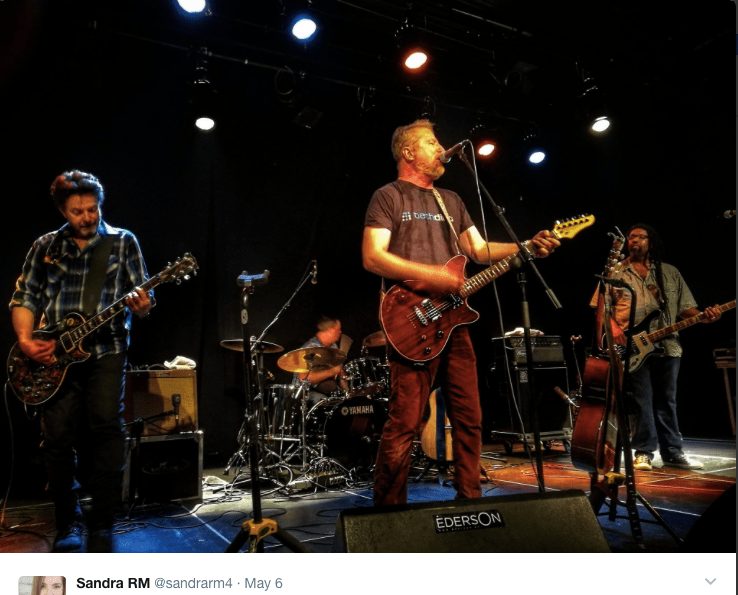
What’s the Deal with the Tech Dirt T-shirt? Protecting the 1st Amendment!


I feel that I didn’t make this clear enough at the beginning, so let me be absolutely clear.

I am wearing this Tech Dirt T-shirt on stage as much as possible because I sincerely believe that Tech Dirt and Mike Masnick are being unfairly sued.  As a blogger I’ve been on the receiving end of letters threatening legal action for simply exercising my free speech.  It without a doubt chilled my speech.  I can’t imagine what it would be like to actually be sued for millions of dollars.   I understand that it is almost comic that I am defending Tech Dirt and Masnick.  We couldn’t be more opposite on so many issues.  However this is deadly serious.  If Tech Dirt is shut down because of this lawsuit no blogger, including this blogger is safe from this sort of intimidation.  We are in 100% agreement here.

As Masnick stated in a post shortly after the suit was filed:

“So, in our view, this is not a fight about who invented email. This is a fight about whether or not our legal system will silence independent publications for publishing opinions that public figures do not like.”

You can read Mike’s detailed explanation here:

https://www.techdirt.com/articles/20170111/11440836465/techdirts-first-amendment-fight-life.shtml

How to help:

https://isupportjournalism.com