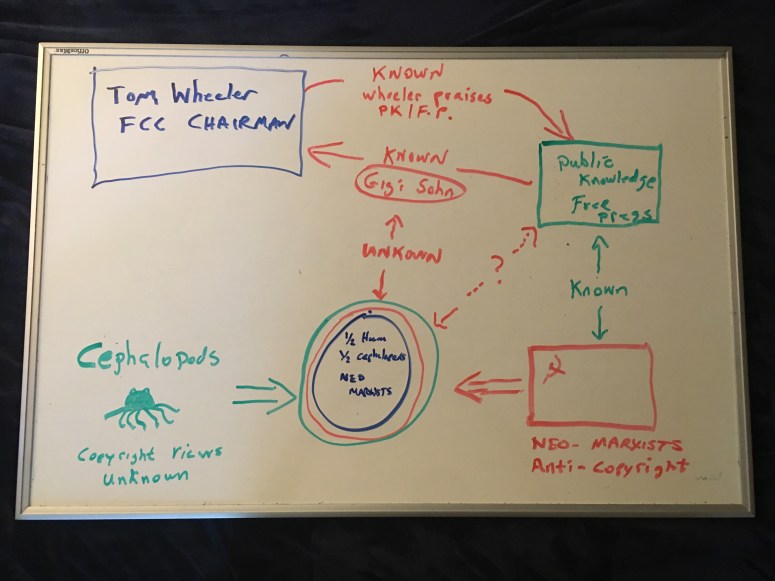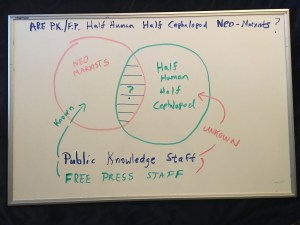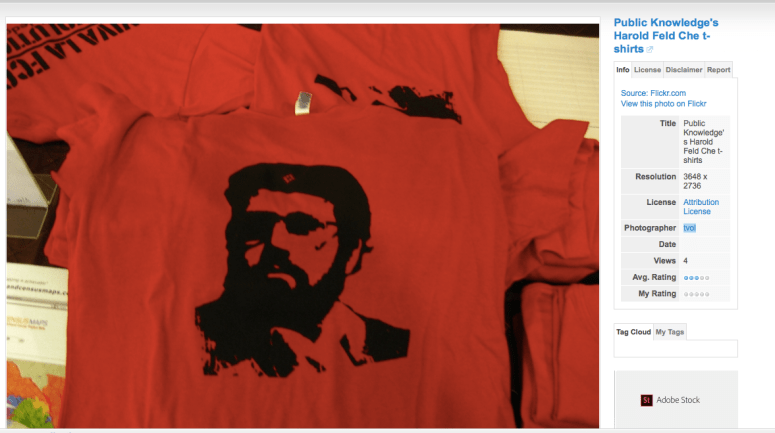
“Public Knowledge? Most of the money and all the policy is Google” – Former board member.
The Google/Soros front group that is Public Knowledge just released an unprecedented attack on the Copyright Office and staff. This is notable for several reasons.
First, the attack is in retaliation for the Copyright Office opposing the FCC and DOJ Antitrust on two recent proposed rule changes that favor Google. I’m mean they don’t even hide it. See screenshot above. They are going hog wild. BTW we should note, the CO does not oppose set top box competition, they oppose all the little copyright goodies for Google stuffed into the proposed regulation. But PK and FCC are dishonestly portraying it very differently. These people are real <Poll Results>.
Did Gigi Sohn phone home to Public Knowledge/Google and ask them to attack the copyright office?
Second Gigi Sohn Senior Counsel to FCC Chairman Wheeler and the driving force behind “Unlock the box for Google” is also founder of Public Knowledge. So think about it. It appears that a high ranking federal official has used her own foundation to publicly attack other federal officials in a disgusting and underhanded manner. Is this even legal? What <Poll Results>! Regardless, it’s FOIA time!
Third Public Knowledge seems to be trying to set the stage for a putsch at the Copyright Office now that they have a new Google/Soros endorsed and funded Librarian of Congress coming in. The Copyright Office is marginally a part of the Library of Congress. Carla Hayden the new Librarian was (is?) a board member at the Soros OSI.
Fourth, Public Knowledge won’t be invited to the Copyright Office holiday party this year. You may thinkn I’m being funny but this is significant. Would you invite these <Poll Results> to your holiday party? If the Public Knowledge/Google/Soros orchestrated putsch at the Copyright Office fails we can expect future Public Knowledge reports to go directly into the shredder at the Copyright Office. So either these folks are extremely confident in their ability to remake the copyright in their image or they have completely lost any ability to shape future Copyright policy.
Clarinet playing William Patry senior counsel for copyright at Google and former Copyright Office employee was left off of Public Knowledge’s “Revolving door” list. It contradicted their false narrative so they seem to have let that *ahem* slide.
Fifth, The Public Knowledge report seema to engage in some extreme cherry picking of data to create the impression that the Copyright Office is “captured” by the “copyright industry.” The “white hot smoking gun” as Disney fan boy and spam science fiction writer Cory Doctorow describes it is the “fact” that 7 copyright office employees over the past 22 years have gone on to work in the “copyright industries!” That’s almost one employee every 3 years! Scandalous!!! Compare that to the Obama administration’s 200+ employee revolving door with Google. Apparently the scandal is that the Copyright Office are just not doing a very good job of cashing in! Try harder folks. But seriously back to the cherry picking. The folks at Public Knowledge omit many many former Copyright Office employees that went on to work at companies that don’t like copyright very much. The most glaring omission is Willam Patry who is now Senior Copyright Counsel at Google. A quick search of the Public Knowledge website reveals the organization is well aware of Patry.
New playground game for the kids “Where in the world is William Patry?”
Perhaps that’s a tad bit hyperbolic. I mean it’s probably unfair to compare Google to meth-heads and low grade strippers. Clearly Google and its DC proxies are much more dishonest and dangerous!
Let’s do a quick round up of all the Obama Administration lame duck favors being called in by Google. And remember this is just copyright and it’s still just the pre-lame duck session. The election hasn’t even happened. It’s gonna be insane after the election. Taxpayers will be lucky if there’s any office furniture left in federal offices by the time inauguration day rolls around.
The DOJ Antitrust Division 100% Licensing Rule For Songwriters
Assistant Attorney General Renata Hesse is also former lawyer for Google.
We have covered this extensively. Read the links at the end of this section if you need to catch up. But this is a rule that only makes sense if you understand that it benefits Google/YouTube in the purported $1,000,000,000 dispute with Pharrell. The rule in every other respect makes no sense. The rule itself reduces competition; it will entrench dominant market players on both sides (licensee and licensor); it reduces licensing efficiency; it violates the constitutional rights of songwriters; it violates the DOJ ATR Division own rules; flies in the face of the previous 75 years of antitrust regulation of songwriter organizations; and it benefits a single company. Fucked up.
The rule was apparently pushed through by former Google attorney Renata Hesse who is now an Assistant Attorney General in charge of the Antitrust Division. This is particularly rich because when Renata Hesse worked for Google she argued and lobbied against the antitrust regulation of the search advertising monopoly. The fox is in the henhouse. And this fox has just overseen one of the most regressive pro-monopoly applications of antitrust law against individuals (chickens) since the 1890s when the antitrust laws were routinely used against labor unions and in favor of the trusts (foxes) they were supposed to limit.
But here is how you really know that the rule is corruption at work. The DOJ ATR very carefully phrased the 100% licensing rule as a “clarification” of the original consent decree rules. In other words it isn’t a new rule.
Why is this important?
Because it is a transparent attempt to get around the constitution, which explicitly forbids ex post facto law. That is, “A law that retroactively changes the legal consequences (or status) of actions that were committed, or relationships that existed, before the enactment of the law.” Essentially Renata Hesse loads the entire US antitrust enforcement apparatus into a time machine and goes back to 1941 and “clarifies” the existing rule. Thus making those legal agreements between songwriters, co-writers and performing rights societies illegal before they were signed!
Presto-changeo no ex post facto.
Hey, that makes a great album title. Or title of a memoir. Preferably one written from a federal prison.
Complexity is theft and the sure sign of a scam. No honest person does something this complicated to fix a simple problem. Surely we are all being scammed here.
So how is this not an unconstitutional “taking” from songwriters that solely benefits Ms Hesse’s former client Google? This takes any co-administration agreements that Pharrell may have with cowriters and makes them illegal. Further the new rule forces his co-writers who are members of ASCAP and BMI (already under DOJ consent decrees) to license his song without his consent. It thus deprives thousands of songwriters like Pharrell of the valuable right to cut their own deal with Google/YouTube.
Maybe in a few years when songwriters begin to notice that their ASCAP and BMI checks are reduced by the extra administrative deductions required by the 100% licensing rule, remember this: a single apparently corrupt (didn’t recuse, ethics violations) government employee Renata Hesse took money out of your pocket. I’m looking forward to some clever songwriter with a clever lawyer finding a way to hold her personally responsible for the loss of income to all songwriters. This is not as unlikely as you think because federal officials that violate constitutional rights of individuals are not always immune from personal liability.
Let’s see what happens when the FOIAs start rolling in.
Google, the FCC and the So-called “Unlock the Box”
Hahahahahahahhahahahahahaahahahahahahhahahaha… phew…. good one Mr President!… about set top boxes … consumer choice, that’s rich”
Honestly this is mostly above my pay grade, but I know enough to say the Google shadow government in Washington DC is doing something that is bad for copyright owners while helping Google cash in.
“Unlock the set top box.” That sounds good. Right? How could this be bad? Well, it is definitely being pushed by Google and their well funded proxy Public Knowledge. And it’s also THE classic Google ploy: Take a position that seemingly has some small benefit to the public or consumers (functional cable boxes you can purchase not rent) and then load up the regulation like a trojan horse with all kinds of goodies for Google.
In this case all you need to know is this: the “unlock the box” rule requires the FCC to institute some sort of panel or process to “oversee and adjudicate copyright licensing issues.” I’m not an expert but I don’t understand how congress has given the FCC any right to regulate private copyright licensing agreements? Did congress act? No. So once again this sounds more like some sort of extralegal compulsory licensing scheme that would benefit Google and once again give the monopoly access to content they have not licensed.
Indeed as Precursor blog notes the copyright office weighed in on the proposal:
“The Copyright Office is therefore hopeful that the FCC will refine its approach as necessary to avoid conflicts with copyright law and authors interests under that law. As a threshold matter, it seems critical that any revised proposal respect the authority of creators to manage the exploitation of their copyrighted works through private licensing arrangements, because regulatory actions that undermine such arrangements would be inconsistent with the rights granted under the Copyright Act, and to some degree, as discussed below, the authority of Congress to decide whether and when limitations on these rights should apply.”
Doesn’t this seem like the same playbook that Google used over at the DOJ Antitrust Division? A novel and likely unconstitutional reinterpretation of the rules to get what they want? This is Google running wild as the clock runs out on the Obama administration.
Why do I say that? This proposal by all accounts is being pushed by Gigi Sohn who is senior counsel to the Chairman of the FCC Tom Wheeler. Gigi Sohn of course was the founder of Public Knowledge. And Public Knowledge is funded by Google. In the Oracle v Google case the Judge forced Google to produce a Shill list. Guess who was on it? Public Knowledge. Does Gigi Sohn play the same role at the FCC that Renata Hesse plays at DOJ ATR? Looks like it.
Just look how fucking cozy FCC chairman Wheeler is with Public Knowledge. It makes you wonder if the FCC and Public Knowledge for all practical purposes have merged. Here’s what Wheeler said at the most recent Public Knowledge awards dinner:
“I’m a little surprised that Public Knowledge would actually ask me to come here today since I stole Gigi Sohn,” Wheeler said as the keynote speaker at a Public Knowledge awards dinner in September.
“We cannot have debate, we cannot have the essence of how [James] Madison said this government would work without organizations like Public Knowledge,” he continued. “There is plenty of ambition on the other side of issues. There is plenty of ability to speak out. Plenty of voices, which many times are presented as ‘independent,’ but aren’t. But the ability of Public Knowledge, Free Press, Common Cause — that ability keeps the process on the straight and narrow. So I’m here to salute you for the job you do in making sure that ambition is countered with other ambition representing people.”
Either Wheeler is totally in the tank for Google or he is an idiot who doesn’t realize that Google funds and calls the shots at Public Knowledge. There is no “independent” public voice that is represented here. Free press ain’t the public either. It’s just Google’s BFF Soros. See Soros hack.
I wonder which large technology company Wheeler works for after his term?
(Also Madison is rolling in his fucking grave: “[government] interference is but the first link of a long chain of repetitions, every subsequent interference being naturally produced by the effects of the preceding.” Have you ever read Madison you dumbass?)
FCC/Google/Public Knowledge Attack on the Copyright Office
Did the FCC’s Gigi Sohn phone home to Public Knowledge/Google and ask them to attack the Copyright Office? Sure looks like it. (AP photo Harry Hamburg).
But none of the preceding compares to this. This is where it gets nasty. There is no way around this but it really looks like Gigi Sohn a government official that happens to be chief counselor to FCC Chairman Tom Wheeler has enlisted Public Knowledge, an organization she founded, to personally attack the Register of Copyrights. Simply because the Copyright Office did its job and weighed in on the FCC proposed unlock the box rule.
Notice that these dishonest astroturfers don’t mention that the Register of Copyrights also worked for The Guggenheim. That would be inconvenient because often the Guggenheim is on the exception side of Copyright law. No, that wouldn’t fit their shitty little narrative.
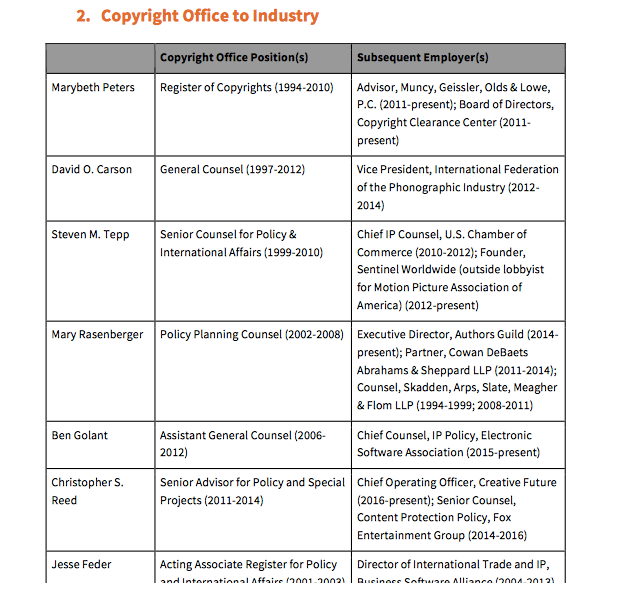
Guess what else didn’t fit their shitty little narrative? William Patry chief copyright counsel for Google once worked at the Copyright Office. In a section of the report titled “Copyright Office to Industry” they list 7 people in 22 years that went from the copyright office to “the copyright industry.” This is supposed to show some sort of revolving door between the Copyright office and such high paying jobs like working in public policy office for the financially decimated photography industry. (That is not a payday if you don’t get the joke.)
Yet these folks they leave William Patry off the list…
How the fuck do you omit that? This is pure dishonesty. Further, are we really supposed to believe that Gigi Sohn and others at the FCC are not somehow in on this dishonest attack by Public Knowledge? C’mon. You know this is all FOIA-able?
This made me so mad I decided to look up “piece of shit” at Urban Dictionary. I’ve heard the phrase before and I wanted to see if perhaps it applied in this situation.
What do you think? If you go out of your way to cherry pick data to make the Register of Copyright and the Copyright Office look corrupt are you a person or organization that is in the business of not sucking?
If you are a high ranking governement official, say, like Gigi Sohn who is senior counsel to the Chairman of the FCC and you just maybe get the organization you founded to mount a dishonest personal attack on another federal official are you “working correctly?”
If you are the FCC chief and you have people working for you that seem to be working in coordination with Google proxies and you don’t fire them are you “working correctly?” Public Knowledge doesn’t even bother to disguise the reason for their attack. They are doing this right under the chairman’s nose. How does Wheeler not know?
Regardless it look like these <href? Poll Results:>Pieces of shit are running wild up there in Washington DC. And everything these <href? Poll Results:>Pieces of shit do seems to benefit Google. Add to that the financial relationship between these <href? Poll Results:>Pieces of shit Public Knowledge and Gigi Sohn? How is this not Google not giving a shit and running hog wild in the last days of the Obama Administration?
Karoline Kramer-Gould reflects on her experience of leaving her long career in radio after standing up to the powerful lobby of the National Association of Broadcasters, the NAB’s fear campaign directed at radio station employees and rediscovering a life in music after the dirty politics of broadcasting.
I get dozens of these a month. They are almost all deficient. In effect they purport to being legal “notices of intent” to license a composition, but they are not. And the services know this. They send them out anyway.
They appear fraudulent in two ways:
Some are sent (knowingly) after the work is used thus the service does not qualify for a compulsory license. This is fraud because the unsophisticated songwriter will be fooled into thinking that they no longer have the valuable right to negotiate a direct license from the services. This is just as fraudulent as tricking pensioners into waiving rights to pension underpayments with an official looking letter.
The remainder are simply backdated. In other words they purport to be a legitimate and timely NOI from say 2012 or 2014. They are not. How do I know? If they had my address back then, why haven’t I received my monthly accountings as required under the law? Why are they sending them only now? It looks like these are simply being manufactured.
Further virtually all of the services are engaged in this fraud. I have deficient NOIs from virtually all of the digital services. They appear to all be participating in this fraudulent activity. How do you suppose that happened? Just a coincidence?
Meanwhile the DOJ Antitrust Division Litigation Section III which has authority over the entertainment business has spent two years investigating the settled practice of “fractional licensing” by songwriters and found (lo and behold!) the previous 75 years of DOJ antitrust lawyers were wrong, and “fractional licensing” is anticompetitive. These guys are smarter than the last 75 years of DOJ lawyers combined! Now songwriters and PRO are burdened with the task of unwinding hundreds of thousands of co-writing agreements and new administrative burdens to account to co-writers.
Not to go too far down the rabbit hole, but you should know the end of fractional licensing benefits one company: Google/YouTube. See here. And the fractional licensing investigation was led by a former Google lawyer Renata Hesse. It’s like the 18 fucking 90s when it comes to antitrust enforcement in Washington DC, a period when antitrust laws were used by trusts to protect against competition.
So it’s virtual torches and pitchfork time. Over the next couple weeks I will demonstrate how to use the new DOJ licensing rules against the services to bring the entire digital licensing system down. It’s really easy and it follows the DOJ orders to the letters of the law. What have we got to lose?
P.S. When I do get a check from these services they look like this. No accounting now statement no nothing? Is this a bait check? Like you cash it and then it’s an “implicit license?”
The Times dropped the bombshell after digging into the Frank Ocean situation, one that is actively causing the music industry to reinvestigate their practices around exclusives. “Executives at two major record labels said that in recent weeks Spotify, which has resisted exclusives, had told them that it had instituted a policy that music that had benefited from such deals on other services would not receive the same level of promotion once it arrived on Spotify,” Sisario wrote. “Such music may not be as prominently featured or included in as many playlists, said these executives…”
However, while Spotify has been clear about rejecting one part of the argument against the company, there is another piece of the story that remains unaddressed. Hidden in the details, the accusations are really twofold, including both the notion that
* Spotify directly suppresses tracks from artists that have previously signed exclusives with Apple Music or Tidal in search results.
* And, Spotify indirectly targets artists who have signed exclusives with Apple Music and Tidal but promoting music differently in playlists and banner ads.
I mean you couldn’t ask for a better screenshot. Who is running DOJ Antitrust Division Litigation Section III?
How the fuck do they get away with this?
The DOJ Antitrust Division Litigation Section III (entertainment industry antitrust beat) spends two years investigating the practice of fractional licensing by songwriters at the behest of the Mic-Coalition (Google) and imposes a ridiculous new 100% licensing burden on songwriters.
But fucking Spotify-the dominant player by market share-is apparently organizing a boycott of artists who sign exclusives with Apple, and then urging a group boycott by record labels of rival streaming services Apple Music and Tidal. Where is DOJ ATR LIT III? I’m not an attorney but how the fuck is this not a violation of the Sherman Act? Are we supposed to believe that the Harvard and UC Berkeley educated lawyers in the Antitrust Division don’t recognize blatant anti-competitive behavior like this? They can’t possibly be that incompetent? Can they?
Why does Spotify get a pass? (Maybe this?) If you ask me this looks like corruption. Just look at this timeline,
We have multiple sources reporting that record labels are urging artists, managers and distributed labels to not do exclusives with Apple and Spotify because “it is making Spotify really mad.” This is a group boycott.
“That said, a representative of a singer-songwriter told Bloomberg that the artist turned down an appearance on an Apple Music show because of fears they would “lose promotion from Spotify.” This is not about suppressing search results, this is about promoting music differently on the Spotify platform as a direct result of exclusives signed with streaming services like Apple Music.”
Spotify wants to hand over less than 50 percent of its revenue to the labels, sources say. Right now, it pays them as much as 58 percent of revenue. “There are two things being discussed — windowing and rates. It’s a bit of ‘we’ll compromise if you compromise,’ ” said a source familiar with talks. “They’re tech people and they want to get rich.”
It may be lost on the elites in Washington, but songwriting is not something that only happens in New York City, Nashville or Hollywood. Music contributes billions of dollars to local economies in states all across the country and to cities all across those states.
Texas is no different–music contributes over $1 billion a year of economic impact to the City of Austin alone. Many other states come to mind who are likely similarly situated in addition to California, New York or Tennessee.
A random choice would be Illinois, Washington, Mississippi, Louisiana, Colorado, Oregon, Georgia, Florida and the District of Columbia in no particular order. Chicago, Seattle, Clarksdale, New Orleans, Denver, Portland, Atlanta, Miami and DC all have associated themselves with music both culturally and economically.
In fact, one could pretty easily point to some aspect of every state’s economy that gets a significant contribution from music–and great records and great shows rely on great songs.
That’s why the Department of Justice Antitrust Division Litigation III Section’s decision to adopt the cockamamie position on 100% licensing that is so destructive to the music ecosystem is rightly of concern to governors and mayors across the country. Protecting our songwriters is a bi-partisan issue that everyone can agree on.
That’s also why it is so gratifying and encouraging to see Texas Governor Greg Abbott lead the way for the protection of Texas songwriters against the DOJ’s Kafka-esque overreach by unelected and unconfirmed lawyers on its antitrust mandate. Governor Abbot has asked U.S. Attorney General Loretta Lynch to reconsider the DOJ’s position in this letter.
We all truly appreciate his leadership at a time when we could all use some good news.
G O V E R N O R G R E G A B B O T T
August 29, 2016
The Honorable Loretta E. Lynch
Attorney General
U.S. Department of Justice
950 Pennsylvania Avenue, NW
Washington, D.C. 20530-0001
Dear Attorney General Lynch:
I write to express my disagreement with the U.S. Department of Justice’s (DOJ) recent decision regarding the consent decrees in United States v. Broadcast Music, Inc. 1 and United States v. American Society of Composers, Authors and Publishers. 2 The Texas Music Office is housed within my office and is charged by law with promoting the Texas music industry. As the head of that office, I must object to the DOJ’s position in these cases, which is both legally flawed and threatens to harm the music industry in Texas. I respectfully request that the DOJ reconsider its position.
The DOJ ultimately concluded that the consent decrees require Broadcast Music, Inc. (BMI) and the American Society of Composers, Authors and Publishers (ASCAP) to offer only full-work licenses to their respective music repertoires, including those songs in which BMI or ASCAP only represent a fraction of the ownership rights. However, despite claims to the contrary, BMI and ASCAP have never offered full-work licenses to fractionally owned songs, and the consent decrees have never been interpreted by the DOJ to require that until now. This drastic change in course will have severe consequences for music artists and the music industry as a whole. Specifically, the DOJ’s conclusion will inhibit collaboration between music artists, upend longstanding practices within the music industry and further reduce royalty payments to music artists.3
The DOJ claims that the plain language of the consent decrees does not permit it to reach any other conclusion. That is incorrect. The decree language on which the DOJ bases its conclusion states that BMI and ASCAP must grant to users licenses to “perform” the songs in their
1 64 Civ. 3787, 1994 WL 901652 (S.D.N.Y. 1994).
2 41 Civ. 1395, 2001 WL 1589999 (S.D.N.Y. 2001).
3 These effects, along with many others, are explained in detail in the dozens of public comments the DOJ received during its review of the consent decrees. See https://www.justice.gov/atr/ASCAP-BMI-comments-2015.
The Honorable Loretta E. Lynch August 29, 2016
Page 2
respective repertoires. From the word “perform,” the DOJ extrapolates an obligation that was never in the contemplation of the parties to the consent decrees and that runs counter to longstanding industry expectations. Consent decrees are not statutes to be construed based solely on their text. Instead, consent decrees are to be construed under the ordinary rules of contract interpretation. They should be interpreted in the context of the lawsuits from which they arise and in light of the expectations of the parties to those lawsuits. See US. v. ITT Continental Baking Co., 420 U.S. 223, 237 (1975) (when interpreting a consent decree, it is proper to consider “the circumstances surrounding the formation of the consent” decree); US. ex rel. Anti Discrimination Ctr. of Metro N Y , Inc. v. Westchester County, 712 F.3d 761, 767 (2d Cir. 2013) (reasoning that a consent decree should be read “in the light of the . . . intention of the parties as manifested” by the decree). There is no indication that these consent decrees were intended to address the issue of full-work licenses or that full-work licenses were even at issue in the underlying litigation. The DOJ’ s conclusion is based on a technical construction of the decrees’ terms rather than a contextual understanding of the decrees’ role in resolving discrete legal claims that had nothing to do with the full-work license issue. It is well-settled law that consent decrees of this nature should be given a narrow construction See Perez v. Danbury Hosp., 347 F.3d 419, 424 (2d Cir. 2003). The decrees in these cases are susceptible to alternative interpretations, and they should be construed narrowly to impose only the obligations anticipated by the parties to the decrees.
Even if the plain language of the consent decrees did clearly impose an obligation to grant full work licenses, which it does not, the decrees should be amended to recognize and legitimize BMI’ s and ASCAP’s current practice of fractional licensing. The DOJ has refused to agree to any such amendment, claiming that it would not be in the public interest. The DOJ claims that permitting BMI and ASCAP to offer fractional licenses would impair the function of the market for public performance licensing and could result in certain music not being played by users. But as previously noted, fractional licensing represents the status quo, and most music users recognize this fact. It is the DOJ’ s new interpretation of the consent decrees that would disrupt the market, not fractional licensing. An amendment modifying the consent decrees to expressly permit fractional licensing is in the public interest, and the DOJ should reconsider its opposition to such an amendment.
Thank you for your thoughtful consideration of these concerns. If you have any questions about this matter, please contact Brendon Anthony, Director of the Texas Music Office, at
(512) 463-6666.
You must be logged in to post a comment.