Streaming “Transparency” and the 70% Black Box Lie… The Solution Is #gettherateright

The argument goes something like this…

Streaming companies are paying 70% of their revenue but artists are not getting paid enough. This must be the result of record labels and rights holders not passing on the right amount to artists.

The first question is, how do we know that streaming services are actually, really paying 70% of their top line gross revenue to rights holders? We know what the revenue of a transaction is on iTunes, because it is factually transparent – it is the list price being charged. We all know this, and we can all verify this. A $9.99 album on iTunes pays out $7.00, or 70%. Same thing for a $.99 song that pays out $.70, that’s also 70% of revenue.

But when if comes to streaming services however we do not know what the revenue is that should be credited to artists and rights holders. This is what is actually of concern. There is a big black box at the top of the waterfall from which all other money flows downstream.

So if streaming services are paying 70% of revenue, what exactly is that revenue? Let us see it. So here we are with the issue of transparency. If we can’t actually see or know what that number is then yes, the low payouts are very much of concern and have very little to do with intermediaries.

We can disagree about how the 70% of revenue is passed onto artists from iTunes and other transactional sales. But one thing is clear, we all understand the transparent economics of how much money is generated on each transaction. This is not so with streaming. So without transparency at the top of the waterfall, everything that follows is suspect.

More importantly, and more to the point, if there are established retail and wholesale rates for each stream, the calculations become immediately transparent in the same way they are with Itunes. See, the issue here is not what is going on downstream, but rather what is happening at the top of the waterfall.

“WE HAVE A MONETIZATION PROBLEM”

The truth is by now (and everyone should be able to agree on this), we know that streaming creates too little revenue relative to the value of the product. In other words the product is being sold to the consumer for less than the cost that it takes to create and produce it, and still remain sustainable.

In simple terms this is expressed as selling a Porsche for one dollar. It doesn’t matter how many Porsche’s you sell for one dollar while paying out 70% of the revenue, there will never be enough money to actually pay for the cost producing the car. Porsche’s, like professional music are expensive to produce. Despite the advances in recording technology, it is he cost of human labor that is the most important in the value chain.

This is the economics of music streaming in a nutshell, but with one added twist. The Porsche may be sold for one dollar one month, and be sold for only eighty cents the next month, and maybe the month after that sold for a dollar and ten cents. This is because of the fixed (and unsustainable) revenue pool that is divided by the total number of plays.

The common sense solution would be to establish a fixed per stream rate at each platform. This is the most simple way to encourage transparency and fairness as the revenue generated per stream can be transparently and easily calculated from top line data – no more black box at the top of the waterfall. The funny thing is, the people shouting the loudest for transparency also seem to be the most opposed to the easiest solution. Why is that?

So, if we are to have conversations about transparency let’s at least be clear about what it is that we actually need to see.


Why Apple Music and Tidal are the right business models with the wrong optics.

Since Spotify launched in 2010 the music business has been in an existential crisis. Convinced that ad-supported unlimited free access to on-demand music would ultimately grow recorded music revenues the major labels opted into what may be their worst decision ever. This decision aided by an estimated 18% (or more) equity position in Spotify has not grown overall music revenues over the past five years. In fact, for the year ending 2014 global revenues reported by the IFPI stated that revenues were at the lowest point in decades. So what to do?

For starters the first and most obvious solution would be to eliminate the unlimited ad-supported free access to on-demand music. This is the model that made ad funded, for profit piracy so popular on over half a million infringing links from unlicensed businesses served by Google search and delivered to your inbox by Google Alerts complete with social media sharing buttons. These unlicensed businesses are receiving hundreds of millions of DMCA notices annually from artists and rights holders. Let us not forget that this is also the same model that Daniel Ek helped to perfect as the CEO of u-torrent the worlds most installed bit-torrent client. Ek has said he’d rather shut down Spotify than give up his failed ad supported business model.  We thought Spotify was built on converting ad supported (where Spotify board member Google makes money serving ads) to subscription (where artists make money).  So much for that.

And this is who the record business is taking notes from? Perhaps that’s why Universal is restructuring.  This may have seemed like a good idea to some senior executives but it turned out to be a complete disaster.  Time to change.

Despite moves in the right direction by Tidal and Apple Music the optics for both of these companies at launch of their respective streaming models have been somewhere between missteps and an absolute disaster. Dismissing for a second that both Apple and Tidal could be the targets of public relations campaigns by competing corporations such as Spotify, Pandora and Google (YouTube) let’s look at what each is offering. Tidal and Apple Music offer no unlimited ad-supported free access to on-demand music. That means no business to those selling advertising… like, Google.

There is nothing more important to the future of the recorded music ecosystem than removing the unlimited ad-supported free access to on-demand music.

For all intents and purposes even free streaming is ownership and here’s how you can tell. If you can chose it, and access it, you essentially own it whether you pay for it or not. Streaming replaces ownership at the consumer level but does not compare to ownership on price. At some point there needs to be a market correction to properly value music consumption.

The launch of Tidal should have been a rallying cry for all artists to support a business model that limited free streaming, incentivized paid subscriptions through exclusive offerings and diversified consumer experiences with higher quality streaming formats. This is the model we should be focused on. As the Buddhist saying goes, “trust the teaching, if not the teacher.” In other words it doesn’t matter if you don’t like Jay-Z and Madonna.  And securities laws makes the whole stock issue so difficult that Tidal would have been far better off saying they’d pay all participating artists a bonus in the cash from the company’s own stock sales rather than get down the rabbit hole of who gets stock and who doesn’t.

Unfortunately the celebrity that could have united a community, instead divided it through messaging that most would acknowledge appeared to be less than inclusive. Worse, the optics appeared to be elitist whereby those already rich and famous seemed to be more focused on their own fortunes as opposed to a sustainable ecosystem for the next generation of musicians.

Perhaps if each of the artists at the Tidal launch would have appeared with a developing artist they were supporting the messaging and optics would have been more inclusive and more about community than celebrity.

We have to acknowledge what kind of business we want going forward. Clearly, unlimited ad-supported free access to on-demand music is not working. Both Tidal and Apple Music do NOT have unlimited ad-supported free access to on-demand music. So what’s the problem?

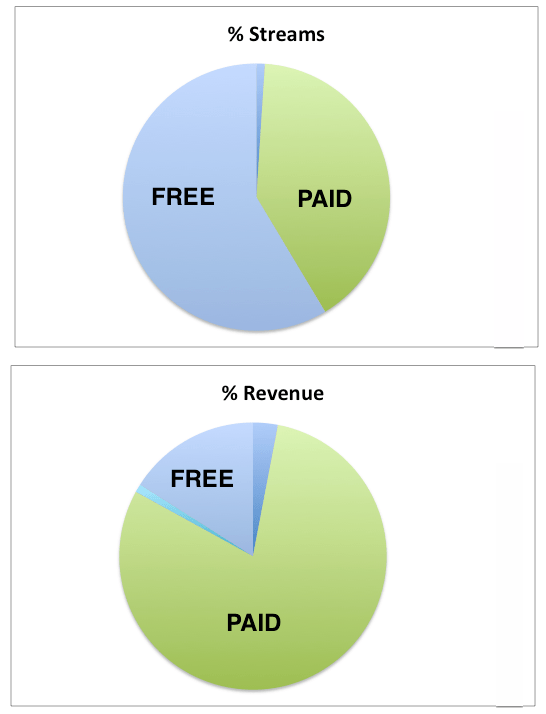
Following the Apple Music launch Spotify announced it had achieved 75m global users (we love that, “users” no kidding) and 20m paid subscribers. So let’s look at the numbers in relationship to what Apple Music could bring to the market place. Keep in mind that 55m of Spotify’s user base are NOT paying for the service. Based on reporting we’ve been provided the free tier accounts for 58% of plays which is only 16% of the total revenue.

With all the back and forth between Apple and labels and the announcement last week by NMPA of the publisher’s deal—freely negotiated without government “help” by the way–it’s pretty clear that Apple announced Apple Music without all their ducks in a row contractually.  This opened up an opportunity for haters who are just gonna hate.  Now that the picture is becoming a bit clearer, we feel more confident than ever that most of the noise is coming from competitors who would like to create yet another consent decree situation but this time for artists and record companies.

So there are a few questions we need to ask about the launch of Apple Music to evaluate the trade-off for eliminating the unlimited ad-supported free access to on-demand music. But before we ask those questions, we need to understand the mechanics of the Apple Music ecosystem.

First, the 90 days free without payment at launch requires the understanding that all consumers will get 90 days free at Apple Music whether they sign up at launch or at any other point later. This means that some people will opt in at launch, some will opt in at some later time. Based on what we have seen of how these streaming subscription services scale we have to ask a few questions.

How many people will have access to opt into Apple Music Streaming on launch? We’ll assume it’s the entire installed user base who upgrade into iOS 8.4. Here’s some back of the napkin math from the iPhone 6 launch when Apple dropped that U2 album into everyone’s Itunes.

According to CBS News 33 Million people of the 500 Million Global Itunes users “experienced” the U2 album. That’s just 6.7 percent of Apple’s reported consumer base.

So what kind of adoption and conversion rate could one expect from the launch of Apple Music? 10 million paid subscribers? 20 million paid subscribers? 50 million paid subscribers? It’s hard to know, but anything north of 20 million pretty much beats Spotify on paid subscribers.  And if you are looking for the company that has defined a paid music service, who you gonna call?  Apple or Spotify?  Who do you trust going forward?

What if Apple is able to convert 30 million or more consumers to paid streaming in only four months when it has taken Spotify five years to acquire 20 million paid?


BREAKING NEWS AT PRESS TIME. APPLE WILL PAY ARTISTS DURING THE FREE TRIAL PERIOD!
Apple Reverses Course, Will Pay Artists During Apple Music Free Trial | Mac Rumors


Of course, Apple should use a couple of bucks from it’s 178 billion dollars in cash reserves to compensate musicians for the consumption of their music during the initial 90 day launch of Apple Music. This would  incentivized artists to promote the service as being both fair and artist friendly and give Apple the thumbs up from the people that matter the most, the artists themselves. Apple’s purchase of Beats was a three billion dollar acquisition, so surely there’s enough money in those coffers to pay artists something.

To put these numbers into perspective Spotify claimed to have paid artists and rights holders two billion dollars globally from it’s initial launch in 2008 through October of 2014.

Here’s some more perspective from asymco.com: In 2012, global music revenues were reported at $16.5 billion, with $5.6 billion coming from digital music. Of that $5.6 billion in music downloads, Apple paid labels $3.4 billion for iTunes sales, which is about 60% of the total digital revenues industry wide—IN LESS THAN ONE YEAR.

In 2012, Apple’s transactional digital model created more revenue for artists and rights holders in less than a year in then it took for Spotify to earn almost 6 years.

If we want to break the death spiral of unlimited ad-supported free access to on-demand music we have to embrace the trade-off of offering limited free trial periods as an incentive for consumers to make the switch.

And by the way—compare the classy way that Eddie Cue of Apple handled Taylor Swift compared to Daniel Ek who comes off like a semi-stalker.  Who understands artist relations the best?

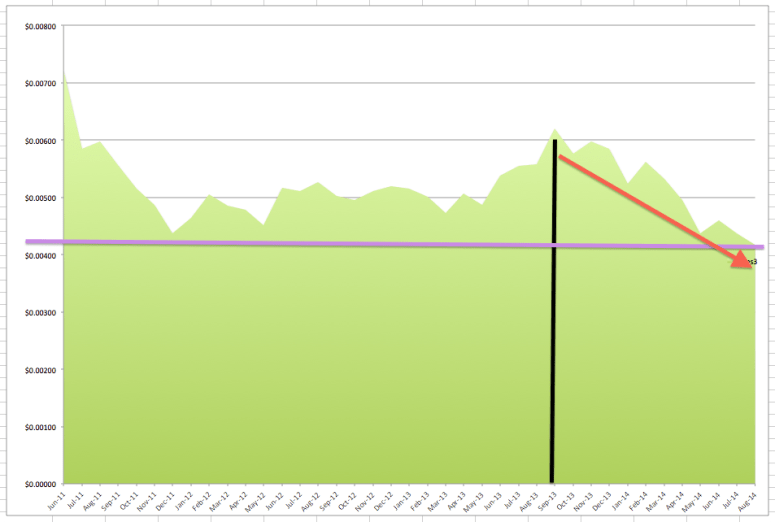
The problem with ad-supported unlimited free access to on-demand music is illustrated below showing Spotify domestic streams and revenues. It’s just math and it’s time to move on. Apple Music and Tidal are showing us the way.

 

Has music missed its ‘Netflix moment’? | Music Business Worldwide

Subscription streaming movie service Netflix announced earlier this week that it has reached 62m users around the world – almost exactly the same number as Spotify.

Big difference is, four times as many of Netflix’s customers pay a subscription each month: 60m of them, or 97% of its total consumer base.

READ THE FULL STORY AT MUSIC BUSINESS WORLDWIDE:

Has music missed its ‘Netflix moment’?


Why Spotify is not Netflix (But Maybe It Should Be)


Streaming Is the Future, Spotify Is Not. Let’s talk Solutions.


BUT SPOTIFY IS PAYING 70% OF GROSS TO ARTISTS, ISN’T THAT FAIR? NO, AND HERE’S WHY…

New Math $.00666 : Billboard’s New “Consumption” Chart, Free Streams and the End Of Meaningful Metrics?

The purpose of a chart is to provide meaningful metrics to determine the relative value of a title in the marketplace. The new Billboard 200 “consumption” chart moves away from the traditional metric of album sales. In doing so, the new chart also creates questions about how meaningful this new information will be to artists, managers and labels. As album sales continue to decrease a method of measurement that addresses today’s environment is absolutely important.

The move from a “Sales Chart” to a “Consumption Chart” acknowledges what we already know…  More music is being consumed than ever before and conversely musicians are being compensated less than ever before, for that consumption.

Track Equivalent Album sales for measuring the volume of individual songs by a single artist has been a helpful and accurate method of comparing unit sales in the ala carte song era of Itunes (and others) in that every 10 song sales equal one album. This is easy to quantify as logically ten songs sold at 99 cents really does equal the revenue of one album at $9.99. So for comparative purposes this makes sense both in terms of the underlying logic and the economic reality.

But the new Billboard chart has a bigger problem when incorporating streams. The new metric of 1,500 streams per album and 150 streams per song would make sense if there were in fact a fixed price point for streams of $.00666 (as in $.0666 x 150 = $.99 and $.00666 x 1,500 = $9.99). We’re gonna have some fun with this, stay tuned…

Maybe Billboard has a sense of humor in that the calculation of streams to song and album equivalent’s are $.00666 per stream?

It get’s worse because we know from our Streaming Price Bible that neither Spotify or YouTube are paying anywhere near those rates on an summed, averaged per stream rate. From what we’ve heard Billboard is excluding plays from YouTube (for now) but we have a feeling streaming from YouTube Music Key will be included just as those are from Google Play.

The problem here is that the free tiers dilute how meaningful this data is actually going to be to everyone. As we pointed out in one data set we reviewed Spotify’s free streams accounted for 58% of total plays, but only 16% of revenue in the USA. On YouTube (by any name) the amount of streams to revenue is likely to be far more extreme.

FreePaidChart

What’s worse is that we can clearly see that over time, as fixed revenue streaming services scale the per stream rate will drop. The bigger the services scale, the less each stream is worth. This is unless of course the labels demand a minimum per stream rate that actually matches the metric the chart is suggesting ($.00666 – retail) and no streams from free tiers should be included.

Suddenly, we’re not feeling so lonely on this point, see here:

WME’s Marc Geiger Sides With Taylor Swift, Calls Free Streaming Services ‘F—ed Up’ | Billboard

Add one more name to the list of industry figureheads who’ve sided with Taylor Swift in her battle with Spotify: Marc Geiger, William Morris Endeavor’s head of music, who called the ubiquity of free, ad-supported streaming music services “a f—ed-up, torturous thing for 15 years”

And…

Essay: Why Streaming (Done Right) Will Save the Music Business | Billboard

As the first music-streaming service to be licensed by all major labels — and the No. 2 on-demand music service in the United States — it may surprise you to learn that we at Rhapsody support, and generally agree with, the decision by Taylor Swift and other artists to not make their new albums available on free streaming services immediately after release.

If we can all agree that Free Streams are problematic for the business, why can’t we agree that free streams are bad for a chart?

SpotifyNetMONTHLY_Charted

Combining the free and paid steams defeats the purpose of what the chart is attempting to achieve, a meaningful metric of paid consumer demand.

Free streams must be filtered out of the chart for it to be meaningful.

Giving away a million of something to gain chart positoning is not new and has been controversial. Lady Gaga’s “Art Pop” album benefited from a 99 cent sale at Amazon.com. However albums given away for free by Jay-Z (in partnership with Samsung) and U2 (in partnership with Apple) have not qualified for charting. There is a reason why.

Add to this YouTube views are known to be gamed regularly with many services offering “pay for plays”. We’re also seeing a growth market for services that provide “pay for plays” on Spotify as well. We recognize that in the early days of Soundscan there were attempts to game that system as well by buying off heavily weighted indie stores with free goods, cash or both.

In a digital world where more consumers are streaming on free tiers than paying subscriptions, where the price per stream is falling as services scale, and where there is no fixed price point as a baseline one has to wonder what the true value of the new chart will really be? If it is to illustrate just how wide the gap is between consumption and revenue, then that may be it’s only real purpose.

It’s not like any of this is new, or news. Big Champange, Music Metric and others have been tracking not only sales data but social media metrics for engagement, free streams (youtube and soundcloud) and even p2p filesharing data for years. If we’re going to get honest about “consumption” charts The Pirate Bay has a Top 100 why not include those rankings? To be clear, this is sarcasm, not an actual suggestion. It also illustrates the grossly mislead notion of including free streams in the new chart. It’s not that hard to determine how we are not making money…

REALTED:

Streaming Is the Future, Spotify Is Not. Let’s talk Solutions.

Why Spotify is not Netflix (But Maybe It Should Be)

How to Fix Music Streaming in One Word, “Windows”… two more “Pay Gates”…


USA Spotify Streaming Rates Reveal 58% of Streams Are Free, Pays Only 16% Of Revenue

Since we published the Streaming Price Bible we’ve been getting data submissions to crunch the numbers. According to one set of data it appears Spotify is reporting seven different streaming rates (in a single month). But the most interesting discovery in the data is the percentage of free streaming volume and revenue versus paid streaming volume and revenue.

We knew there were two price tiers (Free & Paid) but we didn’t anticipate discovering the other five tiers, even as limited as they are.

StreamingRatesandPercentagesUSA


As we had suspected, the majority of consumption is generating the least amount of revenue.

Oh, and for those of you keeping score at home the net summed per stream rate, for all streams divided by all revenue is .00352 in the aggregate. That’s .00169 per stream LESS than reported earlier this year in the Streaming Price Bible of .00521. Just another indication that as streaming models mature the price per stream will continue to drop. Add to this that even Spotify executives have admitted as much.


FreePaidChart

If you have data that looks different than ours, send it our way and let us crunch it. This is the problem when there is such a profound lack of openess and transparency. There also appears to be an overall lack of consistency. Let’s have some real “disruptive innovation” by “sharing” our Spotify statements and comparing the numbers.

[The per play rates noted above are aggregated. In all cases the total amount of revenue is divided by the total number of the streams per service  (ex: $5,210 / 1,000,000 = .00521 per stream). Multiple tiers and pricing structures are all summed together and divided to create an averaged, single rate per play.]

RELATED:

Apple Announces Itunes One Dollar Albums and Ten Cent Song Downloads In Time For The Holidays! | Sillycon Daily News


Who will be the First Fired Label Execs over Spotify Fiasco & Cannibalization?


Streaming Is the Future, Spotify Is Not. Let’s talk Solutions.


BUT SPOTIFY IS PAYING 70% OF GROSS TO ARTISTS, ISN’T THAT FAIR? NO, AND HERE’S WHY…

Spotify is not paying sustainable rates for the cost of goods. Look – it’s like this, if something cost you $100 to make, and someone else sells it for $10… it doesn’t matter that you are getting 70% of the gross, you’re still over 90% unrecouped on a per unit basis. This is the problem with Spotify, is that it undervalues the true cost of goods (including R&D, etc).

Artists agreeing to streaming their music on Spotify are essentially agreeing to sell albums for One Dollar and Songs for Ten Cents… Oh Wait, Spotfiy actually pays way less than that… (calculated on a per stream basis).

This is why arguments about marginal percentages miss the point completely. It’s about simple math and simple economics.

The cost of music is not in the distribution of music (which is cheap). The cost of music is in the human labor of the CREATION of music (which is expensive).

The cost of goods is greater than the marginal cost to distribute those goods. Stop confusing the product with the container.

The CREATION of music is also more than the cost of RECORDING music. The cost of music is in the sustainable needs of the human labor for food, shelter, clothing, etc.

Spotify can not scale and work at current economics… One More Time…

SPOTIFY MATH FOR THOSE OF YOU AT HOME WITH CALCULATORS:

Just show us the math where streaming scales, we’ll wait. Spotify has 3m paid in the US at $10 each.

$10 x 12 mos = $120 per year. Pay out 70% that’s a gross of $84 per year per subscriber. Simple Math.

That $84 per sub is in revenue to all artists in rights holders. Times that by 3m and you get a whopping $252m a year in a $7b business.

Multiple that by 10, to get 30m subs @ $10a month and that’s only $2.5b a year… and that’s a big IF Spotify ever gets to 30m paid in the USA… and IF they do, that’s ONLY 2.5b in revenue against the $7b now…

So you effectively cut the revenue to everyone by 1/2 to 2/3rds… how does this math work without raising the price of subscriptions? It doesn’t.

It’s just math.


calculator


RELATED:

Music Streaming Math, Can It All Add Up?

Who will be the First Fired Label Execs over Spotify Fiasco & Cannibalization?

Streaming Is the Future, Spotify Is Not. Let’s talk Solutions.

Let The Heads Roll…More Genius From The Record Industry Braintrust or Mark Mulligan Gets a Calculator…

Happy Halloween and welcome to the scary stupid post of the day…

We’ve been saying this for a long time, music streaming math just doesn’t add up. Would someone please buy some calculators for the record industry braintrust that keeps making these stupid deals? Seriously, it’s just math and it’s not that hard… even Mark Mulligan is getting it… no kidding…

$2.3 Billion In Net Loss To Artists and Labels Per Year

The report extrapolates that YouTube Music Key will generate $400 million in revenues in its first year. But over the long run it will also be responsible for more than $2.6 billion in lost subscription revenue yearly. That’s a negative net impact of $2.3 billion in lost music revenue every year, according to the study.

Ok, that’s YouTube. Let’s revisit how the Spotify math works…

If you own a calculator, let’s just do the math one more time, real slow and simple like…

1) Spotify and former uTorrent CEO Daniel Ek says Spotify only needs 40m paid subscribers for streaming to be sustainable for artists. But that math just doesn’t work.

2) $10 per month subscription = $120 per year per subscriber

3) $120 per year, per subscriber paying out 70% of gross to rights holders equals $84 per subscriber, per year.

4) $84 per subscriber, per year x’s 40 million subscribers equals $3.4b per year in top line gross revenue to ALL rights holders. That’s $3.4b for labels, artists, publishers and songwriters combined.

5) $3.4b per year is HALF of the current revenue of $7b per year where the domestic business has been flat lined.

6) Assuming you could DOUBLE the subscription base to 80m PAID in the USA within two years by dropping the price in HALF to $5 per subscriber per month you still only gross (wait for it…) $3.4b a year in revenue.

We know this is shocking to the math impaired, but doubling scale (imagined as it is) while cutting the subscription fees in half, actually nets you the same amount of money. Shocking the things one can learn with a calculator or a spreadsheet.

Maybe we’re all screwed, but we will not go quietly and we’re gonna call it how we see it on the race to the bottom. We will document the stupidity undoing the business. Maybe it’s time for Lucian Grange to get out that axe again and let people know what time it is? #stopthemadness

READ THE FULL POST AT HYPEBOT:
http://www.hypebot.com/hypebot/2014/10/youtube-music-service-could-cost-artists-labels-23-billion-in-lost-income.html

RELATED:

Music Streaming Math, Can It All Add Up?

Who will be the First Fired Label Execs over Spotify Fiasco & Cannibalization?

Streaming Is the Future, Spotify Is Not. Let’s talk Solutions.

Spotify Doesn’t Kill Music Sales like Smoking Doesn’t Cause Cancer…

This just in from Digital Music News, we’re not surprised. The death spiral towards the $3b annual record business is accelerating… One word to artists and music executives reading this post… “WINDOWING”…

May 10th, 2013:

“We have data that’s proving and demonstrating the fact that streaming revenue is additional to actual unit download consumption or physical music sales…”

Katie Schlosser, Spotify Account Manager of Label Relations, speaking at NARM.

September 12th, 2014:

“Streaming consumers are buying few albums.  30 percent of consumers are music streamers and a fifth of these consumers pay to stream.  Streaming has driven new market growth in countries such as Sweden but in larger markets such as the US it is denting digital music buying.

READ THE FULL STORY AT DIGITAL MUSIC NEWS:
http://www.digitalmusicnews.com/permalink/2014/09/12/research-now-shows-streaming-kills-download-sales

RELATED:

Why Spotify is not Netflix (But Maybe It Should Be)

Spotify’s Daniel Ek is Really Bad At Simple Math

Merchants Of Doubt in Silicon Valley : What Every Musician Needs to Know About Ad Funded Piracy

Swimming Against the Stream: Musicians Fight for Their Worth in the Internet Era | SF Weekly

The cops were getting lots of calls. Drivers were worried. There was a woman walking down the road — the narrow part of Highway 1, just north of L.A. And she was pushing a baby carriage.

When the cops found her, it turned out she was not a crazy person. She wasn’t even a mother.

She was a musician on a mission.

The woman was Suzana Barbosa, a longtime Toronto singer and leader of the band Lumanova, who had lately become fed up with the state of the music industry. She’d had it with the paltry amounts paid to songwriters and performers by streaming services like Spotify. She’d had it with our culture’s preference for glamorizing starving artists instead of paying them decently.

Barbosa was so fed up with the music business that she decided to walk some 400 miles, from Los Angeles to the Google campus in Mountain View, to publicize what she sees as an existential threat to the world’s independent musicians.

READ THE FULL STORY AT THE SF WEEKLY:
http://www.sfweekly.com/2014-06-04/music/beats-apple-unsound-spotify/

Billy Bragg and Beggars Group Rethink YouTube & Streaming… | MusicAlly

We wonder if this is the future of music and artist revenue streams?

While Wheeler was positive about subscription streaming services, he opened both barrels on YouTube. “If YouTube launches a subscription service and it eats Spotify and Rdio, you’ll look back at these times as great days,” he cautioned. “They want to eat all the other music services and our business. That’s their plan.” He said the record industry was “caught out” in the early days of YouTube and didn’t realise the video site would become so big, initially thinking it was just about licensing music for a video of “a cat on a skateboard and then it became the biggest music service in the world”.

Bragg backed him up by saying, “If you want to talk about artists getting angry about the use of their music, YouTube is the place we should be looking at.”

Wheeler concluded, “We got caught out and that needs addressing. Otherwise they will eat our dinner.”

READ THE FULL STORY AT MUSICALLY:
http://musically.com/2014/04/07/beggars-group-recalibrates-50-streaming-payment-to-artists-and-attacks-youtube/

RELATED:

Exclusive: ‘YouTube Music’ Is Launching This Summer… | Digital Music News

#SXSW REWIND : Venture Capitalist Admits Artists Can Not Make A Living On Streaming Royalties…

What YouTube Really Pays… Makes Spotify Look Good! #sxsw