Spotify Top 10 Territories : Global Revenue Marketshare & Streaming Percentages

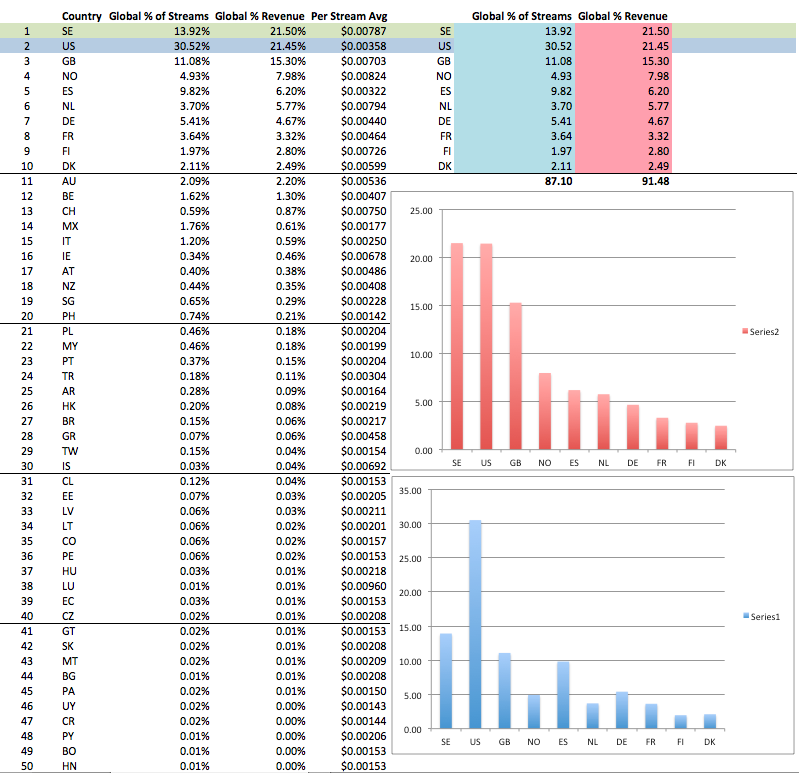
The Top 10 territories account for 87.10% of all streams and 91.48% of all revenue. So all revenue outside of the Top 10 is less than 9% of global revenues. So if you’re streaming your music outside of the Top 10 territories, you are more or less giving your music away.

SpotifyGLOBALMarketshareRevStreams

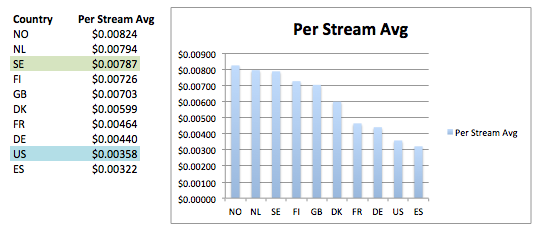
Here’s the summed, net averaged per play rate for the top ten territories.

SpotifyT10CountriesStreamingRates

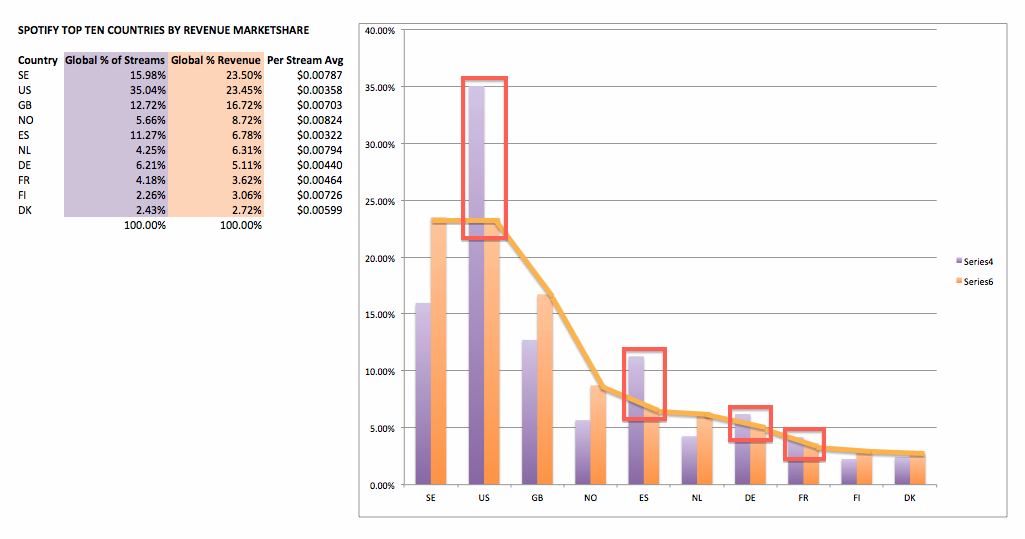
Below the top ten territories are isolated (and the market share recalculated).

The data would seem to suggest that savvy artists and labels avoid the territories where the number of streams far exceeds the percentage of revenue (the red boxes).

SpotifyNOFLYTerritories

Data set provided by US based indie label with 800 songs. Data is summed from sales and reports dated Sept 2011 – Aug 2014. This is what Spotify really looks like to most artists and indie labels.

All Three Pirate Bay Founders Now in Jail | Billboard

One of the founders of popular file-sharing website The Pirate Bay has been arrested under an Interpol warrant as he was crossing into Thailand from Laos, police said Tuesday. Hans Fredrik Lennart Neij, who uses the alias TiAMO, was detained Monday by Thai immigration police at a checkpoint in Thailand’s Nong Khai province, about 500 kilometers (310 miles) northeast of Bangkok.

READ THE FULL STORY AT BILLBOARD:
http://www.billboard.com/articles/business/6304466/pirate-bay-founders-jail-hans-fredrik-lennart-neij


RELATED:

A Tale of Two Pirates? Daniel Ek (uTorrent) and Kim Dotcom (Megaupload)

Pandora’s New Deal: Different Pay, Different Play | NPR

The new payola?

Performers get paid a small royalty each time one of their songs is played on Internet radio, at a rate set by a Royalty Court at the Library of Congress. But Internet radio and labels can strike individual deals, as Pandora did with Merlin. The Internet service will recommend Merlin artists over those not affiliated with the consortium in exchange for paying Merlin’s musicians a lower royalty rate.

Merlin artists get more spins, and Pandora winds up paying less in royalties than it would if were giving those same spins to non-Merlin artists. Plus, consortium labels will get to suggest favorite tracks.

READ OR LISTEN TO THE FULL STORY AT NPR:
http://www.npr.org/2014/11/26/366339553/pandoras-new-deal-different-pay-different-play

Kim Dotcom declares he is ‘broke’ because of legal fight | BBC

Kim Dotcom, the founder of the seized file-sharing site Megaupload, has declared himself “broke”.

The entrepreneur said he had spent $10m (£6.4m) on legal costs since being arrested in New Zealand in 2012 and accused of internet piracy.

Mr Dotcom had employed a local law firm to fight the US’s attempt to extradite him, but his defence team stepped down a fortnight ago without explaining why.

READ THE FULL STORY AT THE BBC:
http://www.bbc.com/news/technology-30209067

RELATED:

A Tale of Two Pirates? Daniel Ek (uTorrent) and Kim Dotcom (Megaupload)

Lars Was First And Lars Was Right

Isn’t it funny how the same arguments used to justify free streaming are the same arguments that were used to justify piracy? In the end, Chuck D was very wrong, and Lars Ulrich was very right…

The Trichordist

Charlie Rose featured guests Lars Ulrich of Metallica and Chuck D from Public Enemy in 2000 to discuss Napster, the internet and the future of the music industry. In stunning clarity, Lars saw the grim future that would disenfranchise millions of artists, musicians, photographers, authors, writers and other creators who would have their living illegally appropriated by internet robber barons.

“if the record labels are not making the money, than the internet companies will be, and if they are not paying the artists, they are profiting illegally.” -Lars Ulrich

Nearly thirteen years later every statement Lars made in this interview has come to pass as truth. The new gatekeepers of the internet profit from the illegal distribution of  artists’ work while paying the artists nothing, nadda, zero, zip.

Meanwhile Chuck D’s prediction definitely did not come true:

“I think there’s going to be more music sold than ever,” – Chuck…

View original post 206 more words

Guest Post: “Taylor Swift, Spotify and the Musical Food Chain Myth” by @DoriaRoberts #irespectmusic

Awesome interview with @DoriaRoberts

Music Technology Policy

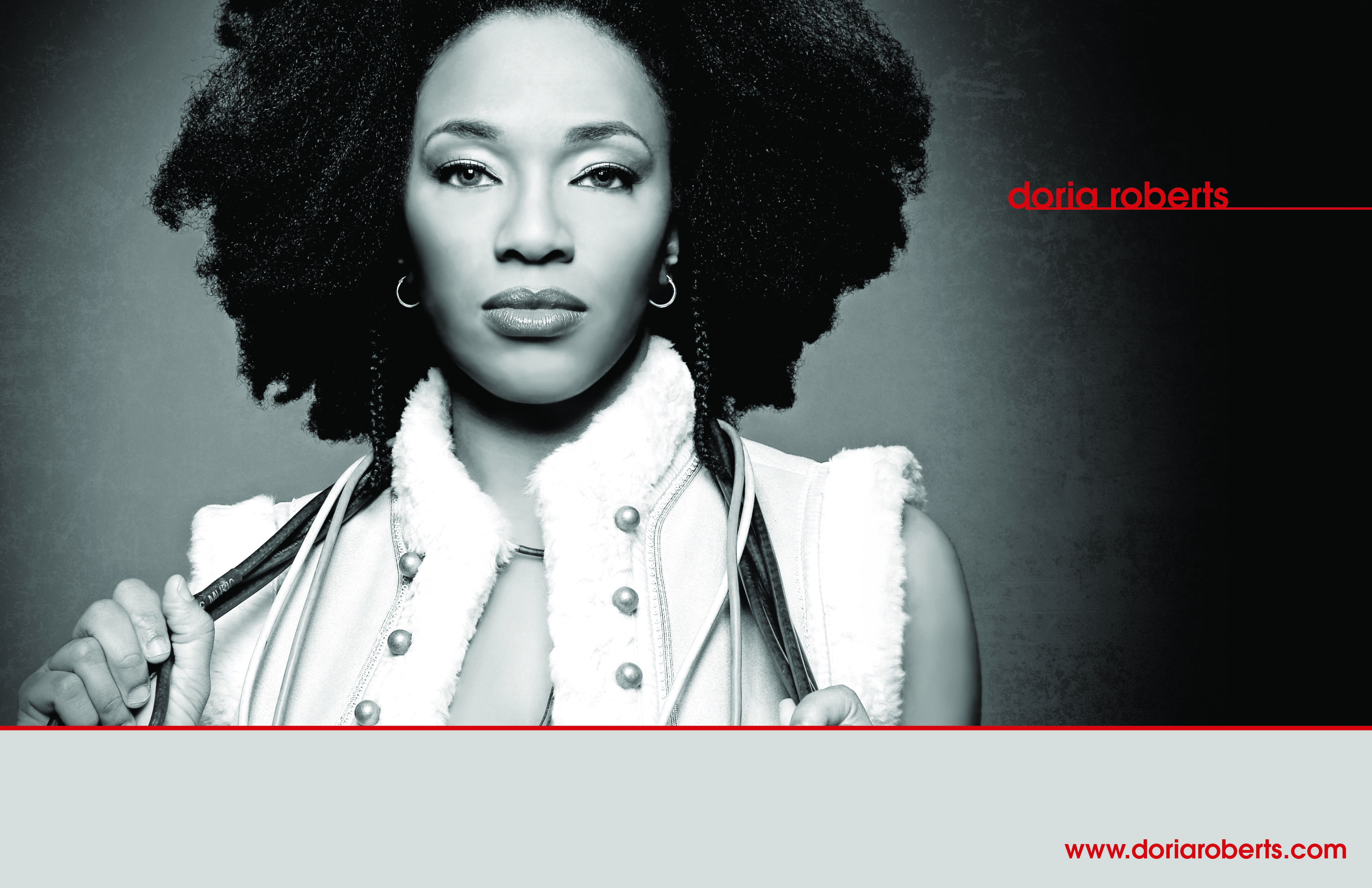
doria roberts promo photo

[Ed. Note: Chris Castle says:  We are so lucky to have the opportunity to publish this illuminating post by Doria Roberts, an outstanding discussion that shines a light on the issues facing all professional artists. I’m sure we’ll hear Doria’s strong voice many times in the future and will be the better for her.] 

“The most common way people give up their power is by thinking they don’t have any.” –Alice Walker

I cannot tell you how happy I am that the conversation about Taylor Swift and Spotify is happening. Maybe people will start listening to what independent artists like me and my peers have been saying for years now.

A little background for those who don’t know me: I’ve been a indie musician by choice for 22 years. In 1999, I was chosen to perform at Lilith Fair and quit my day job the following Monday…

View original post 1,842 more words

Dead Kennedys’ East Bay Ray Explains How YouTube Is Stealing From Musicians | New York Observer

Taylor Swift recently brought these “robber baron” business tactics into the mainstream. When she removed her catalog from Spotify, they were trying to force a bad deal on her. Dead Kennedys had Spotify figured out early on, we pulled most but not all of our tracks off of Spotify back at the start of 2013. Musicians are not against streaming, but we are against “plantation/sharecropping” business practices. It doesn’t have to be this way.

Educate yourself about what’s really going on and the reality is shocking. Don’t buy the lies and memes, educate people, share this article, stand up. The Internet is not like the weather, it was created by humans and can be changed by humans. It’s not about regulating the Internet, it’s about regulating businesses. (They’ll try to confuse that, too.)

Anil Prasad VS Spotify : Public Debate Challenge ( @innerviews vs. @eldsjal / @spotify )

via Facebook:

Anil Prasad
Yesterday at 11:22am
I just challenged Daniel Ek and Team Spotify on Twitter to debate me in a public forum on their policies. Let’s see what comes of it. The truth is, probably nothing, because I am incapable of being bought and sold by any industry association. However, I’m making the attempt. Someone should bluntly ask the hard questions without handlers, message massaging or publicists. If you want a chance of this happening send him a tweet yourself at: @eldsjal (Daniel Ek)

AnilVsEkTweets

Anil Prasad @ Facebook:
https://www.facebook.com/innerviews/posts/10152912535628594

Anil Prasad @ Twitter:
https://twitter.com/Innerviews
@Innerviews

New Math $.00666 : Billboard’s New “Consumption” Chart, Free Streams and the End Of Meaningful Metrics?

The purpose of a chart is to provide meaningful metrics to determine the relative value of a title in the marketplace. The new Billboard 200 “consumption” chart moves away from the traditional metric of album sales. In doing so, the new chart also creates questions about how meaningful this new information will be to artists, managers and labels. As album sales continue to decrease a method of measurement that addresses today’s environment is absolutely important.

The move from a “Sales Chart” to a “Consumption Chart” acknowledges what we already know…  More music is being consumed than ever before and conversely musicians are being compensated less than ever before, for that consumption.

Track Equivalent Album sales for measuring the volume of individual songs by a single artist has been a helpful and accurate method of comparing unit sales in the ala carte song era of Itunes (and others) in that every 10 song sales equal one album. This is easy to quantify as logically ten songs sold at 99 cents really does equal the revenue of one album at $9.99. So for comparative purposes this makes sense both in terms of the underlying logic and the economic reality.

But the new Billboard chart has a bigger problem when incorporating streams. The new metric of 1,500 streams per album and 150 streams per song would make sense if there were in fact a fixed price point for streams of $.00666 (as in $.0666 x 150 = $.99 and $.00666 x 1,500 = $9.99). We’re gonna have some fun with this, stay tuned…

Maybe Billboard has a sense of humor in that the calculation of streams to song and album equivalent’s are $.00666 per stream?

It get’s worse because we know from our Streaming Price Bible that neither Spotify or YouTube are paying anywhere near those rates on an summed, averaged per stream rate. From what we’ve heard Billboard is excluding plays from YouTube (for now) but we have a feeling streaming from YouTube Music Key will be included just as those are from Google Play.

The problem here is that the free tiers dilute how meaningful this data is actually going to be to everyone. As we pointed out in one data set we reviewed Spotify’s free streams accounted for 58% of total plays, but only 16% of revenue in the USA. On YouTube (by any name) the amount of streams to revenue is likely to be far more extreme.
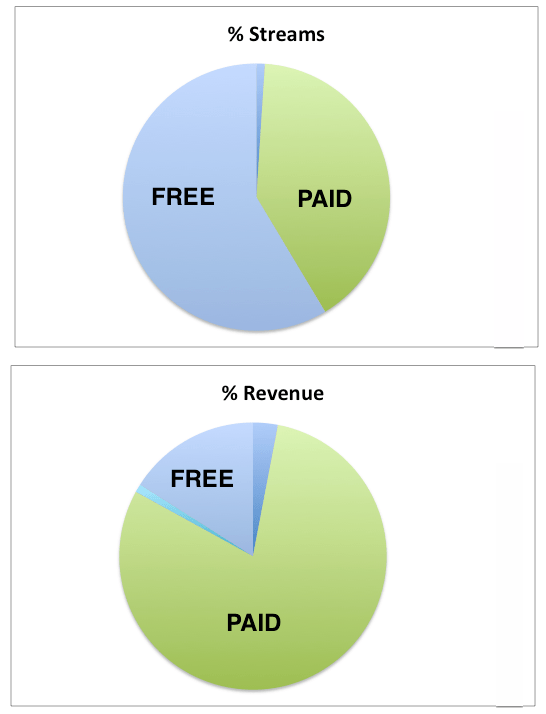
FreePaidChart

What’s worse is that we can clearly see that over time, as fixed revenue streaming services scale the per stream rate will drop. The bigger the services scale, the less each stream is worth. This is unless of course the labels demand a minimum per stream rate that actually matches the metric the chart is suggesting ($.00666 – retail) and no streams from free tiers should be included.

Suddenly, we’re not feeling so lonely on this point, see here:

WME’s Marc Geiger Sides With Taylor Swift, Calls Free Streaming Services ‘F—ed Up’ | Billboard

Add one more name to the list of industry figureheads who’ve sided with Taylor Swift in her battle with Spotify: Marc Geiger, William Morris Endeavor’s head of music, who called the ubiquity of free, ad-supported streaming music services “a f—ed-up, torturous thing for 15 years”

And…

Essay: Why Streaming (Done Right) Will Save the Music Business | Billboard

As the first music-streaming service to be licensed by all major labels — and the No. 2 on-demand music service in the United States — it may surprise you to learn that we at Rhapsody support, and generally agree with, the decision by Taylor Swift and other artists to not make their new albums available on free streaming services immediately after release.

If we can all agree that Free Streams are problematic for the business, why can’t we agree that free streams are bad for a chart?
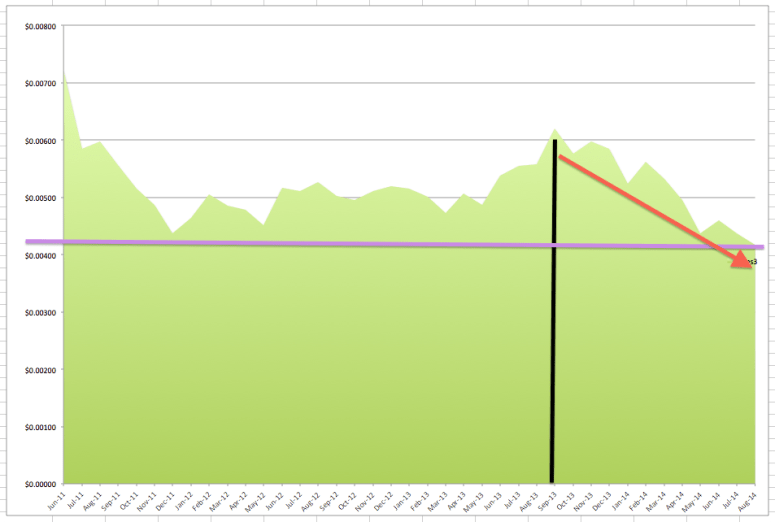
SpotifyNetMONTHLY_Charted

Combining the free and paid steams defeats the purpose of what the chart is attempting to achieve, a meaningful metric of paid consumer demand.

Free streams must be filtered out of the chart for it to be meaningful.

Giving away a million of something to gain chart positoning is not new and has been controversial. Lady Gaga’s “Art Pop” album benefited from a 99 cent sale at Amazon.com. However albums given away for free by Jay-Z (in partnership with Samsung) and U2 (in partnership with Apple) have not qualified for charting. There is a reason why.

Add to this YouTube views are known to be gamed regularly with many services offering “pay for plays”. We’re also seeing a growth market for services that provide “pay for plays” on Spotify as well. We recognize that in the early days of Soundscan there were attempts to game that system as well by buying off heavily weighted indie stores with free goods, cash or both.

In a digital world where more consumers are streaming on free tiers than paying subscriptions, where the price per stream is falling as services scale, and where there is no fixed price point as a baseline one has to wonder what the true value of the new chart will really be? If it is to illustrate just how wide the gap is between consumption and revenue, then that may be it’s only real purpose.

It’s not like any of this is new, or news. Big Champange, Music Metric and others have been tracking not only sales data but social media metrics for engagement, free streams (youtube and soundcloud) and even p2p filesharing data for years. If we’re going to get honest about “consumption” charts The Pirate Bay has a Top 100 why not include those rankings? To be clear, this is sarcasm, not an actual suggestion. It also illustrates the grossly mislead notion of including free streams in the new chart. It’s not that hard to determine how we are not making money…

REALTED:

Streaming Is the Future, Spotify Is Not. Let’s talk Solutions.

Why Spotify is not Netflix (But Maybe It Should Be)

How to Fix Music Streaming in One Word, “Windows”… two more “Pay Gates”…


The Problem With Steve Albini | AdLand

Just last year, during a Reddit AMA, Albini had this to say in a response to a person asking about music piracy and whether or not it hurts him economically.

I reject the term “piracy.” It’s people listening to music and sharing it with other people, and it’s good for musicians because it widens the audience for music. The record industry doesn’t like trading music because they see it as lost sales, but that’s nonsense. Sales have declined because physical discs are no longer the distribution medium for mass-appeal pop music, and expecting people to treat files as physical objects to be inventoried and bought individually is absurd.

Quite simplistic, as we all know not every musician wants their music being shared for free, in exchange for exposure. Also quite simplistic as google happily places ads on such infringing sites, making it tons of money. Keep it in mind before you put up a straw man argument, google did not create the sites, so they can’t hide behind all the hard work it took to build such sites. It merely placed ads on it, with a nice 32% share of the profits to boot.

READ THE FULL POST AT ADLAND:
http://adland.tv/adnews/problem-steve-albini/451760552