So Much For Spotify in Sweden, Overall Sales Drop… and Norway Too…Streaming Kills…

Remember how we’ve been told for years that Spotify is the solution to the record industry’s problems? Remember how we’ve been told that Spotify is the solution to piracy? Remember the stories of how “sales are growing” in Sweden and Norway?

Well guess what? According to Digital Music News (reported by IFPI) overall sales in Sweden and Norway are actually down for 2014.

Overall. Down.

Hmmmm… Click the links below…

After Years of Recovery, Music Sales Are Now Declining In Sweden… | Digital Music News

Streaming Killed Piracy In Norway. It Also Killed Recording Sales… | Digital Music News

We’ve said it before, and we’re willing (and happy to be wrong) that streaming economics, specifically of the Spotify variety are unsustainable. That doesn’t mean the economics can’t be changed, or that streaming doesn’t work and can not work – it just means that the predictions about growing revenue via Spotify are wrong.

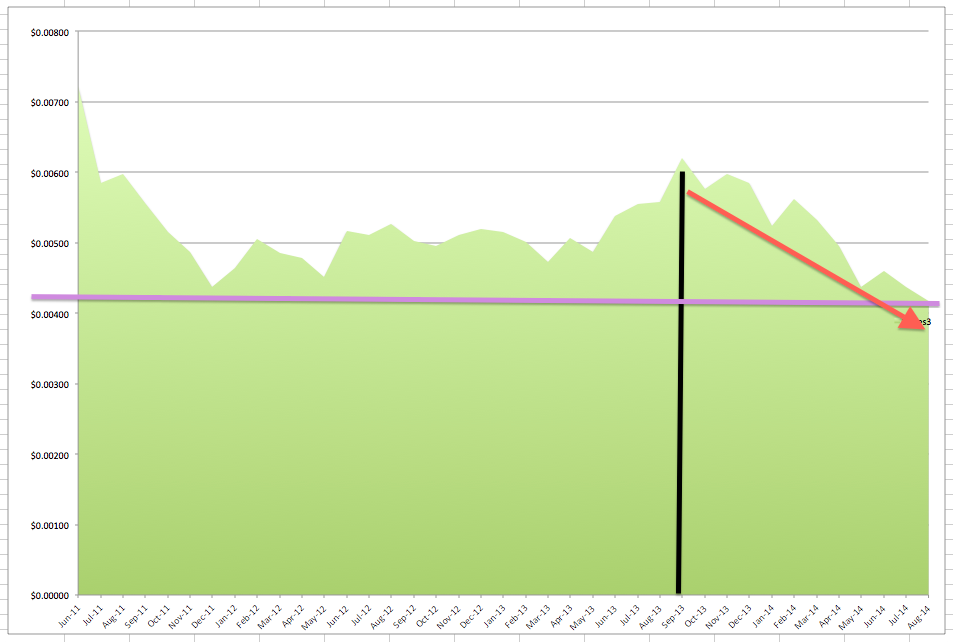
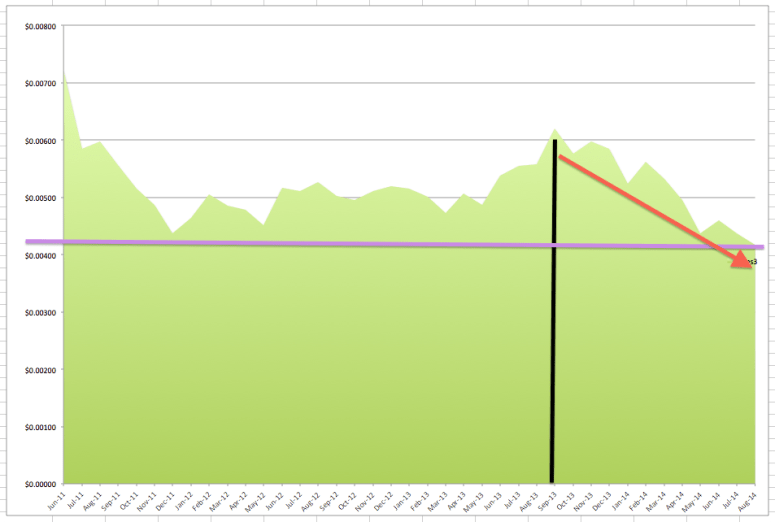
We’ve questioned the philosophy and math behind streaming for a while now and it appears some of our criticisms and concerns are coming true. For example we noted that the Spotify per stream rates are dropping as more users are added to the service.

If overall revenue continue to decline, especially in the most promoted and championed markets in the world, what does that say for the rest of the world?

We previously reported that the per stream rates are dropping as the service add more users (graph below). This new data suggests that not only is the per stream rate dropping, but in two the leading countries in the world overall revenues are also down.

It’s just math.

SpotifyNetMONTHLY_Charted


Zoë Keating Publishes Google/YouTube Transcript : Clarity | Zoë Keating Blog

With friends like these…

If i wanted to just let content ID keep doing it’s thing, and it does a great job at and i’m totally happy with it and i don’t want to participate in the music service, is that an option?

That’s unfortunately not an option.

Assuming i don’t want to, then what would occur?

So what would happen is, um, so in the worst case scenario, because we do understand there are cases where our partners don’t want to participate for various reasons, what we basically have to do is because the music terms are essentially like outdated, the content that you directly upload from accounts that you own under the content owner attached to the agreement, we’ll have to block that content. but anything that comes up that we’re able to scan and match through content ID we could just apply a track policy but the commercial terms no longer apply so there’s not going to be any revenue generated.

Wow that’s pretty harsh.

Yeah, it’s harsh and trust me, it is really difficult for me to have this conversation with all of my partners but we’re really, what we’re trying to do is basically create a new revenue stream on top of what exists on the platform today.

PLEASE READ THE ENTIRE POST/TRANSCRIPT AT:
http://zoekeating.tumblr.com/post/109312851929/clarity

* MUST READ * YouTube’s Heartbreaking Extortion Of Musicians Begins… | Zoë Keating Explains New Rules

Below is the opener, after that – it gets worse…

“My Google Youtube rep contacted me the other day. They were nice and took time to explain everything clearly to me, but the message was firm: I have to decide. I need to sign on to the new Youtube music services agreement or I will have my Youtube channel blocked.
This new music service agreement covers my Content ID account and it includes mandatory participation in Youtube’s new subscription streaming service, called Music Key, along with all that participation entails. Here are some of the terms I have problems with:

1) All of my catalog must be included in both the free and premium music service. Even if I don’t deliver all my music, because I’m a music partner, anything that a 3rd party uploads with my info in the description will be automatically included in the music service too.

2) All songs will be set to “montetize”, meaning there will be ads on them.

3) I will be required to release new music on Youtube at the same time I release it anywhere else. So no more releasing to my core fans first on Bandcamp and then on iTunes.

4) All my catalog must be uploaded at high resolution, according to Google’s standard which is currently 320 kbps.

5) The contract lasts for 5 years.”

Seriously the whole post is an absolute must read, in full, probably at least two or three times to have it all sink in.

READ THE FULL POST ON ZOE KEATING’S BLOG:
http://zoekeating.tumblr.com/post/108898194009/what-should-i-do-about-youtube

Involuntarily Distribution Business Subsidies | East Bay Ray

One of the talking points that various tech company commentators, academics and bloggers have used to try to justify companies exploiting an artist’s work without consent (a loophole in safe harbor) is that it would lessen the barrier for tech companies to start up. The idea is that creators should be required to give something up to facilitate this goal. Business start-ups are all well and good, but to require anyone to involuntarily subsidize a business, internet or otherwise, with something they have put time, effort, money, and skill into is extremely problematic.

Would these same people advocate that landlords and utility companies also give up income and the right of consent to help internet companies? That would also make it easier for them to start. But no one has suggested that.

It could be ruinous for creators to be required to be involuntarily involved in start-ups that may or not succeed, tying them to businesses that the artists has no way to vet to see if they even know how to distribute competently or honestly. If they are to survive, artists need to examine their licensees and distributors. I’ve seen many artist’s careers die prematurely from incompetent, greedy or dishonest businesses. (Compulsory licenses that are a last resort to negotiation, rather than the first resort to eliminate negotiation, is an alternative that has for decades shown itself to ensure artist’s sustainability.)

To put it into personal terms, I shouldn’t be forced, or any person for that matter, into being a lab rat for some click bait experiment. And then if the experiment is successful, none of the content creators share in any of the IPO rewards. A bit un-American I’d say and bad policy, it does not allocate rewards according to risk.

History has shown that exploitation of another person’s work with little compensation or without their consent to insure an enterprise’s survival is fraught with ethical and moral issues. If internet companies can not make money selling a product or service on merit and integrity, and treating the people that supply their “product” justly and with respect, something is not right. No matter how well intentioned by well meaning people, economic philosophies that ignore consent or fair compensation, rarely turn out good for society.

– – –
East Bay Ray is the guitarist, co-founder and one of two main songwriters for the band Dead Kennedys. He has been speaking out on issues facing independent artists—on National Public Radio, at Chico State University, and on panels for SXSW, Association of Independent Music Publishers, California Lawyers for the Arts, SF Music Tech conferences, Hastings Law School and Boalt Hall Law School. Ray has also met with members of the U.S. Congress in Washington, D.C. to advocate for artists’ rights.

Nashville’s Musical Middle Class Collapses | Tennessean

This says it all…

Since 2000, the number of full-time songwriters in Nashville has fallen by 80 percent, according to the Nashville Songwriters Association International. Album sales plummeted below 4 million in weekly sales in August, which marked a new low point since the industry began tracking data in 1991. Streaming services are increasing in popularity but have been unable to end the spiral.

READ THE FULL STORY AT THE TENNESSEAN:
http://www.tennessean.com/story/entertainment/music/2015/01/04/nashville-musical-middle-class-collapses-new-dylans/21236245/

Wondering Sound: “David Lowery Has Become Most Important Spokesperson for Artists Rights In Digital Era”

‘In the last three years, David Lowery has become perhaps most the important and ardent spokesperson for artist rights in the digital era. Who is he?’

Balanced, funny and in depth profile of fellow Trichordist writer David Lowery.  Must read.

READ THE FULL STORY AT WONDERING SOUND:
http://www.wonderingsound.com/feature/david-lowery-digital-music-cracker-interview/

Spotify Must “Adapt Or Die” : Pricing For Sustainability

The single biggest problem with Spotify (and other services like it) is that they have completely removed the relationship between the artists and the fan. The labels have leveraged their catalogs as an asset in exchange for equity shares in a tech start up that is subsidized by the artists. And to be clear, that is equity that the labels are not “sharing” with the artists who are making the equity possible. We’re not even sure how this could be legal, but we’ll leave that to the lawyers to figure out.

The second problem is that the money the consumer pays, does not pay the artists the consumer is supporting. The model for Spotify and others is to divide the total pool of revenue by the total number of streams and pay out the revenue on a per stream basis. But that is not the same as a directing each consumers payments only to the artists that consumer is streaming.

So in two very important ways the relationship between the fan and the artist has been broken by completely disconnecting compensation from consumption.

There’s a very simple fix, per stream retail pricing. We are NOT supporting the notion that 150 streams should equal one song download. However for the purposes of this writing that’s where we’re going to start. We feel that Billboard has grossly undervalued the cost of a stream, but we’ll get to that later.

We’re starting with this metric specifically in the context of the new Billboard “consumption” chart whereby every 150 streams = 1 song. At retail, that means each stream is worth $.00666 (we still love the irony there).

$.00666 x 150 = $.99

Here’s what the breakdown looks like PER STREAM:

$.00666 Gross Retail (Paid by Consumer to Spotify)

$.00666 x .70 = $.00467 Paid to Artist/Rights Holder (70% of Gross)

$.00666 x .10 = $.000666 Paid to Songwriters / Publishers from 70% Above

So let’s recap… in context of 150 streams to ONE SONG:

$.00666 x 150 = $.99 (One Song)

$.00467  x 150 = $.70 (70% of Gross) To Artist/Label

$.000666 x 150 = $.09 (Full Stat Mechanical, One Song) To Songwriter/Publisher

$.70 – $.09 = $.61 Net to Artist/Label

These are the exact same mechanics paid on a single song download.

Another way to express this would be to say that the consumer spending $10 a month on Spotify can play 1,500 streams. Every stream the consumer plays then pays out 70% of gross, just like iTunes. In other words, every 150 streams equals the same economics as ONE Itunes Song Download in the distribution of revenue.

A consumer pays $10 for every 1,500 streams they consume at $.00666 retail pricing. If they consume more, they pay more. If they consume, less they pay less.  Compensation is now directly reconnected to consumption!

Simple. Easy. Fair.

We can argue about what the price of a stream should be, but reconnecting the artist fan relationship through compensation for consumption is essential.

Steve Jobs was a genius. He reversed engineered the margins and mechanics of physical retail distribution for Itunes. Jobs made it easy for labels to make sense of digital revenues, accounting, operations and royalties reporting. There is no logical reason why streaming services can not operate the same way.

There is also no logical reason why per stream retail pricing can not exist. That is unless of course the goal is to NOT have a simple, easy and fair ecosystem that is sustainable and supports artists.

We tend to think that the retail price per stream should probably more like two to five cents per stream (maybe more), as we’ve heard Beats may be paying. Whatever the retail price per stream to consumers there should be flexibility in the model for variable pricing bu artists and labels.  Variable pricing exists in digital stores such as iTunes as it also does in physical distribution.

Retail per stream pricing restores the relationship between the fan and the artist whereby compensation is directly connected to consumption. This model works and does not change the margins paid by Spotify (and others). The streaming service still retain 30% of the gross revenue, except now we have the opportunity of moving closer to a fair cost of goods.

No Music = No Business.

Add to the above experiments with new release windowing, value propositions based on bundled tiers, etc, and we can start to see a smart and sustainable streaming business emerging for all stakeholders.

Spotify can chose to “adapt or die.” It’s just math.



Spotify Top 10 Territories : Global Revenue Marketshare & Streaming Percentages

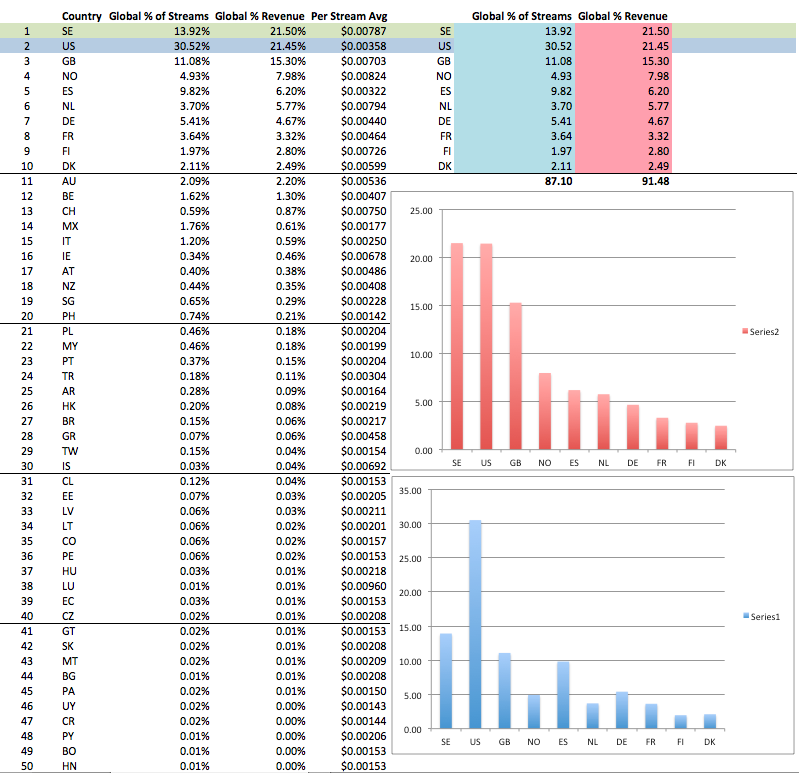
The Top 10 territories account for 87.10% of all streams and 91.48% of all revenue. So all revenue outside of the Top 10 is less than 9% of global revenues. So if you’re streaming your music outside of the Top 10 territories, you are more or less giving your music away.

SpotifyGLOBALMarketshareRevStreams

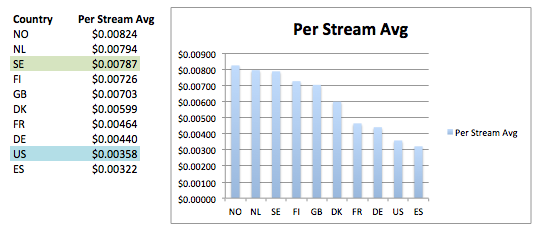
Here’s the summed, net averaged per play rate for the top ten territories.

SpotifyT10CountriesStreamingRates

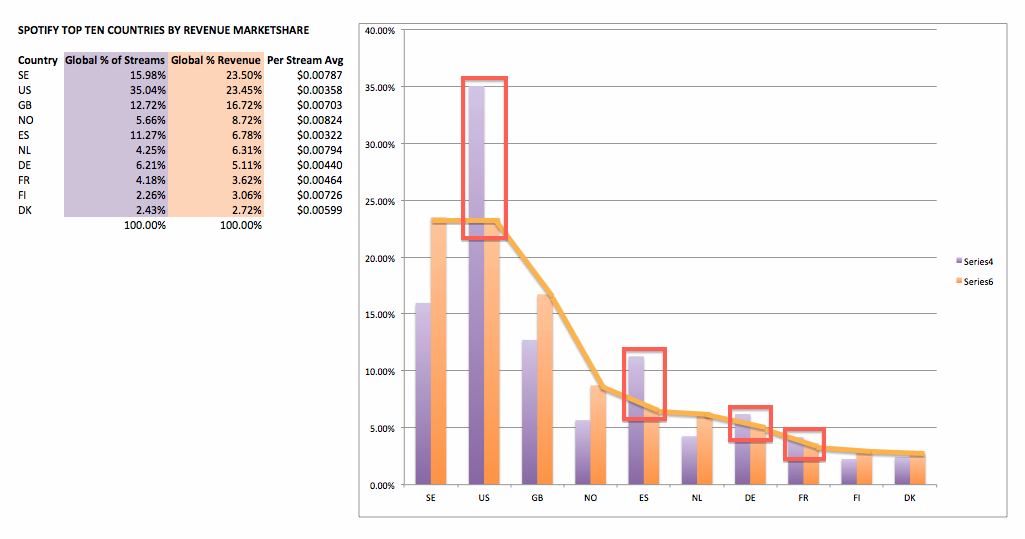
Below the top ten territories are isolated (and the market share recalculated).

The data would seem to suggest that savvy artists and labels avoid the territories where the number of streams far exceeds the percentage of revenue (the red boxes).

SpotifyNOFLYTerritories

Data set provided by US based indie label with 800 songs. Data is summed from sales and reports dated Sept 2011 – Aug 2014. This is what Spotify really looks like to most artists and indie labels.

Anil Prasad VS Spotify : Public Debate Challenge ( @innerviews vs. @eldsjal / @spotify )

via Facebook:

Anil Prasad
Yesterday at 11:22am
I just challenged Daniel Ek and Team Spotify on Twitter to debate me in a public forum on their policies. Let’s see what comes of it. The truth is, probably nothing, because I am incapable of being bought and sold by any industry association. However, I’m making the attempt. Someone should bluntly ask the hard questions without handlers, message massaging or publicists. If you want a chance of this happening send him a tweet yourself at: @eldsjal (Daniel Ek)

AnilVsEkTweets

Anil Prasad @ Facebook:
https://www.facebook.com/innerviews/posts/10152912535628594

Anil Prasad @ Twitter:
https://twitter.com/Innerviews
@Innerviews

New Math $.00666 : Billboard’s New “Consumption” Chart, Free Streams and the End Of Meaningful Metrics?

The purpose of a chart is to provide meaningful metrics to determine the relative value of a title in the marketplace. The new Billboard 200 “consumption” chart moves away from the traditional metric of album sales. In doing so, the new chart also creates questions about how meaningful this new information will be to artists, managers and labels. As album sales continue to decrease a method of measurement that addresses today’s environment is absolutely important.

The move from a “Sales Chart” to a “Consumption Chart” acknowledges what we already know…  More music is being consumed than ever before and conversely musicians are being compensated less than ever before, for that consumption.

Track Equivalent Album sales for measuring the volume of individual songs by a single artist has been a helpful and accurate method of comparing unit sales in the ala carte song era of Itunes (and others) in that every 10 song sales equal one album. This is easy to quantify as logically ten songs sold at 99 cents really does equal the revenue of one album at $9.99. So for comparative purposes this makes sense both in terms of the underlying logic and the economic reality.

But the new Billboard chart has a bigger problem when incorporating streams. The new metric of 1,500 streams per album and 150 streams per song would make sense if there were in fact a fixed price point for streams of $.00666 (as in $.0666 x 150 = $.99 and $.00666 x 1,500 = $9.99). We’re gonna have some fun with this, stay tuned…

Maybe Billboard has a sense of humor in that the calculation of streams to song and album equivalent’s are $.00666 per stream?

It get’s worse because we know from our Streaming Price Bible that neither Spotify or YouTube are paying anywhere near those rates on an summed, averaged per stream rate. From what we’ve heard Billboard is excluding plays from YouTube (for now) but we have a feeling streaming from YouTube Music Key will be included just as those are from Google Play.

The problem here is that the free tiers dilute how meaningful this data is actually going to be to everyone. As we pointed out in one data set we reviewed Spotify’s free streams accounted for 58% of total plays, but only 16% of revenue in the USA. On YouTube (by any name) the amount of streams to revenue is likely to be far more extreme.

FreePaidChart

What’s worse is that we can clearly see that over time, as fixed revenue streaming services scale the per stream rate will drop. The bigger the services scale, the less each stream is worth. This is unless of course the labels demand a minimum per stream rate that actually matches the metric the chart is suggesting ($.00666 – retail) and no streams from free tiers should be included.

Suddenly, we’re not feeling so lonely on this point, see here:

WME’s Marc Geiger Sides With Taylor Swift, Calls Free Streaming Services ‘F—ed Up’ | Billboard

Add one more name to the list of industry figureheads who’ve sided with Taylor Swift in her battle with Spotify: Marc Geiger, William Morris Endeavor’s head of music, who called the ubiquity of free, ad-supported streaming music services “a f—ed-up, torturous thing for 15 years”

And…

Essay: Why Streaming (Done Right) Will Save the Music Business | Billboard

As the first music-streaming service to be licensed by all major labels — and the No. 2 on-demand music service in the United States — it may surprise you to learn that we at Rhapsody support, and generally agree with, the decision by Taylor Swift and other artists to not make their new albums available on free streaming services immediately after release.

If we can all agree that Free Streams are problematic for the business, why can’t we agree that free streams are bad for a chart?

SpotifyNetMONTHLY_Charted

Combining the free and paid steams defeats the purpose of what the chart is attempting to achieve, a meaningful metric of paid consumer demand.

Free streams must be filtered out of the chart for it to be meaningful.

Giving away a million of something to gain chart positoning is not new and has been controversial. Lady Gaga’s “Art Pop” album benefited from a 99 cent sale at Amazon.com. However albums given away for free by Jay-Z (in partnership with Samsung) and U2 (in partnership with Apple) have not qualified for charting. There is a reason why.

Add to this YouTube views are known to be gamed regularly with many services offering “pay for plays”. We’re also seeing a growth market for services that provide “pay for plays” on Spotify as well. We recognize that in the early days of Soundscan there were attempts to game that system as well by buying off heavily weighted indie stores with free goods, cash or both.

In a digital world where more consumers are streaming on free tiers than paying subscriptions, where the price per stream is falling as services scale, and where there is no fixed price point as a baseline one has to wonder what the true value of the new chart will really be? If it is to illustrate just how wide the gap is between consumption and revenue, then that may be it’s only real purpose.

It’s not like any of this is new, or news. Big Champange, Music Metric and others have been tracking not only sales data but social media metrics for engagement, free streams (youtube and soundcloud) and even p2p filesharing data for years. If we’re going to get honest about “consumption” charts The Pirate Bay has a Top 100 why not include those rankings? To be clear, this is sarcasm, not an actual suggestion. It also illustrates the grossly mislead notion of including free streams in the new chart. It’s not that hard to determine how we are not making money…

REALTED:

Streaming Is the Future, Spotify Is Not. Let’s talk Solutions.

Why Spotify is not Netflix (But Maybe It Should Be)

How to Fix Music Streaming in One Word, “Windows”… two more “Pay Gates”…