Why Some Mangers and Agents Love Streaming and Piracy.

We thought you might be interested in this little story we ran last year. Seems like it’s more right on than we could ever imagine. News coming shortly….

The Trichordist

Seems like every six months or so I have friends  forward me an article or interview with a manager or agent extolling the virtues of streaming (and sometimes even piracy.)  Usually this comes with some note that reads something like this “Agent/Manager  X thinks streaming/piracy is a good thing, Why don’t you?”  I am always  perplexed by this.   Of course some managers and agents love streaming and piracy! Less revenue from recorded music means their artists must play more and more live shows to make up the difference.  I thought everyone knew this.

You see managers and agents make virtually all their money from an artist’s live performance not from the artist’s recorded music.    However screwed up it might seem from an artist’s perspective it makes perfect financial sense (at least in the short term) for managers and agents to turn a blind eye to piracy and low…

View original post 1,219 more words

Sell! Pandora Can’t Do Streaming Unless They Fire Chris Harrison

I like reading stock analyst and blogger reports on companies like Pandora and Google.  I think this is where you really get a read on the machiavellian strategies of these predatory monopolies.  Not necessarily taking the analysts and bloggers at their word, but by interpolating the truth from what these folks are being fed.

I’ve noticed recently that  “someone” is floating the idea that Pandora will add on demand streaming to their offerings.  This  has become a lively topic on the stock trading blogs.

The problem is that Pandora can’t do streaming.  There is no compulsory license and they would have to negotiate in the free market with rights holders.  But rights holders no longer trust Pandora’s main legal strategist Chris Harrison. He has pulled two nasty bait and switch routines on rights holders with the CRB.  Here just read my comment on Seeking Alpha:

“… that’s just not true. Easy to google the facts on this one.  IF McAndrews and Herring really wanted to play nice with rightsholders they’d get rid of Chris Harrison. Harrison is still there and still up to the same old tricks. Harrison just pulled a bait and switch with MERLIN (the independent label alliance and about 16% of market). The same old one he pulled when he worked with DMX. He negotiated a sort of “payola” scheme with MERLIN, essentially a discount on spins in bulk for the MERLIN alliance (Payola is not illegal at digital unless maybe like Pandora you own a radio station). He then baited and switched on the labels and took this deal to the Copyright Royalty Board as evidence of a lower free market rate. I doubt the majors and large independents are gonna forgive him for this (a) second time.

Across the board in the music business there is the impression that Pandora, but especially Harrison, will not negotiate in good faith. Harrison always seems to have a trick up his sleeve. They aren’t gonna negotiate a favorable free market streaming deal with Harrison, and they are not required to. On demand streaming is not governed by feds, and Pandora/Harrison’s bad faith is now being used as an example of bad behavior in the copyright review process.

Frankly though, I think Harrison is brilliant. Like a hyena he picked off the dull witted sickly gazelle of the music business, MERLIN/Charles Caldas, and now he’s using its rotting corpse to bludgeon the CRB to lower rates across the board to all labels. Take that UMG! Now that’s leverage! If your strategy is just simply buying some time so Pandora executives can unload this years haul of $122 million dollars in stock compensation, it’s perfect.

Now this may seem to contradict everything I just said, but I don’t disagree with you that Pandora may be a buy (below $15?) But it’s a buy because it will be a takeover target.

Check these links  for background.”

http://bit.ly/1E5T3kp

http://bit.ly/1E5T3kq


Indie Band @excops Goes After McDonald’s for “Play for Food” SXSW “Exposure Showcase”

Remember when we called out McDonald’s for advertising on pirate sites?  (And remember how they never responded?)

Well, continuing McDonald’s tradition of screwing over artists and songwriters, the company is also refusing to pay artists ANYTHING for playing at McDonald’s SXSW showcase.  This is almost as good as “free beer and hugs” except it’s free food and exposure.  And McDonald’s has the gall to end their response with a “#slownewsday”

Slow news day?  Like the only reason anyone cares about artists being screwed over by megacorporations is because it’s a slow news day?  Hey Ronald McDonald, have you met Daniel Ek?

Is this what it’s come down to?  Free food and insults?

Apparently not–ExCops responded with a hearty fuck you.

A must read post by the band on their Facebook page

Read Stereogum (and a bunch of others including the New York Times):

Ex Cops Blast McDonald’s For Offering Its SXSW Talent Exposure Instead Of Money

Rolling Stone:

McDonald’s Responds to Indie-Pop Duo’s Viral Complaint

“ISIS is armed with butcher knives, captured weapons and YouTube…”

Music Technology Policy

Israel’s Prime Minister Benjamin Netanyahu laid it down today in his speech to a joint meeting of Congress:

“ISIS is armed with butcher knives, captured weapons and YouTube…”

This will come as no surprise to MTP readers as we have been hammering this issue for a long, long time.  And of course YouTube has gotten away with it so far, just like Google has with so many of its bad acts. Thanks to sharp reporting by Laurie Segall at CNN Money this story got on their air:

Jennifer Aniston lauds the benefits of Aveeno, Bud Light shows off beer at a concert, and Secret sells its freshly scented deodorant.

Pretty standard commercials, but what’s different is the content that comes after. In this case, they’re all followed by ISIS and jihadi videos.

Terrorism analyst Mubin Shaikh said one video is part of an ongoing propaganda series that ISIS produces and…

View original post 321 more words

This is Your Brand, This is Your Brand On @YouTube & @MediaComUS: @AnheuserBusch Advertising on ISIS Videos

YouTube is a cesspool of videos unsuitable for your children or your brand.    Here it appears the geniuses at MediaCom. Along with the geniuses at YouTube ran a bunch of ads on an ISIS lone wolf training video.  As CNN reports:

“Jennifer Aniston lauds the benefits of Aveeno, Bud Light shows off beer at a concert, and Secret sells its freshly scented deodorant.
Pretty standard commercials, but what’s different is the content that comes after. In this case, they’re all followed by ISIS and jihadi videos.
Terrorism analyst Mubin Shaikh said one video is part of an ongoing propaganda series that ISIS produces and another is a jihadi-themed video.
Video sites like YouTube sell ad time to companies, and the ads get automatically inserted before the videos play. Advertisers don’t directly control where their ads are placed although they can specify the demographics they’d like to target.”…  read more here.

What happens to the money generated by these videos?   This is literally BLOOD MONEY.  Does Google keep it?  We asked this question over and over again.  No one will answer.

With the March 23rd YouTube Music Awards coming up,  will there be a category for “Best Jihadi Lone Wolf Training Video?”


These Charts Show Why The US Government Should Stop Setting Prices For Songs and Recordings

First I bet you didn’t know that US Government sets the prices for many uses of songs and recordings?  What? Are you telling me that in 2015 there is not a technologically feasible way to let the free market set the price of songs and recordings for broadcast, webcasting and streaming?   Bat-shit crazy ain’t it?

Well if you consider that some of the largest most politically powerful corporations benefit from this process it makes a little more sense.  I’ll name just two: Clear Channel and Google. Pay to play government at its finest.

Before you accuse me of pie-ism (arguing over who gets how much songwriters or performers get of the paltry and shrinking pie) I am not. I’m simply pointing out how irrational it is to have the government setting prices in this day and age.   It is not even clear that the process is constitutional as much of the price setting process has no statutory basis, simply just a “temporary” DOJ consent decree that dates from 1941!!!  How are my rights limited by something that is neither a law passed by Congress nor something to which I agreed?  Remember I wasn’t even born yet in 1941.  Neither were the vast majority of songwriters working today.  This is the craziest thing ever.

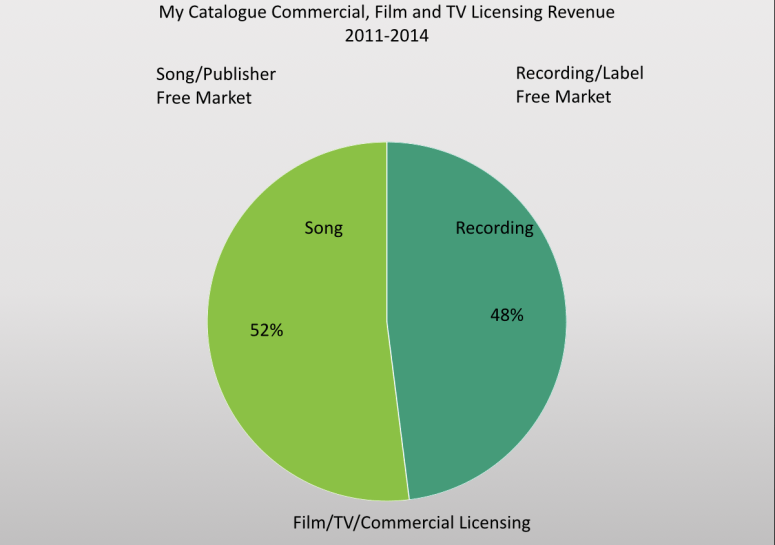
The first chart represents the revenue generated by my songs and recordings from  commercial, TV and film licensing deals 2009-2014. 35 deals.  Notice the free market values the song and recording almost equally.  I’ve polled a couple  mid-size indie publishers and they report approximately the same ratio (based on MFN deals).

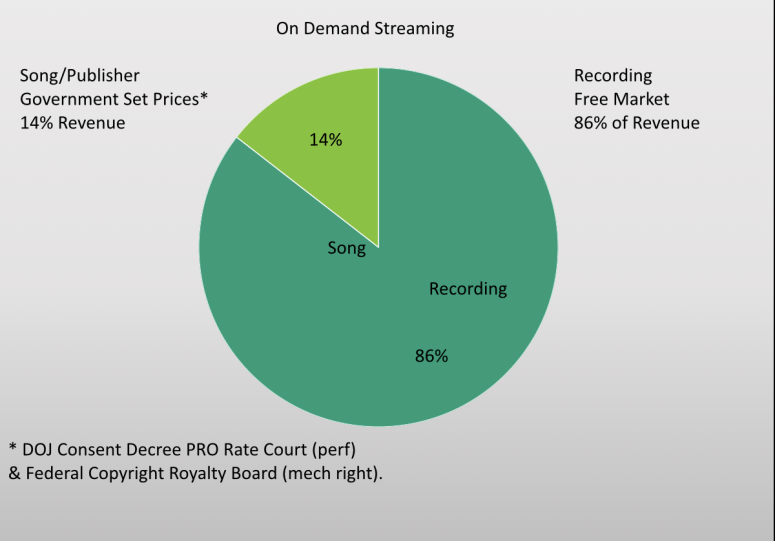
The second chart shows what happens for streaming,  when the rights to the recording is negotiated in the free market but the songwriter rates are set by the government.   These ratios are the same for virtually every songwriter/performer and don’t apply to just my catalogue.

How does the market value songs compared to recordings?

Screen Shot 2015-03-03 at 10.02.26 PM

What happens when the government interferes with pricing for songs?

Screen Shot 2015-03-03 at 10.01.15 PM


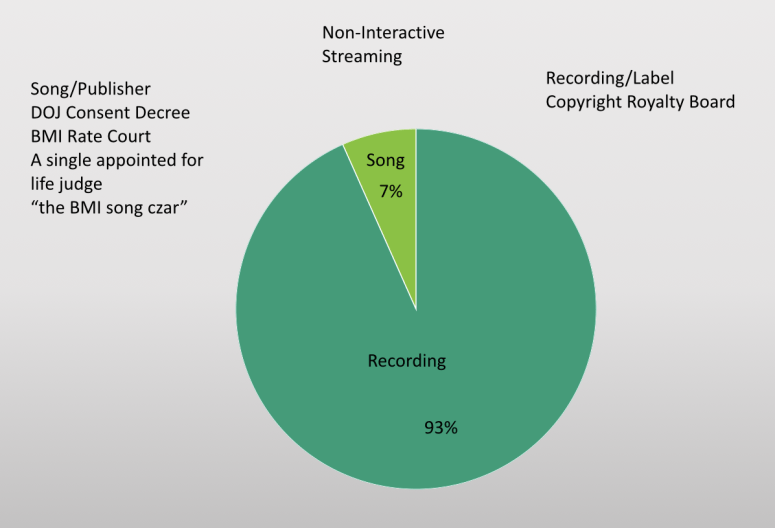
This third chart takes a little effort to explain.  This chart shows what happens for non-interactive streaming (Pandora/Sirius/IHeartRadio etc)  when the rates are set by two totally different government processes.  The rates for my BMI registered songs are set by a single appointed for life federal judge.  The rates for the recordings are set by the Copyright Royalty Board in Washington DC.  The CRB must take in to account “free market” pricing.  But make no mistake it’s government set pricing.  And it’s totally arbitrary and subject to manipulation.

What happens when the government uses two different processes to set prices. One for songs and a different one for recordings.  

Screen Shot 2015-03-03 at 10.35.25 PM

YouTube’s Content ID : $375.00 Per Million Views… aka “Block In All Countries”…

We’ve been supplied nearly a year’s worth of Content ID data from a mid-sized indie label. Over the course of about a year here’s what the data shows:
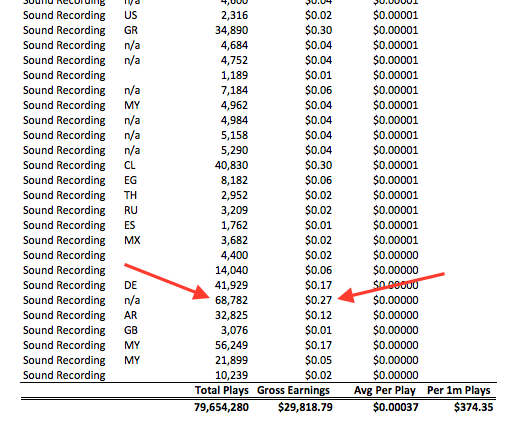
Content ID

After nearly a year and 80 million plays, the net average per play amounts to less than $375.00 per MILLION Plays on YouTube. Ok, that’s just for the sound recording, there are two other parts to the uploaded copyright, the musical composition and the video content itself. Assuming each of the three parts earns an equal share (why would they not, but how would we know given YouTube’s usual secrecy sauce?), then the full amount payable by YouTube for 1 Million plays via Content ID would be $1,125, or $.001125 per play (on average).

We know that on directly uploaded videos where the creator or rights holder is claiming all three copyrights they are being paid more than $1,125 per million plays on average. So why is the revenue reduced when claimed on Content ID?

The other interesting thing about this data is that there is ZERO consistency on what one play is worth. For example, in what world, and under what circumstances is nearly 70,000 plays worth less than $.30? We’ve heard that the major labels may have a per play floor (or indirectly get the equivalent in off the books “breakage”), but after reviewing this data even that is hard to believe.

The lack of openess, transparency and consistency makes it virtually impossible to determine what the true value of a play is within a single category like a Sound Recording let alone comparing the comparable rates paid for Song Writing and the Video itself. Oh yeah, and there’s no audit clauses either – how convenient.

It is still shocking and amazing to us that after a decade YouTube is still not profitable and is being subsidized by Google’s monopoly money from search and data scraping, and yet digital music executives have been trying to sell us on this as the future of revenue for musicians. How is it that after a decade YouTube can not make a profit? If this is the new financial standard for record labels we can see that it’s starting to work! Is this the genius business model labels are embracing? No profit for a decade? If this is the new standard then we suppose everything is fine…

YouTube’s Content ID presents the same problems and challenges of virtually every other ad-supported streaming platform – it’s just math, and it doesn’t work.

There is an even darker side to YouTube that is exposed in Content ID. Even though the video pictured below was eventually removed from YouTube (via a manual DMCA claim) it illustrates the core problem of YouTube in general.

Here’s the music of Jack White being used to sell Sex Tourism and perhaps even Human Trafficking and Sex Slavery.

Note the Ads by Google with the fine print asking YouTube users to “chat now” or “send gift” for asian girls in Thailand and China as well as filipinocupid.com.

Artists have no consent over where their music is being used, or for what their music is impliedly endorsing or selling. It’s not a big leap from the above to political uses where an artist’s song can be exploited to endorse political candidates, ideologies and issues to which the artist is philosophically opposed.  Like human trafficking.

We have a hard time believing artists would lend their consent to these types of videos (if they knew at all), but then again, you never know when dangling that carrot of thirty cents of revenue in front of them…

So in a world where Spotify is paying about $5,000 per million plays on sound recordings, YouTube by comparison is paying less than $375 for the same million plays. So let’s add this up.

On YouTube artists have no consent and are granted no licenses for the (infringing) distribution for the majority of their work and they’re paid less than 1/10th of what Spotify pays for the same sound recording. Wow, just wow. Ya’ll doing the math on this?

If you thought that Spotify was problematic as an ad-supported streaming platform one has to wonder what could possibly be attractive about YouTube… Oh, you don’t have a choice. You do what YouTube and Google tell you to do as we saw with Google’s “notice and shakedown” practices with Zoë Keating and indie labels. The great decade long experiments of ad-supported streaming are a disaster for artists and rights holders while cannibalizing transactional revenues that once sustained the industry.  Not to mention Google taking down an eye popping 180 million infringing videos from YouTube.

Although streaming is no doubt the future of distrbution, the mismanagement of this transition may well be the worst planned in the history of the industry.

Our advice to artists, particularly artists who own their recordings, is it’s time to take a pass on that $375 per million views and toggle your Content ID setting to “Block In All Countries.” How about adding a little scarcity and reality back into the economics of online music distribution? If YouTube wants to monetize your work maybe they can come up with a fair license.

It’s just math. Just say no…
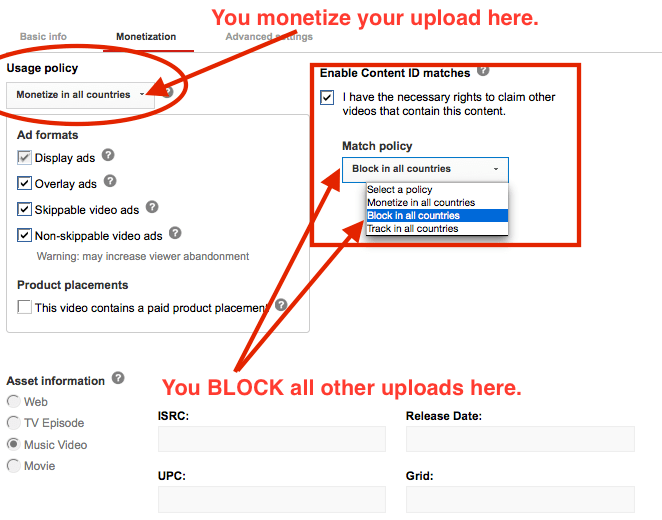
Block_In_All_Countries

OK, let’s review, you can enable Content ID and make $375 per 1 million views, or you can Block In All Countries. The choice seems pretty obvious, doesn’t it? It’s pretty stunning when Spotify start to look like the good guys.



On The Other Hand #4: Unlike YouTube at least Spotify Doesn’t Broadcast ISIS Terror Videos

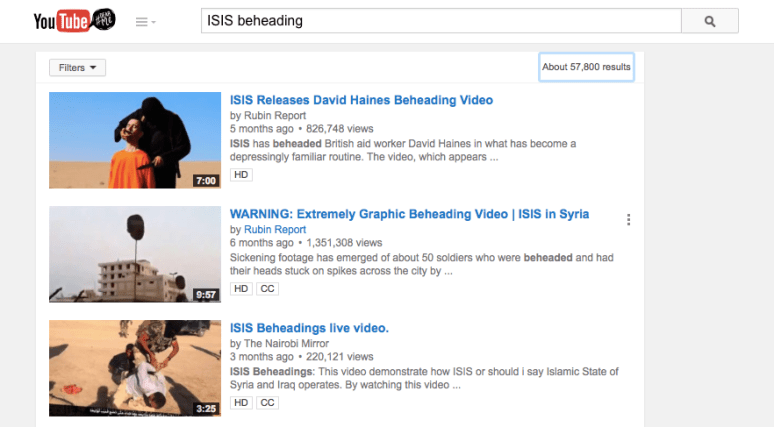
While artists focus on the paltry payouts from Spotify,  we’d like to take this opportunity to remind you that YouTube ALSO aids terror groups in spreading terror by hosting ISIS beheading videos.  Why the fuck do artists do business with this company?  Why the fuck do parents let their children use YouTube?  Why would any advertiser in their right mind do business with these people?

Hosting and spreading these videos doesn’t further free speech. It aids and abets terrorists by spreading the terror.  Also known as “material support”.

As the Israeli Prime Minister Netanyahu correctly pointed out in his speech to Congress:

 “ISIS is armed with butcher knives, captured weapons and YouTube…”

YouTube admitted taking down 180 million videos last year.  Why do they leave these beheading videos up?


Screen Shot 2015-03-03 at 9.03.46 PM


And in case you didn’t quite get the point from beheadings:

Google Admits to Taking Down 180 Million Infringing Videos from YouTube in 2014 Alone

If you follow the Google Transparency Report, you will have seen this official Google description of what the report measures:

Google regularly receives requests from copyright owners and reporting organizations that represent them to remove search results that link to material that allegedly infringes copyrights. Each request names specific URLs to be removed, and we list the domain portions of URLs requested to be removed under specified domains.

That means that the transparency report only measures links in Google’s search engine.  That doesn’t include Blogger which is a hot bed of links to sites using the BitTorrent protocol, and it also does not include YouTube.

YouTube, of course, is a site that is 100% within Google’s control and for which Google sells 100% of the advertising.

We’ve always wondered why the transparency report doesn’t include all take down notices that Google receives across all of its platforms, because that would be…you know…transparent.

Today we find out from a Google representative (the elusive and nameless Google representative who really gets around) that YouTube took down 180 MILLION infringing videos LAST YEAR ALONE according to PC World:

Google argues that new laws aren’t needed to protect copyright holders.

“We’ll continue working to protect people using our services,” Google’s lawyer said Monday. Last year alone, he said, it removed 500 million “bad ads” and over 180 million YouTube videos for policy violations.

Aside from the mindblowing number of takedowns, this admission raises a more interesting question.  If any advertising was sold against the 180 million videos–and it would be hard to believe that NO advertising was sold–what happened to that money?  Did any advertisers get a refund?

What do you think?

It’s Just Math : Digital Music Execs Exit, But will the Pivot to Paid Subs Be Enough To Save The Record Biz?

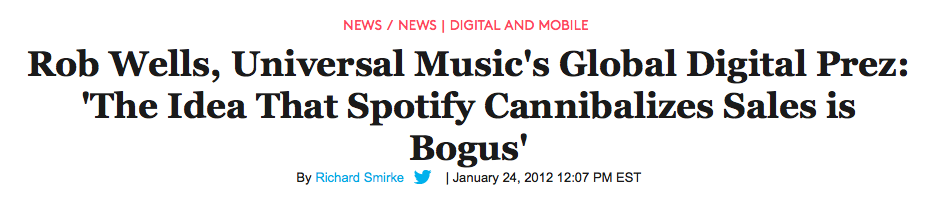
Back in October of 2014 we asked the question “Who will be the First Fired Label Execs over Spotify Fiasco & Cannibalization?“. Now we know. In one week, two senior major label digital music execs have resigned. First Rob Wells on Monday, and on Friday David Ring followed.

Screen Shot 2015-02-24 at 12.18.56 AM

We don’t know if these resignations are related to the realization that Spotify actually is cannibalizing transactional revenues, or that YouTube Music Key will do more and worse, but the timing is suspect given recent statements by label chief Lucian Grange.

“We want to accelerate paid subscriptions… Ad-funded on-demand is not going to sustain the entire ecosystem of the creators as well as the investors” – Lucian Grange

Spotify has been a disaster from bad artist relations to the catalyst for declining transactional revenues. We celebrate the move for more aggressive positioning to paid subscriptions, but even at current rates of $9.99 a month it’s hard to see subs gain the marketshare and revenue needed to compensate for the rapidly declining transactional revenues. In 2014 Itunes revenues dropped by double digits with Apple reporting a decrease of 13%-14% year to year. This following a decrease in overall digital revenues in 2013 (the first decrease ever in digital format sales since their inception).

So that’s two consecutive years of reduced revenue in what should be a growing market segment. So what went wrong? In a word, Spotify. Two more, YouTube.

In other words, Free Doesn’t Pay…

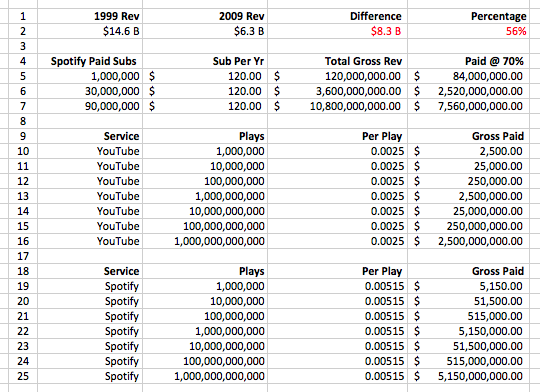
We’ve said it before and we’ll say it again, it’s just math. Below is a table we first published two years ago in February of 2013 when we asked the question, “Music Streaming Math, Can It All Add Up?”.

streamingmath

Although the aggressive move to paid subscriptions is a very positive one, we’re still concerned when looking at the numbers in the tables above when put in the context of the current state of the mature subscription based businesses (see below).

Netflix only has 36m subscribers in the US, no free tier, and massive limitations on available titles of both catalog and new releases. Sirius XM, 26.3m in the US as a non-interactive curated service installed in homes, cars and accessible online. Premium Cable has 56m subscribers in the US paying much more than $10 a month and also with many limitations. Spotify… 3m paid subscribers in the US after four years. Tell us again about this strategy of “waiting for scale.” Three Million Paid… Three…

* 3m Spotify Subs Screen Shot
* 26.3m Sirius XM Subs Screen Shot
* 36m Netflix Subs Screen Shot
* 56m Premium Cable Subs Screen Shot
* $7b Music Business Screen Shot

Of course none of this is to say that streaming can’t work. It can. It’s that Spotify (and YouTube) are just really bad music business models that have unsustainable economics and exploit artists because they are financial instruments and not a music companies.

Let’s be clear about this. We do believe that streaming is the future of music delivery and distribution, but thus far the transition has been horribly mismanaged. What is needed is clear leadership to define the models and value propositions that work for all stakeholders. We’ve made some suggestions in our common sense post “Streaming Is the Future, Spotify Is Not. Let’s talk Solutions.

We’re open minded about new business models, but before people get ahead of themselves with wild claims about a $100 Billion Record Business based on magic unicorn math we need to get back to earth, and get out the calculators.

It’s just math.