Seabrook’s Stories About Money

Music Technology Policy

ROOSTER

I don’t believe in fairy tales, sermons, or stories about money, baby sister, but thanks for the cigarette.

From True Grit written by Joel Cohen and Ethan Cohen

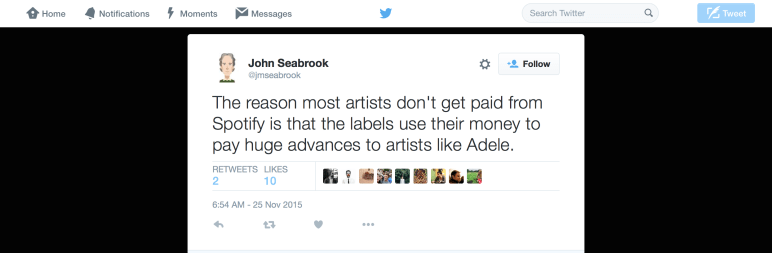
seabrook 1

The author John Seabrook has written another extraordinary piece on Spotify for the New Yorker that one could charitably describe as struggling with truthiness.  But to paraphrase Mrs. Longworth, if you’re not feeling charitable, come sit next to me.

Of course this is not the first time Mr. Seabrook and the New Yorker have come to the rescue of the Darling of Goldman Sachs.  Who can forget John Seabrook’s puff piece on Daniel Ek that appeared in the New Yorker after Spotify’s Taylor Swift debacle.  That was an article that IPO underwriting syndicates like a whole lot more than…let’s just say reality.

That Daniel Ek piece had some howlers that belied what is increasingly appearing to be Mr. Seabrook’s self-directed…

View original post 973 more words

Did Cox Communications Just Do the Dirty to Shareholders?

Last week Cox Communications lost its DMCA “safe harbor” defense against songwriters in BMG Rights Management’s lawsuit against Cox for failing to maintain a repeat infringer policy in Cox’s ISP business.  It has always seemed pretty obvious that an ISP running a “whack a mole” business requiring songwriters and artists to send repeated DMCA notices shouldn’t get the protection of the safe harbor if the law was working the way it should.  Finally a U.S. federal judge things so, too.

As we are often told by Big Tech, the DMCA safe harbors were a negotiated balance, a “grand bargain.”  What usually comes next is some spin that would have you believe that the “notice and takedown” operates as a kind of “tag you’re it” functionality that allows certain anointed ones to get away with not doing the actual stealing, but providing the means for the stealing to occur.  You know, because the Internet.

But now it looks like at least Cox Communications executives might have a real problem on their hands depending on how the facts turn out in the BMG case.  Why?

As Professor Tim Wu taught us before he started working for the New York Attorney General:

If the Internet were not a bookstore, or tubes, but rather a red-light district, YouTube would best be imagined as the hotel, and Napster, well, the pimp. YouTube, like a hotel, provides space for people to do things, legal or not. It’s not doing anything illegal itself, but its visitors may be. But Napster, everyone more or less now admits, was cast as the pimp: It was mainly a means of getting illegal stuff.

To extend Professor Wu’s pimp allegory, in Cox’s case it is the ISP who is providing the means of getting illegal stuff, and Cox wants to hide behind the “grand bargain” of the DMCA in order to look less like that metaphorical pimp.  In a way, it’s actually more complex than that.  According to Cox’s insurance carrier that is suing Cox to get out of any coverage, Cox’s executives intentionally failed to implement a repeat infringer policy.  The burden of implementing that policy is what ISPs take on in return for the benefit of the safe harbor.  The “grand bargain,” remember?

This notwithstanding the fact that BMG gave Cox many opportunities to get out of the middle.  Although Cox received far fewer DMCA notices than Google has, by failing to adopt a meaningful repeat infringer policy, Professor Wu might say that Cox has pimped its way to do the opposite of what the Congress intended with the DMCA’s repeat infringer requirement.  Or that seems to be clear to Cox’s insurance carrier who ought to know.

This is the real significance of the ruling and why notice and stay down is both vital to artists and entirely consistent with the goals of Congress when drafting the DMCA.

Continuing the criminal motif, Mr. Wu’s new boss, New York Attorney General Eric T. Schneiderman, had this to say in an op-ed that could easily have been written about Cox and certainly could at least be applied to ISPs:

Regulators should not be deterred and, as a practical matter, they can’t and won’t be — we are now living in an online world, one that offers great promise but is also becoming one of the primary crime scenes of the 21st century. Major service providers cannot be allowed to treat it as a digital Wild West. The only question is how long it will take for these cybercowboys to realize that working with the sheriffs is both good business and the right thing to do.

There is, however, a new face at the table now that Cox has both lost the protection of the safe harbor and may well be denied coverage by their insurance underwriter at Lloyds of London.  That face is Cox’s stockholders.

Lloyds is already trying to get out of paying Cox’s legal bill which appears to be north of $1 million already with trial starting next week.  Why is Lloyds denying coverage?  Because Lloyds quite correctly says it won’t insure Cox for its intentional refusal to comply with the DMCA for largely the same reason that the DMCA has a repeat infringer requirement in the first place.  If you try to do it right and screw up, you can get insurance or you might be entitled to the safe harbor (and you can probably more easily get insurance if you promise to comply with the safe harbor).  You cannot insure your way out of doing something that is purposely bad behavior.

The Hollywood Reporter tell us:

According to Lloyds’ complaint filed in New York Supreme Court, Cox has been told that its insurance policy doesn’t cover the BMG claim because it “arose out of intentional and not negligent acts” and “did not arise out of acts in rendering internet services but rather Cox’s business policy and practice of ignoring and failing to forward infringement notices and refusing to terminate or block infringing customers’ accounts.”

….It’s one thing for an ISP to put up a brave front — and maybe even win some goodwill among customers by fighting those like Rightscorp — but to do so with neither safe harbor nor possibly insurance raises the risk level quite substantially. Time will tell if this is a game-changer on the piracy front.

May be–but what this means is that the individual conduct of Cox Communications executives has now put the company’s shareholders on the hook for what could be massive copyright infringement damages for failing to implement a practice that’s not much more complicated than what you would expect from a university network.

Remember when Google paid a fine of $500,000,000 of the stockholders’ money to keep its senior executive team (many of whom are insider board members) from being criminally prosecuted for violating the Controlled Substances Act?  Google stockholders sued Google’s board members for breach of fiduciary duty and a bunch of other nasty things.

The argument goes like this:  We hired you executives to comply with the law.  If you choose to operate outside of the law that is your business, but you can’t use our money to pay for your bad behavior.  Cox Communications is the 17th largest private company in America, so we would have to assume that there are some institutional investors who hold shares of Cox and who are not too pleased about the pimping part.


Cox Communications DMCA Woes Continue as Lloyds of London Cuts the Cord

The massive Internet Service Provider and cable operator Cox Communications currently being sued by BMG Rights Management and Round Hill has been dealt two body blows in a week.

First, Cox lost its DMCA “safe harbor” protection and now its insurance company (the venerable Lloyds of London) is refusing to cover any damages from claims for intentional copyright infringement.  Those two go together if you think like Lloyds of London because the safe harbor isn’t supposed to protect “intermediaries” from their intentionally bad behavior and you’re not going to get insured against it either.  Given how bad this is for similarly situated companies like Google (who also sells advertising), Cox should have no want of litigation financing, but it sends a chill up the spine, even so.  If Cox loses, that could push the company into bankruptcy where intentional infringement and crimes are not washed away.

Cox is getting sued by BMG Rights Management and Round Hill over the infringement of songs, a great example of publishers standing up for their songwriters and putting their money where it counts.  The case is going to trial next week in Virginia, and it’s starting to look like songwriters are finally going to get justice from ISPs who don’t understand the purpose of the DMCA safe harbors, eloquently summed up by Beggars Group Chairman Martin Mills at Canadian Music Week last year:

They were introduced, with some foresight, by the legislators in the USA framing the DMCA, to provide a notice and take down procedure for unlicensed content. But the legislation has been distorted into a protective wall behind which cyberlockers and torrent sites, and companies such as YouTube and Grooveshark, operate [or used to for Grooveshark].

The original intent was to protect reasonable people acting reasonably from falling foul of the law, to enable the digital economy to grow without “gotcha” law suits against ISPs who had no idea that their networks were being used for infringement. They were not intended to provide fortress walls behind which companies could build billion dollar businesses on content that had not been cleared. They were never intended to become a de facto “license”.

Mills captures the exact problem with the way that “intermediaries” like Cox profit themselves off the backs of creators, and especially songwriters.  Remember, Cox failed to join the Copyright Alert System, the user education and graduated response agreement signed by AT&T, Cablevision, Comcast, Time Warner and Verizon.  Also remember that songwriters and music publishers are also not covered by the CAS.

According to Ars Technica, the judge in the case apparently didn’t think much of Cox’s repeated failure over a couple years to properly adopt a repeat infringer policy.  We don’t have a full opinion yet from the judge in the case, but it’s starting to look like the whack a mole problem we have all experienced with Google, YouTube and others in the piracy chain may actually turn out to be evidence of a failed repeat infringer policy that will trump the safe harbor.  Once that opinion comes down, we will report back.

Google BMG

Now wouldn’t that be interesting.  That’s starting to sound like notice and stay down.

In other words, the availability of the safe harbor may turn on an objective truth.  If you get over x DMCA notices, you’re just not doing enough to be entitled to the special protection of the safe harbor law.

As Martin Mills also said at CMW:

Copyright is meant to allow you to control your own work. That is totally undermined when another law says that people in effect can ignore it with impunity. Would we consider a safe harbour law allowing small restaurants to ignore food hygiene laws ? Or a safe harbour for personal data being inappropriately used ? Of course not.

Cox is out of the safe harbor business (although somehow they’ll appeal that ruling–in a hurry because trial starts December 2 according to Ars).

On top of that, Digital Music News is reporting that Lloyds of London  (Cox’s insurance company) sued Cox in New York for a ruling that they don’t have to insure Cox against claims for intentional copyright infringement.

It’s the “intentional” part that will get Lloyds out of insuring Cox’s bad behavior.  Just like you can’t get insurance if you have a fatal wreck while driving drunk on alcohol, Cox can’t get insurance for destroying songwriters’ lives while drunk on power.  And they can’t get out of the liability by declaring bankruptcy for largely the same reasons.

There’s a very long way to go before this case is over, but Lloyds isn’t waiting around to find out.  They want out right now, which may–may–mean that they know something we don’t.

All in all, one of the best litigation weeks for songwriters in a very long time, and thanks to BMG and Round Hill (who was dismissed from the case on a technicality) for sticking it out.  But wait…there’s more.

Needless to say that Google is going to be very interested in this case.  Naturally, Google sent in its shills back in October to file friend of the court briefs intended to influence the judge–the Electronic Frontier Foundation and Public Knowledge.  According to Ars Technica, Judge O’Grady was having none of it, and refused to allow either the EFF or Public Knowledge to file their briefs (which is evidently at the discretion of the court).

“It adds absolutely nothing helpful at all,” O’Grady said of the EFF brief, according to Techdirt, based on a transcript of the October hearing. “It is a combination of describing the horrors that one endures from losing the Internet for any length of time. Frankly, it sounded like my son complaining when I took his electronics away when he watched YouTube videos instead of doing homework. And it’s completely hysterical.”

Yeah.

One other point to brighten up your Thanksgiving.  The same judge will be hearing the U.S. criminal case against Google Adsense customer Kim Dotcom/Megaupload once Dotcom is extradited from New Zealand.  Dotcom was no doubt thinking about making some of the same “head in the sand” defenses that Cox tried on Judge Liam O’Grady, so the betting is that Mr. KDC may be taking a long look at the hospitality of the federal government right about now.

That can have a tendency to focus the mind and loosen the tongue.

Please pass the turkey.

Adele Outclasses Her Critics

Music Technology Policy

Notwithstanding the predictably boring and misogynist spew about Adele from Bob “Trigger Warning” Lefsetz, Adele’s “25” album sends an unmistakable message.  Her recording reminds us of the one idea that streaming boosters and other Spotify apologists want you to forget. The CD configuration still makes up an average of 50% of sales, particularly for superstar releases, and in Adele’s case, CDs and digital downloads make up 100% of the album product configuration for “25,” at least for the time being.

But not the single–“Hello” has been available on iTunes, Spotify and other streaming platforms since October 23–you know, the commercial single street date.  That’s right–all this press that has been ginned up about Adele “snubbing” streaming is all about “25”–that’s the album.  Somehow few of these stories (and I say “few” but I think if you read all of them you would find that none of them) tell you…

View original post 668 more words

Call to Action TODAY: The Department of Justice is Assaulting Songwriters Yet Again

When you write a song with another songwriter, do you ask them “Who’s your PRO?”  Never, right?  If the U.S. government has its way, you better start–because the Department of Justice wants to force ASCAP and BMI to license 100% of any song their affiliated songwriters control any part of, like a government-mandated controlled compositions clause.

Yes, you read that right. Example:  You write a song 50/50 with another writer.  One of you is ASCAP the other BMI.  The U.S. government seems to think that the rule always has been–which we all know is utter and complete bullshit–that ASCAP and BMI could both license 100% of that song.  Even though ASCAP and BMI want no part of it and have never done 100% licensing, the U.S. government wants to force them to do it.  How would that work?

It can’t possibly work, never was the deal, and will stand the entire songwriter community on its head.  This will screw up co-writes, parodies, samples, you name it.  It will change everything for the worse.  It will be a disaster. It’s all based on a quirky theory of U.S. real estate law applied to copyright that has never been applied to PROs.

It will also create a huge disincentive for anyone outside the U.S. to co-write with a member of ASCAP or BMI.

We’ve all suffered through the U.S. government’s regulation of songwriters.  The worst example of this is the regulation of songwriters through the ASCAP and BMI rate courts from antitrust consent decrees that are imposed on songwriters by the Department of Justice.  Why?  Wait for it…to promote competition.  But what is really happening is that the Department of Justice is attempting to change the rules of the road to something manufactured out of thin air and then pretending those new rules were there all along.

Instead, the U.S. government and their consent decrees and hugely expensive rate courts have caused many songwriters to exit ASCAP and BMI for SESAC and Global Music Rights.  So why can’t that solve the problem?

Because the U.S. government wants to fix it so that even if you leave ASCAP and BMI, if you write with a songwriter who is a member, then the government will force ASCAP and BMI to license 100% of your song.  That’s right–even if you are at a PRO that isn’t subject to government regulation like SESAC or Global Music Rights, then the long hand of the Department of Justice can still take your rights by regulating your co-writer.  Don’t we still have a Constitution in this country?

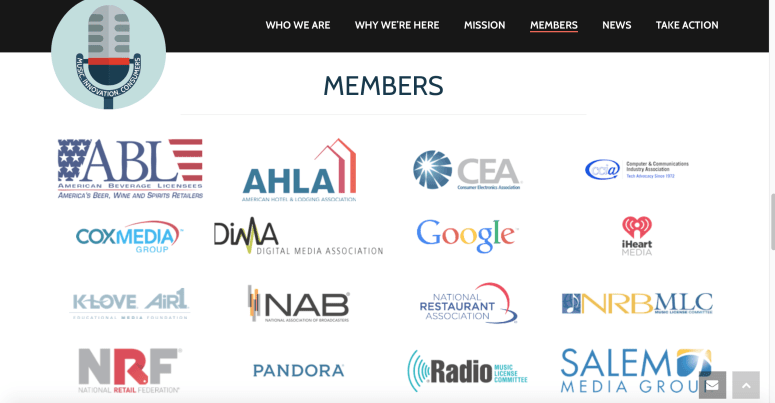
That’s interesting because Google, Pandora and the National Association of Broadcasters formed the MIC Coalition along with the Computer and Communications Industry Association, the Consumer Electronics Association, the Digital Media Association as well as hotel owners, retailers and of course Clear Channel (the absurdly rebranded iHeart).  Purpose?  To stop artists getting paid for radio play.

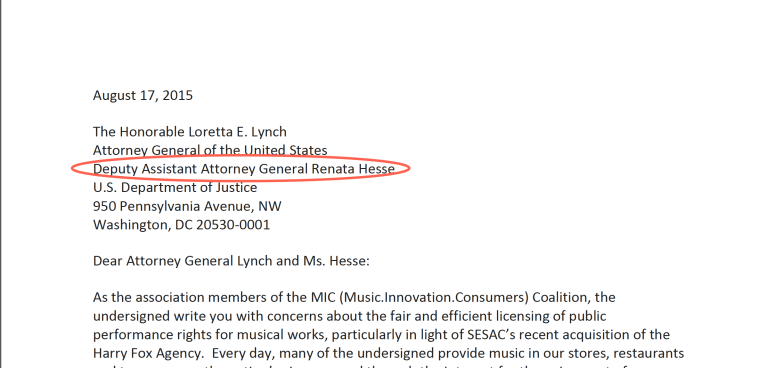
But the first official act of the MIC Coalition was to ask a revolving door lawyer in the Department of Justice who previously represented Google to investigate SESAC!


hesse

That’s right–companies with trillions of dollars of market capitalization have to have their cronies in the government protect them from songwriters and put SESAC under a consent decree!

mic-coaltion-8-15

Don’t forget that songwriters with Global Music Rights are attempting to withdraw from YouTube on a fractional share basis to renegotiate their YouTube deal or just leave YouTube altogether.  Those songwriters will also be affected by this new rule by the U.S. government.  If these songwriters co-write with an ASCAP or BMI writer, then the U.S. government will force ASCAP or BMI (or both if its a three-way split) to license the co-write and collect the royalties.

It should not be lost on you that Google is in a battle with songwriters over YouTube and that Google dominates the Obama Administration which explains why there’s never been an antitrust prosecution of Google.

But Google isn’t the only one.  Apple is doing it, too.  As SONGS CEO Mark Pincus said in a Billboard op-ed :

[I]n a break from industry convention, [Apple Music’s] offer called for 100 percent ­licensing. This means Apple will accept licenses from a publisher for an entire song, even if the publisher only controls a fraction of it.  Though it never has been the custom in music publishing, by copyright law publishers are allowed to issue a 100 percent license and account to the other rights holders owning shares of the work. That’s right: A competitor can license your shares to Apple whether you like it or not. Now, other DSPs are asking for 100 percent licensing as well. What will happen if DSPs accept 100 percent licenses from their largest licensees (who have shares of more songs)? More control to the bigger companies; less control to everyone else.

That’s right–by protecting its cronies in Big Tech, the government is actually destroying competition, not promoting competition.  The opposite of what the antitrust laws are supposed to do.

Fortunately, you can make your voices heard on this one.  The Department of Justice is asking for public comments on a series of trick questions they have posted on their website which you can read here.  David is going to be writing a comment which we will post on The Trichordist later today.

THE DEADLINE IS TODAY!

Write your own comment and tell the DOJ what you think about this latest change in the rules.  Here’s the notice from the DOJ website:

All comments should be submitted by electronic mail to ASCAP-BMI-decree-review@usdoj.gov  by November 20, 2015, and will be posted in their entirety for public review at http://www.justice.gov/atr/ASCAP-BMI-comments-2015. Information that parties wish to keep confidential should not be included in their comments.

We have to stop this latest end run around our rights.

Letter to the New York Attorney General Asking for Investigation of Unpaid Royalties at Spotify and YouTube

November 9, 2015

The Honorable Eric T. Schneiderman

Attorney General of New York

120 Broadway

New York , New York 10271-0332

Re: Unclaimed Property/Unpaid Royalties at Spotify and YouTube

Dear Attorney General Schneiderman:

I wish to call your attention to reporting by the Wall Street Journal that digital music service Spotify routinely fails to pay songwriter royalties for songwriters who Spotify has failed to locate—but whose songs they use anyway.  (“Songwriters Lose Out on Royalties”, October 14, 2015 available at http://www.wsj.com/articles/songwriters-lose-out-on-royalties-1444864895).   Precedents established by your office over 10 years ago could go a long way to solving this problem if you enforce them against “new boss” companies failing to disclose they are holding royalties.

According to the Wall Street Journal, Spotify’s practice is to “escrow” royalties for songwriters whom Spotify has not located, and it is our understanding that YouTube also follows this practice, as may other services.  Some estimate that the total sums being held in this manner by Spotify, YouTube and Google are in the tens of millions of dollars.  I personally have estimated that Spotify is using over 150 song I wrote or co-wrote for my bands Cracker and Camper van Beethoven and am demanding an explanation from Spotify.  (“Spotify Has Apparently Failed to License, Account and Pay on More than 150 Cracker and Camper Van Beethoven Songs” available at https://thetrichordist.com/2015/10/20/spotify-has-apparently-failed-to-license-account-and-pay-on-more-than-150-cracker-and-camper-van-beethoven-songs/ )

However, because no digital service does something as simple as publishing lists of songwriters for whom it holds royalties, it not only is impossible for anyone other than the individual services to determine how much is owed, it is also impossible for the songwriters concerned to know there is money being held—ostensibly on behalf of the songwriters–by these services.  If the monies are never disclosed or paid, then how are these services not unjustly enriched?  This seems like a prime case for the imposition of a constructive trust—that “has been famously described as a remedy applicable to ‘whatever knavery human ingenuity can invent’” (In re Alpert, 9 Misc 3d at *7 [Sur Ct, New York County 2005]

Recall that a similar situation arose in 2004 when the New York Attorney General took swift action to protect creators.  According to a press release from your office (http://www.ag.ny.gov/press-release/50-million-royalties-returns-artists):

State Attorney General Spitzer today announced a deal with the nations top recording companies that returns nearly $50 million in unclaimed royalties to thousands of performers.

The agreement comes after a two-year investigation by Spitzer’s office found that many artists and writers were not being paid royalties because record companies had failed to maintain contact with the performers and had stopped making required payments. This problem affected both star entertainers with numerous hit recordings and obscure musicians who may have had only one recording.

“As a result of this agreement, new procedures will be adopted to ensure that the artists and their descendants will receive the compensation to which they are entitled,” Spitzer said.

Under the deal, the recording companies have agreed to do the following:

  • List the names of artists and writers who are owed royalty payments on company websites;
  • Post advertisements in leading music industry publications explaining procedures for unclaimed royalties;
  • Work with music industry groups and unions to locate artists who are owed royalty payments; and
  • Share artists contact information with other record companies.

In addition, each company has agreed to have the heads of the royalty, accounting and legal departments meet regularly to review the status of royalty accounts and take steps to improve royalty payment procedures.

The companies have also agreed to comply with New York State’s Abandoned Property Law, which requires that if an artist or his or her family cannot be found, unclaimed royalties be “escheated” or turned over to the state. The state then holds these monies until a claim is made.

I see no difference between the 2004 situation regarding record companies and the 2015 situation involving digital services.  I think that highly sophisticated and well-funded high-tech digital services like Spotify and Google should be held to at least the same standard as the record companies regarding unpaid royalties if not a higher standard—if licensees don’t know who to pay, then why are they using the music in the first place?

If what Spotify told the Wall Street Journal is true, then Spotify knows which songs they are “escrowing” royalties for, and Google likely has the same information. They should know the song title and the name of the artist who performed the song.  Even if Spotify doesn’t know the name of the songwriters concerned, they could at least publish the song title and artist name so that there could be a hope of the songwriter tracking down what was owed to them.  I suspect the same is true at YouTube and all the other digital services.

While the Wall Street Journal refers to the monies being held in “escrow,” I don’t know of any legal basis for a secret “escrow” with an unknown songwriter accrued at a royalty rate the songwriter did not agree to because they were not asked and for which there is no license.

This situation seems ideally suited to the kind of investigation that your office undertook in 2004.

I look forward to your reply.

Sincerely,

David Lowery

More Free Non-Display Uses of Music: Google’s Tying Agreements Force Phone Companies to Use YouTube

Music Technology Policy

We’ve talked before about how Google profits out the back door from its “fair use” of scanning millions of books at its high security scanning center (see “Epsilons at the Brave New Googolplex“), what I call “non-display” uses of works of authorship.  Here’s another one, this time with YouTube.

Remember–YouTube is essentially a datamining honeypot disguised as a video service.  Google uses the behavioral and other data scraped from YouTube users (very likely indiscriminately including children) to assemble its highly refined data profiles that it makes most of its revenue from exploiting.  That’s the real money, not the advertising that some YouTubers get a few mils from permitting to clutter up their videos.

Needless to say, none of that revenue finds its way to the pot.  Hence–non-display, as in happening in the background and undisclosed.

Not only does Google profit from data profiling culled from YouTube users, Google…

View original post 596 more words

Pandora’s Butterfly Effect: They should have just paid the Duke

Music Technology Policy

The Wall Street Journal reports that the (largely) European streaming service Deezer has pulled its initial public offering float of shares on the Paris stock exchange.  Let me tell you, pulling an IPO is no small thing, particularly on the eve of registering the shares.  That’s the kind of thing that can ruin your whole day, and makes it very, very difficult to keep the underwriting syndicate together.

Why did it happen?  Partly due to the sharp drop in Pandora stock after investors began to realize that Apple Music had made significant gains against “free music” services like Pandora and Spotify that survive on advertising often served by Spotify board member Google.

This is to be expected–even Google’s legendary ability to suppress news about its interests that it doesn’t like cannot break through this:

Pandora Stock Drop Pandora Media, Inc., from Wall Street Journal

We can understand how a public company’s stock…

View original post 265 more words

The Global Database Fallacy: Disdain for Rights + Numerosity + Secrecy = Steroidal Black Box

Music Technology Policy

You’ve probably heard a lot about the gut wrenching need for a “global rights database” because “music licensing is broken”.  It sounds like of like a political campaign advertisement, right?

Music licensing is broken

Let’s drain the swamp

And protect the future for our children

Let’s get something straight at the outset:  This “if we only had a database” jive is the grand deflection at work.  You see it coming from a number of places all at once which is a bit of a head scratcher.  I think that having a global rights database will do absolutely nothing to fix what is looking more and more like a totally predictable and massive black box of earned but unpaid royalties at streaming services (other than Apple).  Which is why streaming services are trying so hard to get you to “look ovah theah” with the light touch of a James Carville (a…

View original post 1,612 more words

Show Me the Money: No Transparency in the Henhouse for the Real Black Box at Spotify and YouTube

Music Technology Policy

You may have heard the rumor that Spotify is in the middle of renegotiations with the major label groups–that typically would include publishers.  If Spotify owed you a pile of money and wanted to extend your contract, wouldn’t you expect them to clean up any money they already owed you first?

The Wall Street Journal reports that the “black box” at streaming services is even worse that we thought:

In the 10 months that ended this past January, Spotify users in the U.S. listened more than 708,000 times to “Out of Time” by the pop-punk band A Day to Remember, but the music-streaming service paid no songwriter royalties, according to data shared with the band’s record label and music publisher.

The omission wasn’t an isolated event.

Of the millions of times Spotify users listened to songs distributed by Victory Records and published by sister company Another Victory Music Publishing during…

View original post 1,834 more words