Liar Liar Streams on Fire #3: Spotify Is Paying LESS per Stream as it Scales

We’ve got data.  Lots of data.  We have two different consumption surveys of college students and one of the broader population.  We’ve also got the details of 2014 digital revenues from a moderately sized independent catalogue.

While everyone else wildly speculates we’re gonna show you our data.  All this week.

This is not pie in the sky projections involving “connected refrigerators” from the VPs of digital “strategy” at your record label or distributor.   This is what is really happening.  And can we really trust these digital executives anyway?  They have been proven objectively and demonstrably wrong.  We suspect they are now  just making shit up to try to cover their asses,  (or looking for jobs at the streaming services.)

See: Who will be the first executive to lose their job over the streaming fiasco?

But I digress, here’s todays installment:

The Cynical Musician has demonstrated a flat rate streaming model of the music business essentially creates a cap on the size of the recorded music business.   The corollary to this is that as streaming services “scale” the rates will go down per spin. Our data shows that this is indeed the case.  Streaming rates per spin are falling.  This is contrary to what pro-streaming music business executives and the digital services have claimed.  Details here.

SpotifyNetMONTHLY_Charted

Liar Liar Streams on Fire #2: Ad Supported Spotify pays .0009 in US per Spin.

We’ve got data.  Lots of data.  We have two different consumption surveys of college students and one of the broader population.  We’ve also got the details of 2014 digital revenues from a moderately sized independent catalogue.

We’re gonna show you our data all this week.

This is not pie in the sky projections from the VPs of “digital” at your record label or distributor.   This is what is really happening.  You know you can’t trust these digital executives, right? They are objectively and demonstrably wrong.  We suspect they are now  just making shit up to try to cover their asses (or looking for jobs at the streaming services.)  Who will be the first executive to lose their job over the streaming fiasco?

Here’s todays installment:

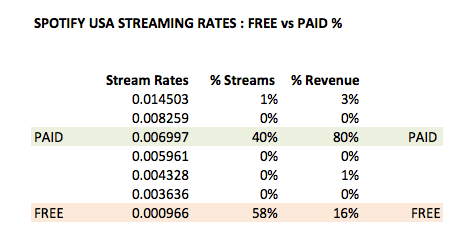
According to our detailed examination of a moderately sized labels digital revenue, it appears that free Spotify pays less than a tenth of a penny per stream.  $0.000966 to be exact.  This is all revenue to rights holders!  The paid service pays 7.5 times as much (But as we detailed yesterday a survey of college students shows revenue from paid subscriptions appears to be falling).

See our detailed post about this from November. 

SpotifyFREEvsPAID


The Fix Is In: Did @Billboard Change the Way Charts Calculated to Help Streaming Services Avoid Artist Boycotts?

December of last year Billboard changed the way it calculates it’s album charts.   The publication once hailed as “The Bible of the Music Business” last year announced that it would count 1500 streams as the equivalent of an album sale.  While I welcome the addition of a streaming component to the charts,  I believe that Billboard may be overweighting free streams in order to help streaming services keep artists on the free tiers of streaming services.  Let me explain.

The 1500 streams were supposedly based on the approximate rate that streaming services pay per spin. At $0.005 a spin to rights holders the $7.50 generated by 1500 spins is close to the $7.00- 9.00 rights holders net on an iTunes album sale. Ed Christman detailed and previewed these changes last fall in Billboard before they were formally implemented. This was clearly part of the logic of the change.

But since that time we have discovered that Spotify free tier does not pay anything close to that.   Our examination of the revenue generated by a moderately sized indie catalogue shows that in the US Spotify free tier generates $0.0009 per spin.   So 1500 plays on the Spotify free service really only generates $1.35.  YouTube generates a similarly low amount per 1500 spins.  By our calculation YouTube pays $0.00175 to all rights holders per spin (including video!).  That’s $2.63 for 1500 spins.   So on Spotify free platform the revenue equivalent of an album sale would require more like 8000 streams and on YouTube more like 4300 streams.

Objectively we can conclude that in terms of revenue both YouTube streams and Spotify free plays are vastly overweighted compared to sales.

SpotifyFREEvsPAID


Now let’s put this in context.  What happened at the end of October/ beginning of November?  Taylor Swift released an album that she tried to place only on the paid or premium tiers of the streaming services.  Or in other words she tried to withhold her full album from the free tier of the  streaming services.  Both YouTube and Spotify refused to do this.  As a result Swift’s new album did not appear on these two streaming services at all. Largely unreported was the fact that Swift wasn’t making an anti-streaming statement, indeed she left key parts of her catalogue on the premium Rdio service.

Wait! This isn’t the way the mainstream press and Billboard first reported it?  That’s right. Ever wonder why? In the case of the mainstream press they may have innocently missed this subtlety.  But Billboard?  The Bible of the Music Business? You got to wonder.

This wouldn’t be the first time that Billboard has seemingly engaged in very Hearst like reportage to prop up a streaming service in trouble.   When we broke the story that Pandora founder Tim Westergren had repeatedly contributed funds to a congressman that tried to have Washington DC’s gay marriages voided,  Billboard quickly stepped in with this piece by Andrew Flanagan to defend Westergren.  Flanagan seemed to find some sort of “balance” in Westergren’s donations that canceled out those donations to a gay baiting congressman.  Interesting. An unusual  argument for a NYC based, sometimes NPR reporter to make. I wonder if he’s ever tried this argument out on his gay neighbors?

But I digress.  The point is this: Treating Billboard as an unbiased observer in the music industry battle over streaming is becoming a sketchy proposition. It has clearly become a partisan player in the battle over streaming.    And you have to wonder if the curiously timed changes to the Billboard charts are not part of this battle.  Because now if an artist wishes to “chart” they will have to think twice about removing their songs from YouTube or Spotify.

How convenient for the streaming services!


New Math $.00666 : Billboard’s New “Consumption” Chart, Free Streams and the End Of Meaningful Metrics?

On The Other Hand #1: Spotify Premium Must Compete With YouTube Free and SoundCloud

Why do we expect mobile consumers to adopt Spotify premium when they can steam any song they want on YouTube mobile already? Without a subscription to Music Key?  They can do the same on SoundCloud for that matter.  Further these services pay a pittance to artists compared to Spotify.  Why aren’t artists outraged?

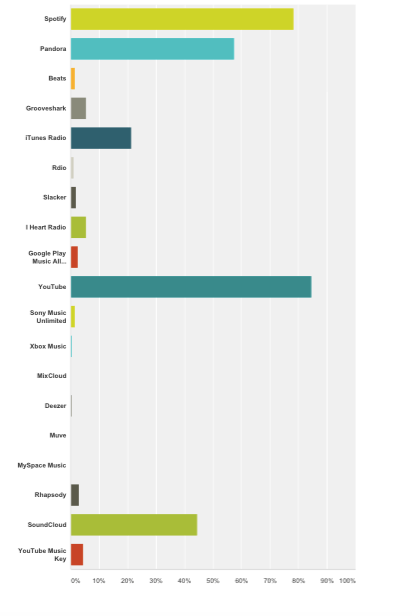
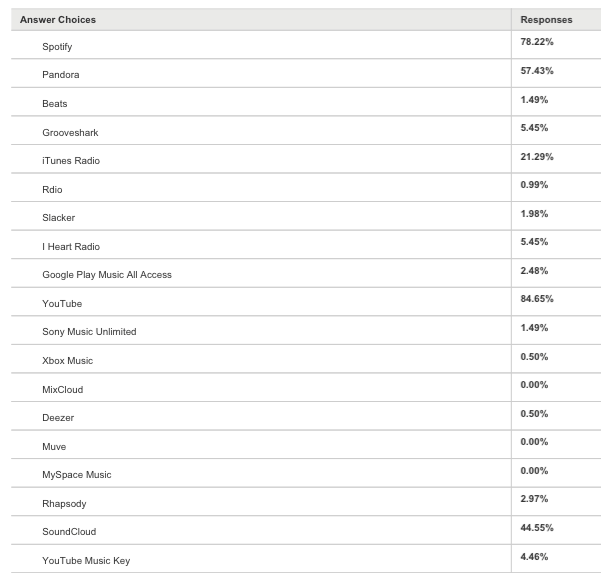
A survey of music consumption habits by students at a public university indicates just how tough it is for Spotify.  When asked which services they use to listen to music, clearly YouTube dominates. The not-fully-licensed SoundCloud is a respectable 4th. (Ed Note: And what’s the deal with 8tracks.com? This was not really on our radar until now.  It was a write in but had it been included in survey it would have polled at nearly 10%.)

We can also objectively conclude that Beats Music Service is DEAD. Monty Python might phrase it this way:

“This streaming service is no more. It has ceased to be. It’s expired and gone to meet its maker. This is a late streaming service. It’s a stiff. Bereft of life, it rests in peace. If it had not been purchased by Apple it would be pushing up the daisies. It’s rung down the curtain and joined the choir invisible. This is an ex-streaming service.”


Screen Shot 2015-02-23 at 4.06.12 PM


Screen Shot 2015-02-23 at 4.06.46 PM


Liar Liar Streams On Fire #1: Survey Suggests Spotify Has Peaked Among Key Demo

We’ve got data.  Lots of data.  We have two different consumption surveys of college students and one of the broader population.  We’ve also got the details of 2014 digital revenues from a moderately sized independent catalogue.

While everyone else wildly speculates we’re gonna show you our data.  All this week.

This is not pie in the sky projections from the VPs of “digital” at your record label or distributor.   This is what is really happening.  And you know you can’t trust these digital executives, right? They have been objectively and demonstrably wrong on so many things.  We suspect they are now  just making shit up to try to cover their asses (or looking for jobs at the streaming services.) See: Who will be the first executive to lose their job over the streaming fiasco?

Here’s todays installment:

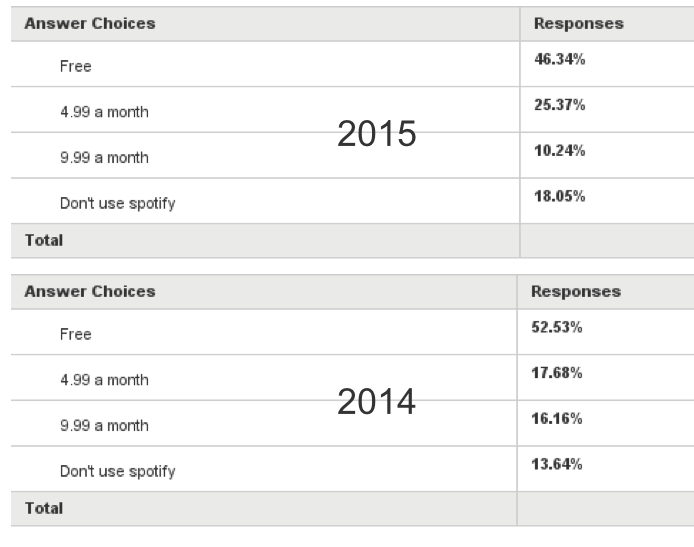
An informal semi-longitudinal survey of students at a large public university shows that overall use of the Spotify is already falling among a key demo. Further revenue from paid subscriptions for the service appears to have already peaked for this important group.   This appears to be the result of students switching from the $9.99 service to the $4.99 service.  Or put another way Spotify is cannibalizing it’s own paying subscribers resulting in lower revenues even as it loses overall popularity with these students.   Genius.


Spotify subcribers and revenue down

Out there waiting

Music Technology Policy

When the years have done irreparable harm
I can see us walking slowly arm in arm
Just like that couple on the corner do
Girl, I will always be in love with you

When I look in your eyes
I’ll still see that spark
Until the shadows fall
Until the room grows dark

Then when I leave this Earth
I’ll be with the angels standin’
I’ll be out there waitin’ for my true companion

From True Companion by Marc Cohn

I have always believed there is no human loss greater than the loss of a spouse.  Parents, of course, will immediately disagree, but that’s OK.  When you have struggled through tough times together and prevailed, every close call reminds you of how indescribably dear your spouse is.

It’s also a reminder of the inevitability of having to take on life alone for one of you because one of these days…

View original post 86 more words

Live From YouTubeistan Delivered Straight To Your Living Room

Music Technology Policy

When moms in Middle America let Little Johnny use YouTube in his room of an evening, do you think it ever occurs to them that Little Johnny is watching radical jihadi recruiting videos?  When moms hear about jihadis using “social media” to radicalize new followers, do you think the moms think that means it’s coming into their house? Ah, but it is.  Thanks to YouTubeistan–the digital library of jihadi videos readily available on YouTube, the jihad will be monetized.  And which videos will be made available is apparently totally arbitrary, contradictory and trends toward making these videos available.  They do draw millions of views, after all. Two days ago we spotted a YouTube video courtesy of the Long War Journal which evidently was taken down within hours of the MTP blog post.  This is what I wrote:

According to Long War Journal: [T]he media wing of al Qaeda in…

View original post 753 more words

The Return of the $50 Handshake: Pandora says “no comment” about “steering” payola in direct deal with @naxosrecords

(Ed note- The $50 dollar handshake was record industry slang for the age old practice of illegal payments by record labels to radio stations for preferential airplay.  The technique was for a record promoter to palm a $50 bill to a DJ concealed in a handshake.)

Pandora announced another “direct” deal this week, this time with Naxos Records.  Remember, Pandora is in the middle of a rate setting proceeding for the webcasting royalty at the Copyright Royalty Board (CRB)  in Washington. This is no accident that Pandora is trying to get as many of these direct deals done as possible before the CRB rules on its statutory webcasting rates that Pandora will pay–sound recording owners.  Record labels like Naxos have the ability to “opt out” of the statutory rate set by the CRB if they make a direct agreement with any service including Pandora.

And you know there’s always a trick with Pandora, so here it is.  If Naxos did nothing, they would get the statutory rate.  If they make a direct deal, they presumably got “something” better than the direct rate.

But why would Pandora make a direct deal with Naxos (or Merlin for that matter)  and pay a higher rate than the one they get from the CRB? It’s unlikely they did.  They have no incentive.  It only makes sense that Pandora got a lower-than-statutory rate and in exchange Naxos (like Merlin) got “something else” in exchange for taking the lower rate.

Be sure you don’t miss the point here–Pandora is trying to show these direct deals with Naxos and Merlin as evidence of what royalty rates should apply to the rest of us.  So Pandora wants the royalty rate to be lower than the rate that SoundExchange is asking for so they can use the Naxos and Merlin deals as examples of “free market” agreements between a “willing buyer” and a “willing seller”.

As the Radio and Internet Newsletter (RAIN) explained:

[Pandora’s p]rivate licensing deals are significant for another reason. The CRB process of setting government-mandated rates has been distorted, some audio publishers believe, by a lack of real-world deal-making examples which could establish a value of licensed music that isn’t theoretical. Pandora used its Merlin deal as an anchor example in its initial argument brief. Presumably, the Naxos agreement could bolster Pandora’s case during this year-long lead-up to new rates.

So again why would Naxos and Merlin agree to a rate that helped Pandora lower the royalties paid to everyone else?  There’s probably an easy answer to that.

Very likely because they got each something else that made it worthwhile.  And if by taking that vigorish it hurts the rest of us–well, it’s a cruel world, don’t you know.

Now what might that vig be?

In the case of Merlin, they accepted a lower rate in part in exchange for Pandora “steering” listeners to Merlin artists.  If this sounds a little like payola you wouldn’t be the first to question this practice. 

Pandora Says No Comment

“Steering” payments are a different beast–these are payments that benefit Pandora by triggering a lower royalty rate if Pandora plays more of the label’s artists.  That consideration that flows to Pandora is a lower royalty rate–the benefit to Pandora being the difference between what they would pay under the presumably higher statutory rate and what they do pay under the steering arrangement.  You know, consideration for airplay.

Consideration for airplay…isn’t that payola?

Was there a steering payment in the Naxos deal?  RAIN also noted:

We reached out to Pandora to ask whether the Naxos licensing agreement includes similar “steering” as with Merlin, and received a polite “no comment.”

Now why would that be?

Let’s recap a little history.  One trick that Pandora is trying to fool us with was originated by their in-house lawyer, Christopher Harrison when he was at DMX.  David Lowery noted that Billboard called out Harrison on the issue:

 Ed Christman did his homework on this part of the story, too and called Pandora lawyer Chris Harrison on the bullshit he pulled while he was at DMX that shafted songwriters and that Harrison is trying to duplicate for Pandora to shaft artists, musicians and vocalists.  Ed got that exactly right.

Here’s how Mr. Christman described DMX’s dirty tricks on songwriters:

Back in 2007-2010, when ASCAP and BMI rate court judges were involved in litigation between DMX and performance rights societies, the judges examined the direct licensing deals DMX cut with publishers. During that process, judges did not review the advances or any of the other aspects of the deal, and only looked at the reduced per-store royalty rate Consequently, in the case of BMI, this resulted in the per-store negotiated rate falling from $36.36 to a per-location fee of $18.91, much to the chagrin of the publishers, who stayed a part of the PROs’ blanket licenses. The ASCAP rate court returned a similar finding.

(Did we mention that Pandora vp of business affairs and assistant general counsel Chris Harrison was DMX’s vp of business affairs at the time of the rate court ruling in a lower per-location blanket fee?)

Oh yes…the advances.  There is usually money involved after all.  We don’t know if Naxos or Merlin got any advances, or better yet for a label, nonrecoupable payments from Pandora–the kind they don’t share with artists.  (This is a variation on “breakage”, being payments that are so large there’s no chance that the label will ever recoup during the life of the license.)

But we do know that when Pandora filed the Merlin agreement with the CRB as evidence in their rate proceeding, there was a whole bunch of stuff blacked out so we couldn’t read it and know what the deal was.  What do you bet that had something to do with M-O-N-E-Y.

So if Naxos did a deal that is so great for their artists (including symphonies and conductors), why aren’t they singing it from the rooftops?  If Pandora only has the artist’s best interests at heart, then why isn’t Pandora singing it right along side Naxos?  Of course in a way, anyone doing a direct deal with Pandora is driven to it by the threat of having to take the statutory license if they don’t–the implication being that the statutory license that the rest of us have to live with will be worse than whatever deal Naxos made that did not rely on the statutory license.  So what could make it better?

The Merlin deal had “steering” payments in it…why would Pandora say “no comment” about a component of the Merlin deal that Pandora did sing from the rooftops at the time.

Why oh why oh why?

And right there you should understand what is really rancid about these direct deals.  If nothing else, the CRB rate setting process is transparent.  Artists, musicians, vocalists and sound recording owners are represented by SoundExchange and have more or less equal voting power on the SoundExchange board.  Three judges set the rates after hearing from all sides in the process.  Unlike the ASCAP and BMI rate courts, you don’t have a situation where a single judge can decide to just ignore a vital part of the evidence the way each of the single rate court judges did in the DMX case–not doubt to the great glee of Christopher Harrison.

Not only that, but who knows if Naxos is going to apply the artist share of webcasting against unrecouped balances of their artists, or simply keep the artist share of royalties.

SoundExchange hasn’t allowed labels to collect the artist share of statutory royalties.  Artists, musicians, vocalists and labels are all paid at the same statutory rate.  No under the table shenanigans, no side deals, no payola.  Plus SoundExchange audits these services on behalf of everyone.  There’s definitely some significant benefits to artists from staying in the SoundExchange system particularly as SoundExchange pays out hundreds of millions.

Instead of the relatively transparent CRB process, Pandora is repeating the sleazy DMX charade and is trying to hide the ball.  Would we prefer that the government wasn’t involved at all?  Would we prefer if everyone made their own deal?  Probably.  But we also like the idea that all the cards are on the table and appreciate the benefit of collective licensing.  (And we know it’s a good thing because Pandora tried to stop it in the infamous Internet Radio Fairness Act.)

But You Can Give Them to the Birds and Bees

What about this steering payola?  There’s a real question of whether these steering deals are even legal, particularly if Pandora is the service.  That’s because Pandora bought a radio station, and payola laws definitely apply to FCC licensed radio station owners.  David wrote about this before (“@Billboard is Demonstrably Short on Pandora Payola: Just Read FCC Website“) so let’s read an important long quote from David’s post:

As we previously postedPandora’s own high powered Washington DC lawyer, David Oxenford, wrote an article in 2008 about Internet radio and payola that everyone should read:

As Pandora lawyer Mr. Oxenford tells us:

“The payola statute, 47 USC Section 508, applies to radio stations and their employees, so by its terms it does not apply to Internet radio (at least to the extent that Internet Radio is not transmitted by radio waves – we’ll ignore questions of whether Internet radio transmitted by wi-fi, WiMax or cellular technology might be considered a “radio” service for purposes of this statute).  But that does not end the inquiry.  Note that neither the prosecutions brought by Eliot Spitzer in New York state a few years ago nor the prosecution of legendary disc jockey Alan Fried in the 1950s were brought under the payola statute.  Instead, both were based on state law commercial bribery statutes on the theory that improper payments were being received for a commercial advantage.  Such statutes are in no way limited to radio, but can apply to any business.  Thus, Internet radio stations would need to be concerned.”

So as Pandora’s lawyer tells us, if the FCC can’t get  jurisdiction over pureplay webcasters, state attorneys general may be able to under applicable state law commercial bribery statutes.  That’s potentially what’s called a 51 jurisdiction issue (50 states plus federal law)….

And if payola only applied to cash money as Pandora’s CEO would like you to believe, would the FCC have looked the other way when broadcasters received the legendary “hookers and blow”?  Vacation trips and clothes?  You know, “other valuable consideration”?  Do we really have to start quoting “Hit Men” or “Stiffed” here?  Morris Levy is laughing his ass off!

I’m just not hearing a credible argument for why getting a below market discount on something–in this case, royalties in exchange for airplay–is not “other valuable consideration.”   Therefore since Pandora is doing everything it can to buy a radio station (and is in front of the FCC right now trying to get their acquisition approved) you’d think they’d want to disclose receiving valuable consideration for playing Merlin artists. And they aren’t.

Billboard and I agree on this:  stranger things have happened in the U.S. legal system.  Far, far stranger things.  The only one who can sort this out is the FCC–and good news!  The FCC has a way to do that as part of its review of Pandora’s license for South Dakota radio station KXMZ that the FCC is reviewing right now.  And until the FCC rules on the payola issue with Pandora, it’s hard to see why Pandora’s lawyer Chris Harrison should be able to use Pandora’s end run around the law to lower everyone else’s rates in the [CRB] rate hearing in Washington….And won’t it be interesting if it turns out that Chris Harrison filed an illegal contract with the royalty hearing on everyone else’s already putridly low Pandora royalties to try to drive Pandora’s payments even lower.

Sounds like “no comment” is the safest thing that Pandora and Naxos could say at this point.

Judge Wingate to Rule on Whether Federal Government Protects Google or States Protect Consumers

The latest on Google’s lawsuit to stop states from investigating…Google. Imagine if this was Enron or Pandora!

Music Technology Policy

Right on cue, Jeff John Roberts gave his usual Googley spin to Mississippi’s scrappy Attorney General Jim Hood’s investigation into Google: Google and Mississippi meet in court over secret MPAA lobbying.  Roberts story first posted almost on the dot of the commencement of the hearing today in Judge Wingate’s courtroom in Jackson, Mississippi.  Like most of Roberts’ “reporting” on anything relating to the music or movie business, you can get a good idea of where Google is at just by reading the headline.  No need to suffer through the Satanic idolatry he wraps around the MPAA and the RIAA who vie for status as the Great Satan.  1999 called and wants its anti-artist rhetoric back.  As we know, Lars was right.

So sure enough, Google launched their attack on Hood largely based largely on documents stolen in North Korea’s hack of Sony Pictures.  Try as they might, Google is not…

View original post 925 more words